–> Picture Gallery [pdf] – [ppt] <–
The following originated as a classroom lecture on what is often called the Progressive Era of United States history. Here’s a 55-min video of a lecture in which I read an earlier version of the text, with the slideshow. It may help towatch that, but it’s probably best to view the images and read the script yourself. For best results, you will have to read it on a desktop or large pad.
INTRODUCTION
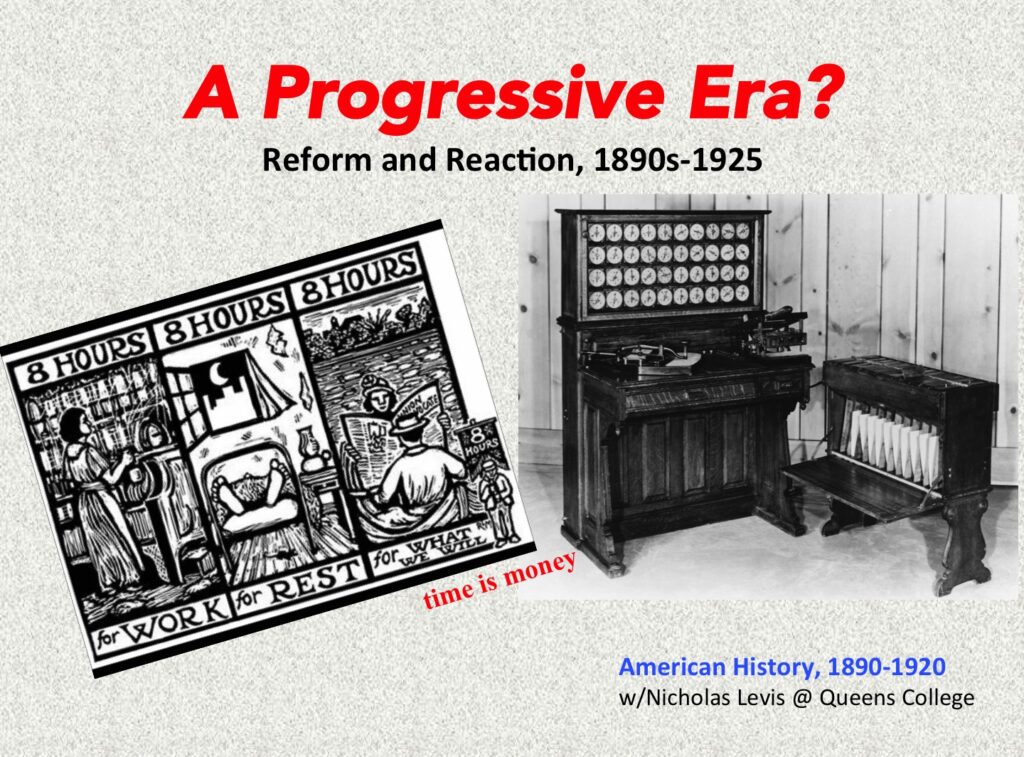
(Slide 1, cover) In the forty years from the 1880s to the early 1920s, different social groups and movements organized to change and shape the new, industrial, technological, always growing, and ever-more urban American society. Society was indeed transformed in many ways. By the end of this period, many people were calling it “the Progressive Era.” Local, state and federal government took a stronger role in promoting progressive social change and reforming the political and economic system. A few historians go so far as to call these decades a ‘Second Reconstruction.’ At the same time, business corporations also evolved, and became more powerful and present in all aspects of American life, so that the historian Martin Sklar has has instead called it the “Corporate Reconstruction of America.”
Working Class Movements, Progressive Campaigns
(2) The rural-based Populists fighting for farmers’ interests and the more urban movements of the industrial working classes continued organizing and fighting for their causes. But they continued to meet with frustration and defeat in almost all of their struggles and demands. The Populists declined after the 1896 presidential elections when they supported the losing Democratic candidate, William Jennings Bryan. Industrial labor actions continued to gain in strength, numbers, and militancy. As we will see, the working-class movements met with powerful opposition from business and government, but remained strong. Then they were hit by heavy repression and suffered a series of defeats during and after World War I (1914-1918).
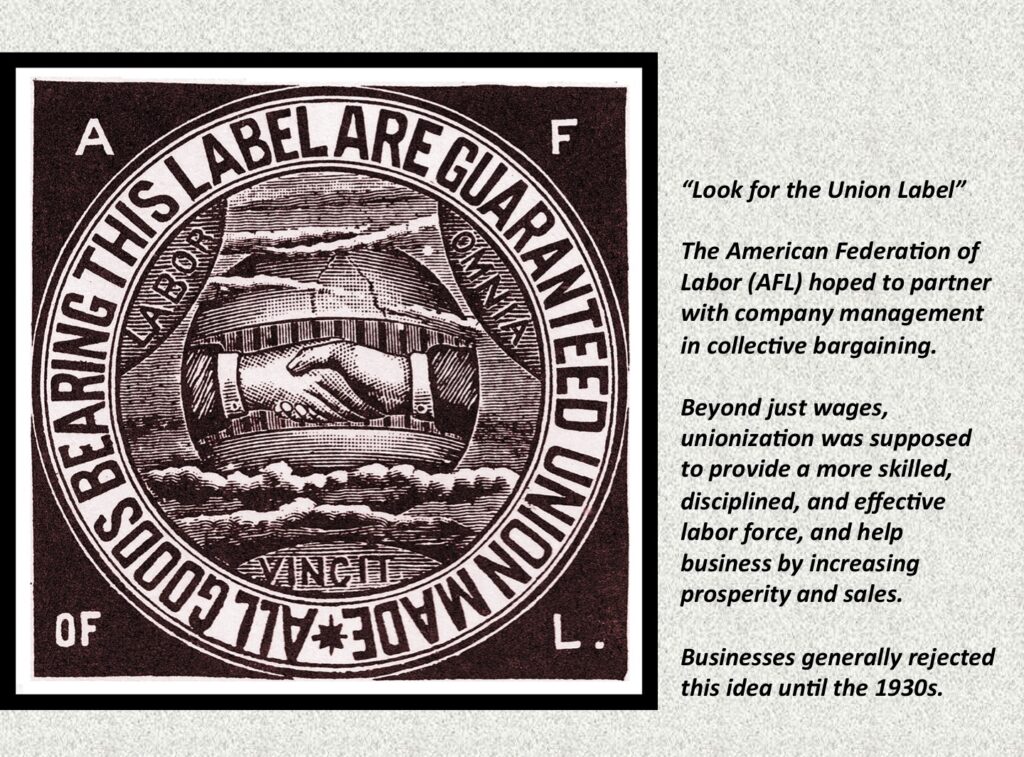
(3) Efforts associated with the American Federation of Labor followed the same by-now time-honored strategy as in decades past. The AFL were an organization of employed, skilled, and generally white workers. It was not radical or revolutionary. The AFL strategy was to organize by industry and company. Their main aim was to get company management to accept unions as bargaining partners. They hoped to get each company to sign its own contract with the unions representing the workers at that company. The AFL argued that rather than treating unions as enemies, private industry would benefit from having an organized, capable, reliable, loyal, well-paid and well-fed work-force.
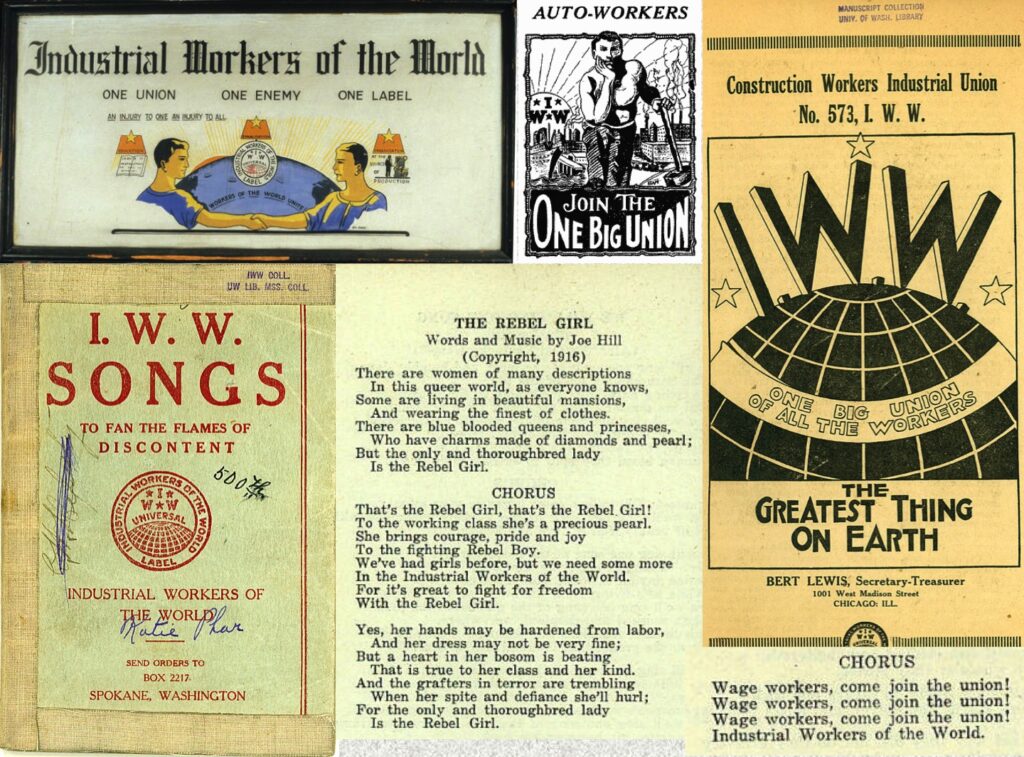
(4) Like the old Knights of Labor, the Industrial Workers of the World (IWW), founded in 1905, believed in uniting all workers into “One Big Union.” The IWW hoped to break down and bridge all divisions among workers. Workers should not be separated by industry, trade, skill level, or even employment status. Membership was supposed to be open to all, regardless of race, sex, ethnicity, citizenship, or language. The IWW was never recognized as a negotiating partner by governments or by businesses, and its members undertook “wildcat” actions and strikes. In many cases the IWW contributed to working-class unity and even general strikes, such as the Seattle general strike of 1919 and the ‘mine wars’ of Colorado (1914) and West Virginia (1915-1919). But for the most part the activists of the IWW had a tough time organizing different kinds of workers in different indusries. It was often difficult to bridge the gaps between ethnic and racial groups, immigrants and natives, male and female workers, people speaking different languages, and cultural and regional divisions among workers. Employers often exploited these divisions ruthlessly, pitting one group against another. IWW activists also suffered many forms of repression from management and governments. Employers were quick to fire IWW members. Many members were arrested, convicted on fake or trumped-up charges, beaten by private security forces like the Pinkertons, and even assassinated. IWW membership rose to 150,000 by 1915, but the union was then crushed and dismantled by hostile government action against its leadership during World War I and the subsequent ‘Red Scare’ of 1919-21.
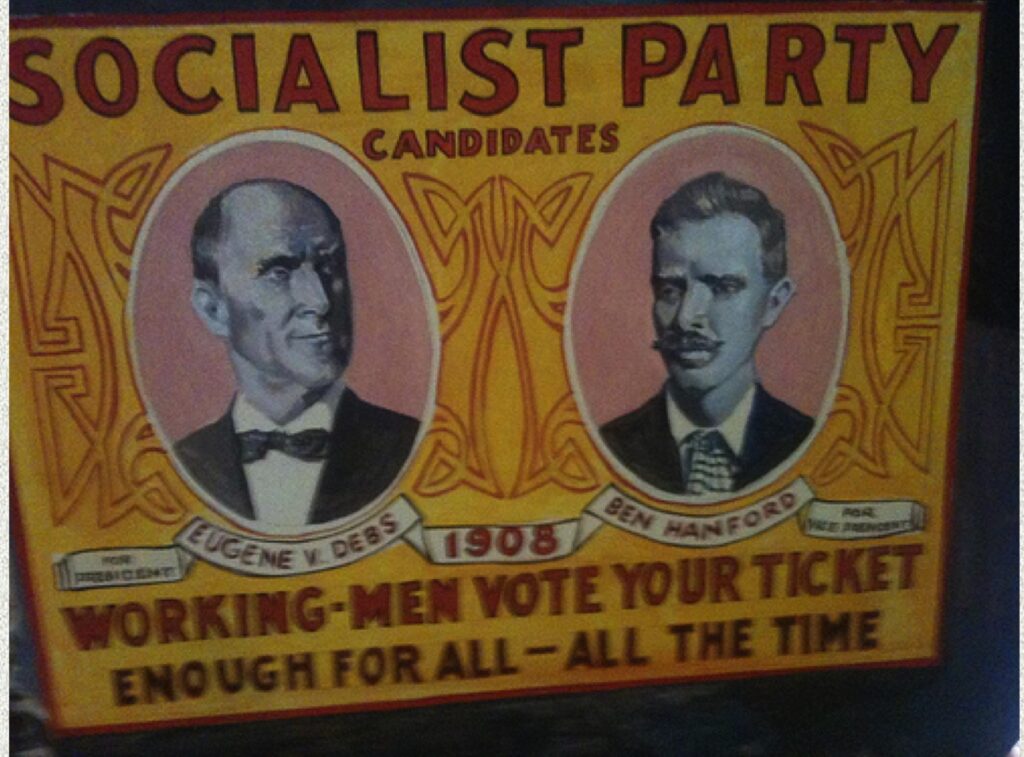
(5) Starting in the 1890s, there was also a Socialist Party, led by Eugene Debs, the deeply Christian labor organizer who had spent months in prison after leading the American Railway Union during the two-month railway strike in and around Pullman, Illinois in 1894 (one of the many epic labor battles of the era that again, mostly ended in defeat). Debs ran for president five times, picking up 3.5% of the popular vote in 1920 (one million votes), although he spent that year in a prison cell, having been convicted for sedition after he made a speech against the military draft. Almost none of these efforts won widespread and lasting implementation of main demands, like forcing management to recognize a trade union as a partner in collective bargaining, or to accept permanent guarantees of the eight-hour work-day. Labor organizing would however provide some of the radical energy that boosted many progressive reform campaigns.
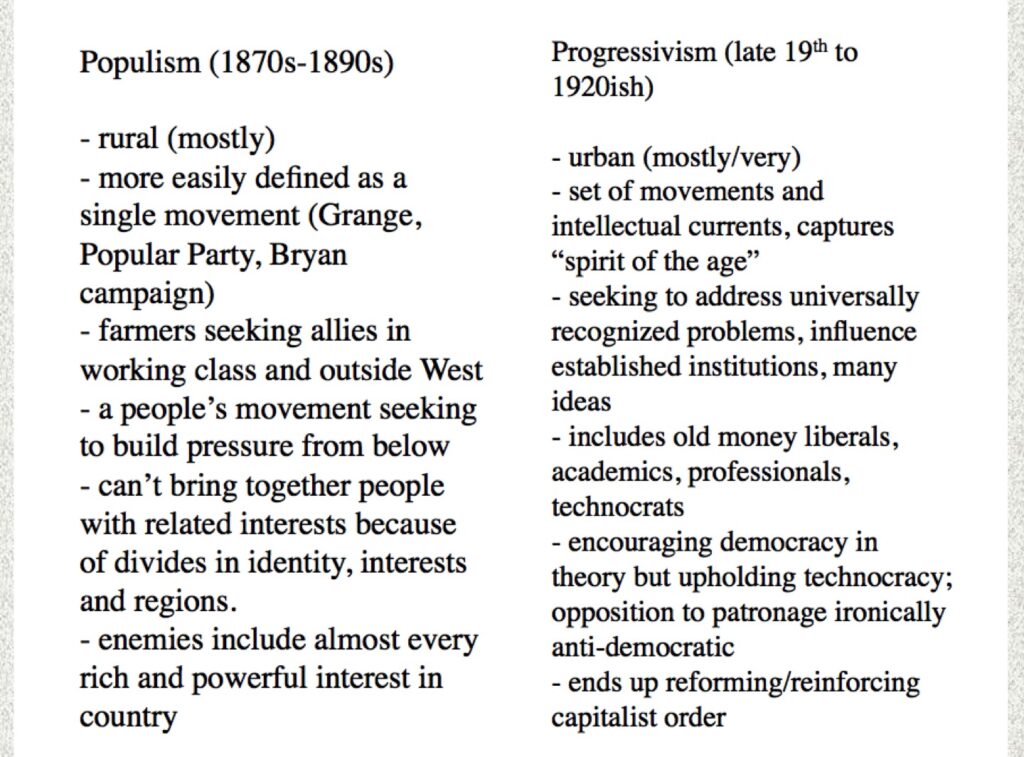
(6) In contrast to the difficult situation facing the labor movements, the progressive reform campaigns, based mostly in middle-class advocacy, succesfully advanced a number of important social reforms. That is not to say the going was easy. Progressive efforts also ran into fierce opposition and setbacks. Like any form of people power wielded against establised power, success required hard work, persistence and sacrifice, faith and idealism, and a degree of realism. The first apparent successes of progressive reform came already in the early 1890s, with the passage of federal and state laws intended to impose limits on the power of private capital and political machines. By the early twentieth century, a wide variety of progressive reform movements and actions were underway. But making reform stick against entrenched interests often proved tricky, as the stories of anti-trust laws and the standard ballot in the 1890s show.
Anti-Trust and Philanthropy
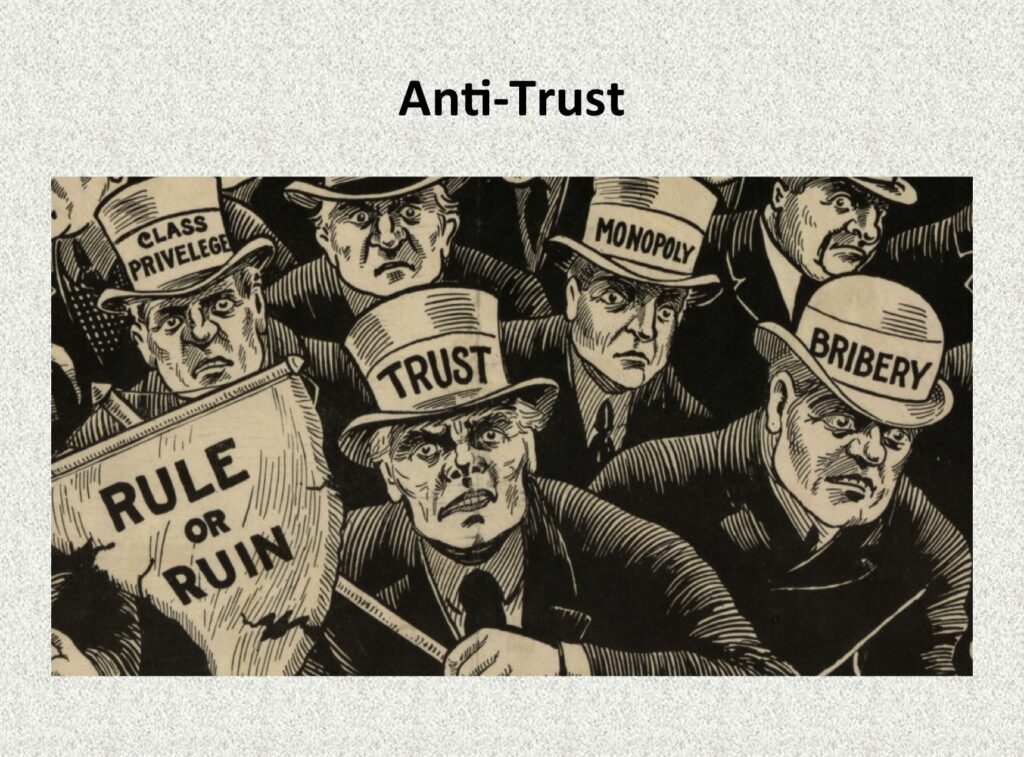
(7) An important reform move, starting already in 1889, was the passage of federal anti-trust acts.
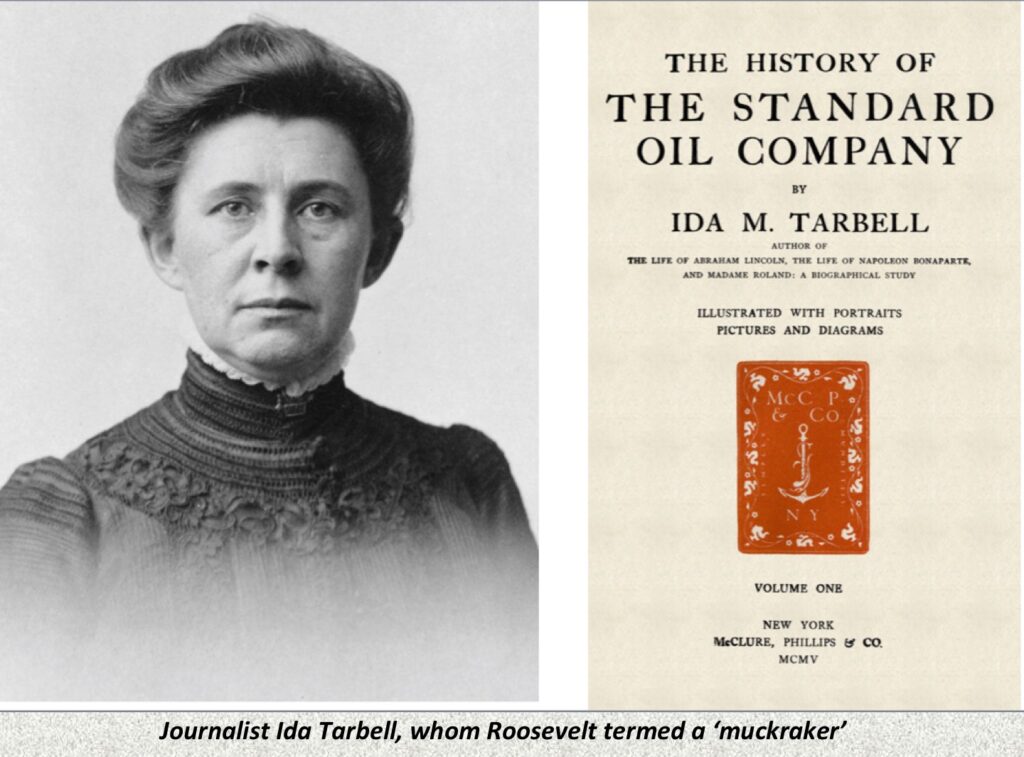
(8) These targeted corporate-financial monopolies and cartels (‘trusts’) in vital industries, for example: the Standard Oil company brought together by John D. Rockefeller in the 1870s and 1880s, after the first discovery of oil in Pennsylvania in 1869. By the 1890s, Standard Oil set prices for kerosene and oil products throughout the country, dominating 90 percent of the market.
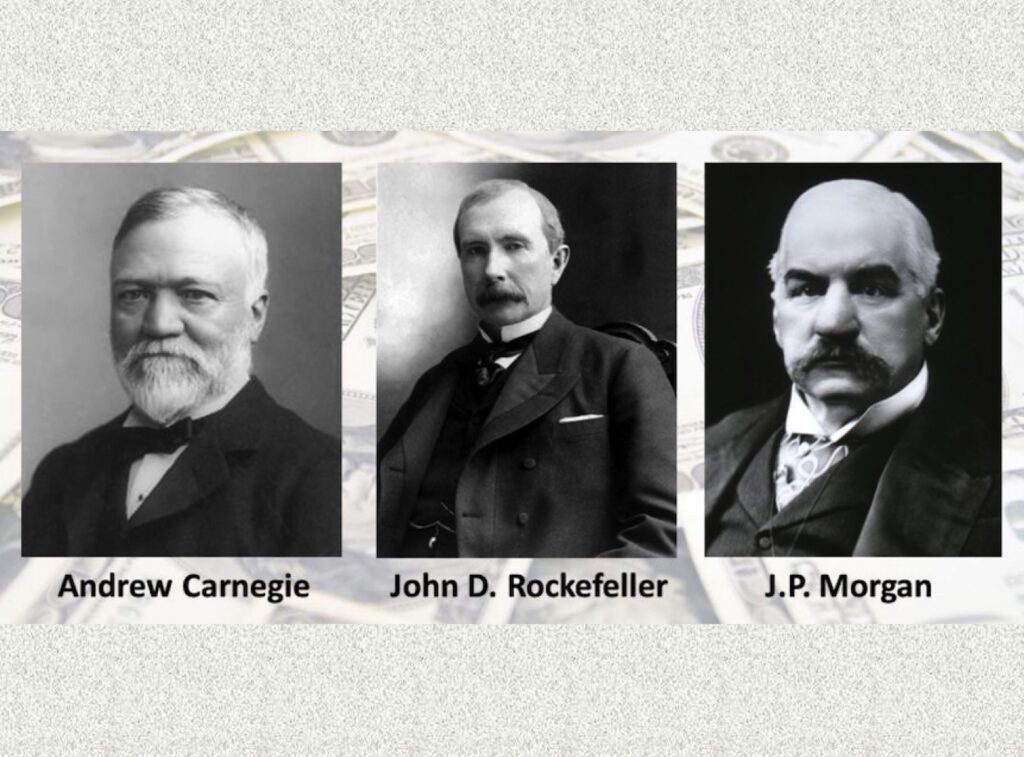
(9) Rockefeller, Carnegie, Morgan: The three richest men in the United States, representing control of oil and kerosene (Rockefeller), steel (Carnegie), and banking and railways (Morgan). Standard Oil collaborated with both the railway companies (who provided fuel transport before there was an extensive pipeline system) and the Wall Street banks. J.P. Morgan was the informal kingpin of Wall Street. He had organized a ‘trust’ of several holding companies owning railways, known as Northern Securities. Another corporate behemoth, U.S. Steel, was formed when Carnegie finally sold his steel businesses. Steel was the most important building material for the railways and allowed the construction of ever taller buildings.
(9, cont’d) Before we go on, it should be noted that Carnegie was perhaps the most remarkable of the three for having guided the creation of a production machinery that was utterly devoted to increasing efficiency and scale at every level from buying the raw materials to delivering the final product. This new model was called “vertical integration.” It reduced the price per unit. It allowed the Carnegie-Frick enterprises to outproduce the rest of the market, in both North America and Europe. Carnegie factories adopted every new technology as soon as it became viable. He cultivated a management obsessed with finding every possible reduction of costs per-unit — including labor. However, he believed that if the steel was getting cheaper, then the labor should be paid a lower amount. The cuts in employment and pay finally caused a giant labor lockout and months-long battle at the stell plants in Homestead, Pennsylvania in 1892. The workers and the town were united in the fight. They even defeated and captured a force of 300 Pinkertons. But then the national guard intervened. A dozen were killed, and the strike became another epic loss for organized labor.
(9, cont’d) European states sometimes took over and reorganized or nationalized monopolies and exploitative companies. By contrast, US law left action to lawsuits by states or competitors. It was up to a judge to rule that a “trust” (monopoly) be broken up, for example if it was found to be fixing prices or unfairly squelching competition. At first, such measures were toothless, as was the case with an 1892 state court ruling that ordered Standard Oil to sell its Ohio subsidiary. Standard Oil went through the motions of transferring its Ohio subsidiary to a separate company, but kept full management control of it. Nothing slowed down the merger wave of 1897-1904, which left an ever-smaller handful of companies in control of every major industry. Worse, courts turned anti-trust more often against labor than the trusts. In decisions like Lochner v. New York (1905), the Supreme Court favored management suits to ban labor organizations, claiming they were colluding to monopolize and fix the price of human workers.
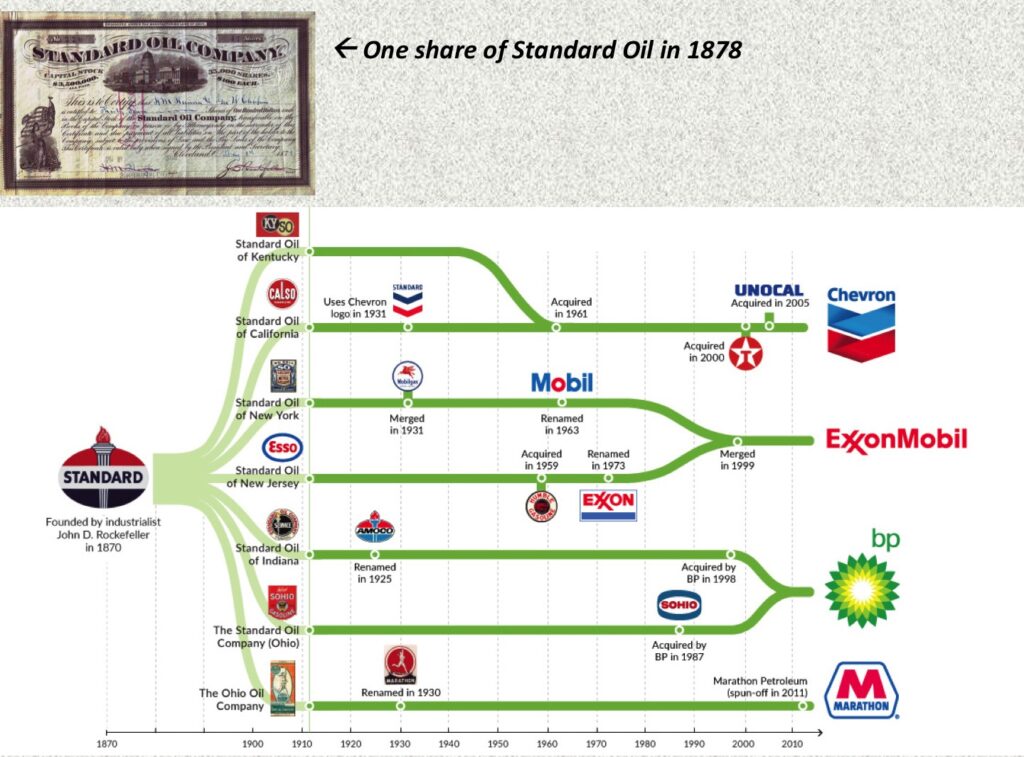
(10) During the Theodore Roosevelt and Taft administrations (1901-1912), the federal government became more involved in closing the legal loopholes and pursuing lawsuits against the trusts. They finally achieved some anti-trust successes, after court battles that lasted for years. Court rulings ordered the break-up of the railroad trust, Northern Securities, in 1906, and of Standard Oil in 1911. Standard Oil was spun off into separate companies and sold to new shareholders. The managements of the new companies still knew each other and were still usually able to act in unison, maintaining an informal cartel. (If nothing else, different managements could just read the same newspapers to know what prices “the competition” was setting.) The robber barons, meanwhile, had little trouble moving their wealth into more diversified asset portfolios. That’s a fancy way of saying they re-invested the mountains of cash they had received from being forced to sell their shares in their companies. They bought a whole lot of real estate, invested in companies in other industries, bought up resources like mines, bought or founded new companies around the world, and opened bank accounts in places like Switzerland. A few tried a different strategy: They started big philanthropic foundations that effectively remained under the control of their families for many generations to come.
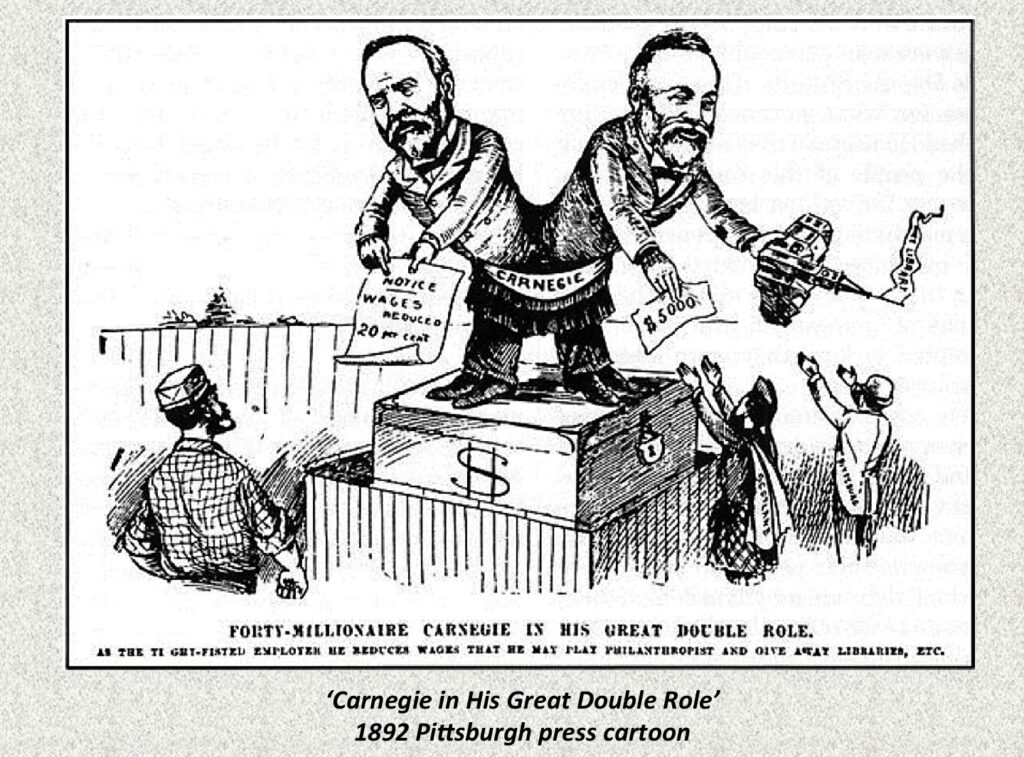
(11) Depending on your perspective, some of the robber barons turned themselves into philanthropists with the aim of improving society. This was undoubtedly true, in some cases. Carnegie opened hundreds of free libraries for the public. This originated many municipal public library systems. But the philanthropy of the super-rich also followed the aim of influencing society, shaping it in their preferred image. Carnegie made no secret of his philosophy for society as a whole in publications like The Gospel of Wealth. Philanthropy improved the public relations of the super-rich. It protected their wealth from more muscular efforts to redistribute it. Over time, the philanthropies of the wealthiest turned to the universities and began providing academic funding for the new disciplines like political science, economics, and sociology. They encouraged academics, scientists, and researchers to study the practical top-down management of politics and populations.
*
Clean Elections?
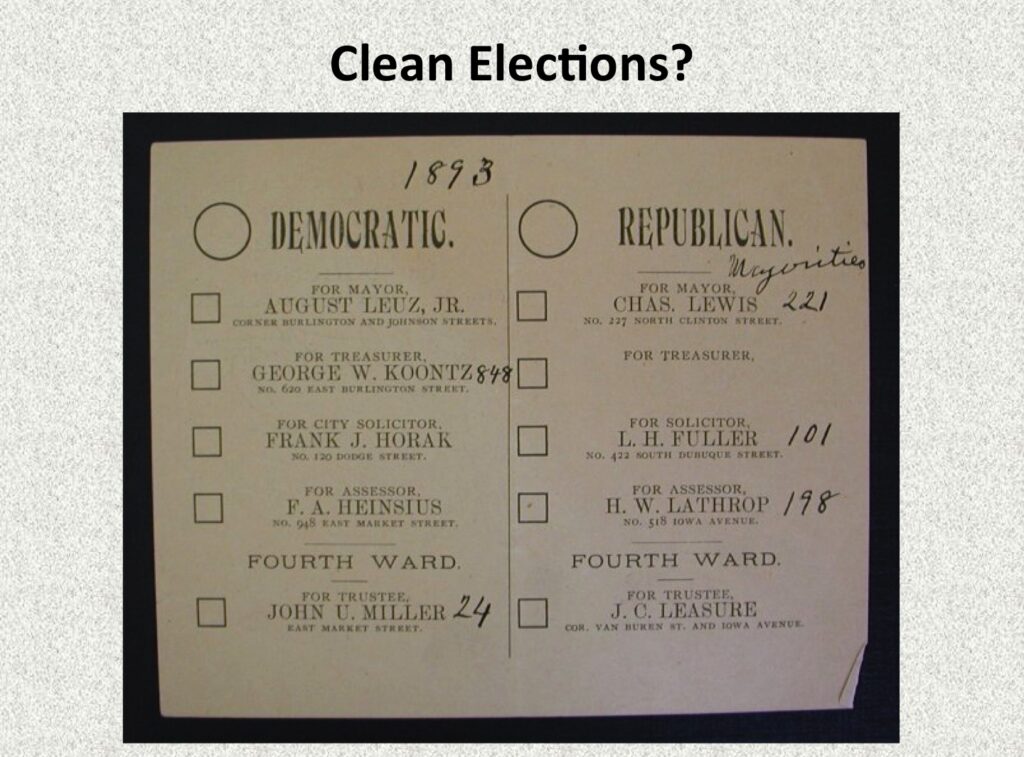
(12) Another important (and usually little-noted) reform effort, this one against political machines, came with the rapid adoption of standard ballots in most states starting in the late 1880s. Slide 12 shows an early example of a standard ballot. A standard ballot is not printed by just anyone (as was the case with “tickets” until then). A standard ballot is issued by the voting district. It is the only allowable ballot. It includes the names of all candidates running for each office–if their candidacy has been accepted by the state. At the time this innovation was called the Australian ballot, because the reform was first adopted in Australia.
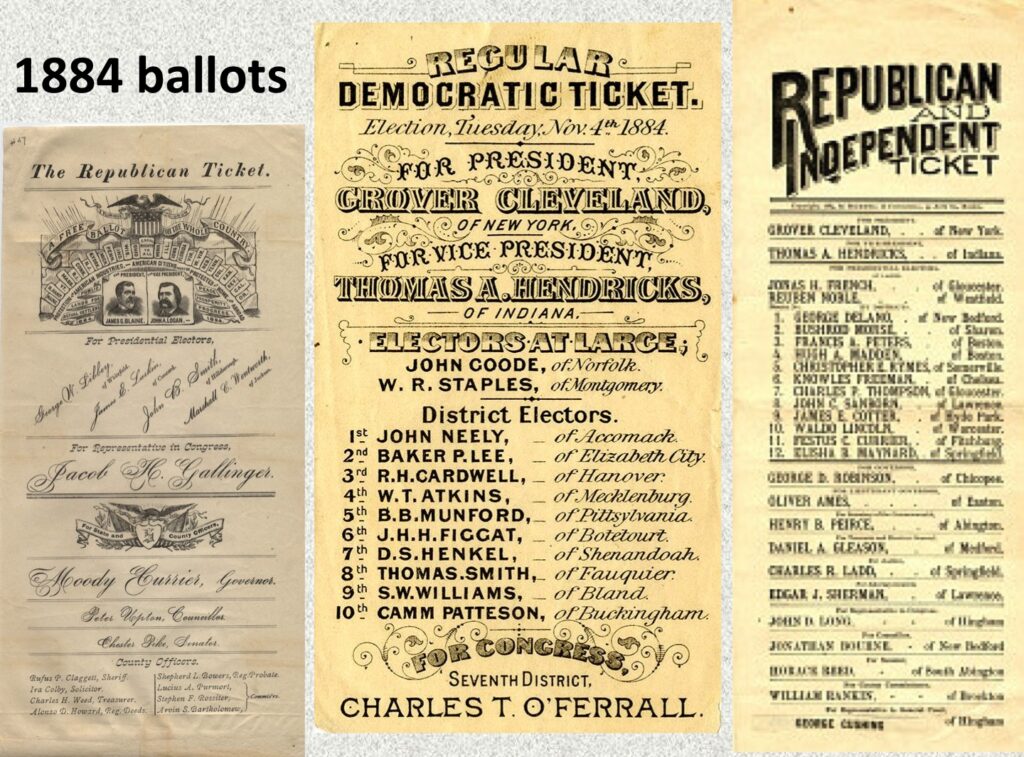
(13) Standard ballots ended the practice of voters coming to the polling place with their own colored ballots printed by political parties or by local political machines. (Political “machines” were not actual machines. This was a term for political organizations that controlled local governments and politics. Generally speaking, political machines were funded by given business interests.) Slide 13 shows examples of printed ballots, known as ‘tickets.’ These were distributed on the street by parties and local alliances known as ‘lists.’ The tickets were used as the actual votes that voters inserted into the ballot box. Before standard ballots, voters could also just write their own ticket by hand. Tickets were of different sizes and colors, and it was therefore hard for people to hide how they were voting. But until the mid-19th century, it was normal in many localities to have votes recorded in public by judges, so that there was usually no secrecy in voting. People could be subjected to intimidation or beaten up. This was one of many ways that elections were rigged by political machines. The most significant surely was that once in power, machines could fire and hire the police and other employees. The police were the key group to hire, because they were the ones who guarded the ballot boxes and counted the votes.
In short, the implementation of a standard ballot theoretically made election fraud more difficult, and also enabled the secret ballot. Political machines did not disappear. They found ways to adapt to the new systems. Standard and secret ballots were a crucial step toward greater election integrity, reliability of vote counts. They also made it easier for vulnerable groups to vote against a local majority. There is little doubt that the greater protection of individual voters under the standard-secret ballot system was a key step toward the achievement of full women’s suffrage by 1920. At the same time, it also meant that state governments became the regulators of elections. This gave the states much more power because state laws would determine who got on the ballot and how the votes were counted. In practice, the most popular and powerful party in a state could exclude independents and third parties and find new, legal ways to maintain its hold on power.
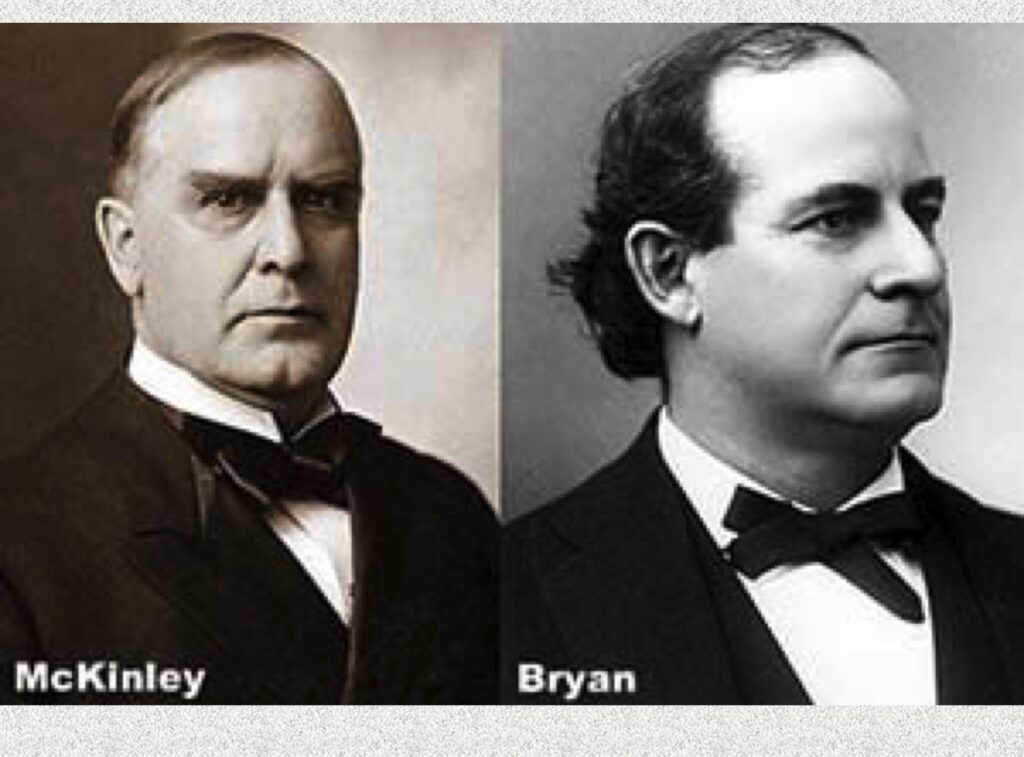
(14) Reforms to limit the power of the old political machines had other unintended effects. One was to increase the effectiveness of corporate lobbying of individual lawmakers. For the rich it meant big money could be spent directly on individual election campaigns, with less needing to deal with and pay off political machines and local bosses. It helped cut out the middle man. This was illustrated in 1896, during what is often called the first ‘modern’ presidential election. The Republican candidate, William McKinley, was pro-business and also pro-empire. (He was actually ambiguous about imperialism and the racism that justified it, but once in office as president he went along with the prevailing Republican opinion favoring a war with Spain.) McKinley’s campaign had an estimated five to ten times more funding at its disposal than that of the Democratic and Populist candidate, William Jennings Bryan. McKinley enjoyed direct backing from Rockefeller and Morgan. Perhaps most importantly, he had the favor of the biggest newspaper magnates, who provided free advertising for his campaign through favorable news stories and propagandistic attacks on his opponent. The McKinley campaign was run by Mark Hanna, a coal and iron magnate who was a master of fundraising. He got himself appointed to the Senate soon after McKinley’s victory. The Populists, inspired by Bryan’s condemnation of the gold standard, had risked a joint run with the Democrats. Bryan’s defeat caused them to split and break up. Some later joined the Socialists. President McKinley oversaw America’s move into overseas empire in 1898, as we saw last week, and again defeated Bryan in 1900.
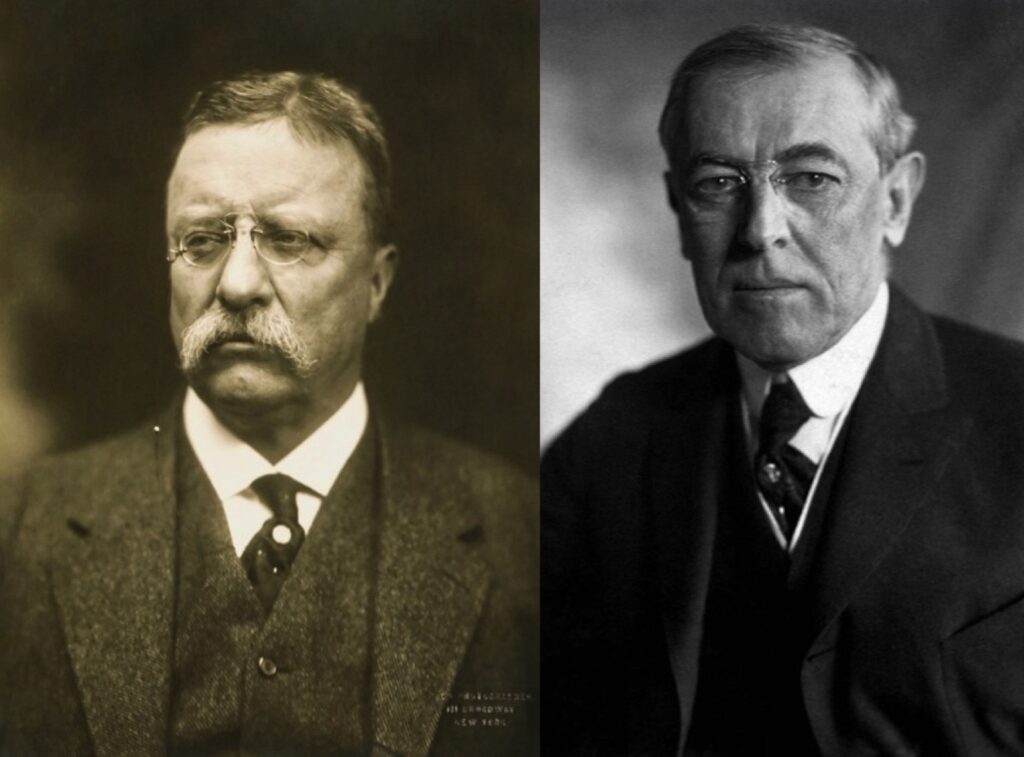
(15) McKinley was assassinated the next year by an anarchist and was succeeded by Theodore Roosevelt (left), known to us as “TR” to distinguish him from his nephew, the later president “FDR”. Teddy Roosevelt, who had successfully presented himself to the world as a military hero of the 1898 war in Cuba, became president from 1901 until 1908. Justly or not, his name is closely associated with the Progressive Era, along with that of the Democrat Woodrow Wilson (right), who won the presidential elections of 1912 and 1916. As we shall now examine in detail, the period until 1920 did indeed see the greatest number of the kind of successful reforms that gave the “Progressive Era” its name, most of them supported by Roosevelt, his successor Taft, and Wilson. These included a series of four major constitutional amendments — to allow income tax, make Senators electable directly by the voters, to prohibit the sale of alcohol, and, finally, extend the franchise to women — as well as the creation of federal wilderness reserves, the founding of the Federal Reserve Bank, the abolition of industrial child labor, regulation of workplace safety, stricter building standards, water and food safety, and much more.
(15, continued) Internationally, Roosevelt continued the war in the Philippines, built a huge military fleet (the “White Fleet”) and sent it on a world “friendship” tour, and started a period of interventions and “Banana Wars” in Latin America, most notably arranging for the U.S. takeover of the Panama Canal project and initiating the 20-plus-year occupation of Nicaragua. Wilson would continue in the same vein, launching an intervention to change the government of Mexico, starting a 20-plus-year occupation of Haiti, and eventually entering the U.S. into the Great War in Europe.
(15, concluded) At home the political machines, meanwhile, continued to adapt to new circumstances. They innovated new ways to stuff ballot boxes, rig elections, keep competitors off the ballot, control public budgets, and stymie reform. In the South, this was still done with little need to cover it up with nice words about democracy or equality or law. State and local laws and courts in southern states circumvented the 14th and 15th amendments to almost completely lock black people out of voting and to guarantee a monopoly of power for the ‘Dixiecrats’ (the Democratic parties in the southern states). Southern systems of segregation and racial hierarchy (caste) remained in place. These received periodic cultural enforcement through outbreaks of violence and popular terror, like lynch justice.
*
Progressive Reformers and the Cities
(16) A huge variety of citizen initiatives continued to arise throughout these decades. Not all of these were related. Some were in conflict. But most tended to use a modern organizing tool-kit.
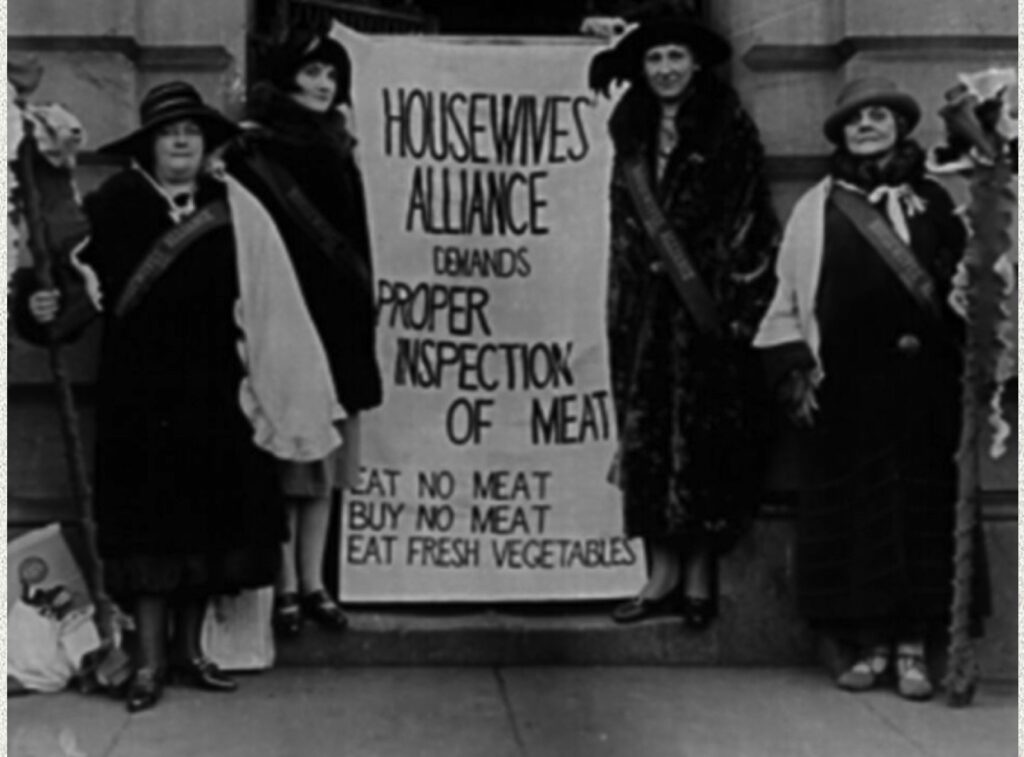
(17) Progressive groupings and campaigns, in large part with middle-class women as foot-soldiers and often leaders, worked with a mix of agitation, protests, scientific research and journalistic exposes, arts and literature, education, and media campaigns. They often looked to forge alliances across causes and groups, and with lawmakers and philanthropies. They helped to create new disciplines of knowledge and new professions for the new age, in areas like social work, education, urban planning and architecture, public health, library sciences, and what became the environmental sciences.
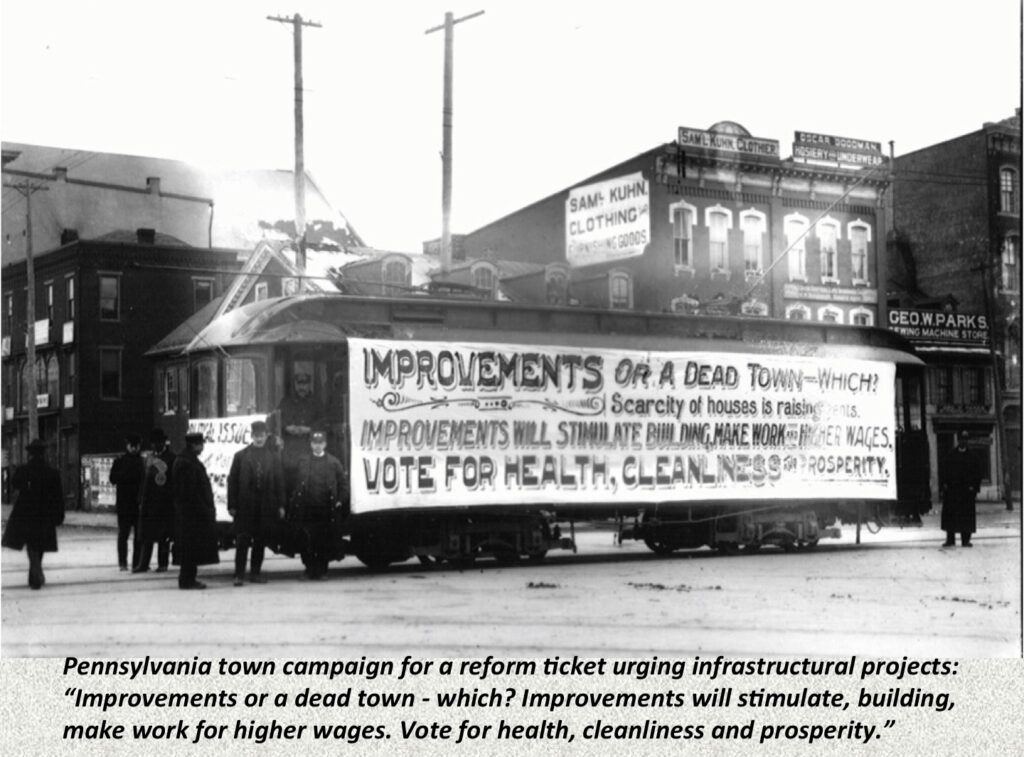
(18) They fought for stronger municipal governments independent of state-level machines, and managed to beat the machines and elect many reform slates to municipal government in many places around the country. While the earlier Populists can be described as a movement and a party, progressivism was more of a label given to reform efforts during this time.
(18, cont’d) ‘Progressivism’ was meant to describe a spirit guided by science, by enlightened and democratic values, by a general concern for the public good, by a desire for the better functioning of government and society, and by the idea — an American perennial — that every individual human being can and should engage in self-improvement, as well as measures to improve society.
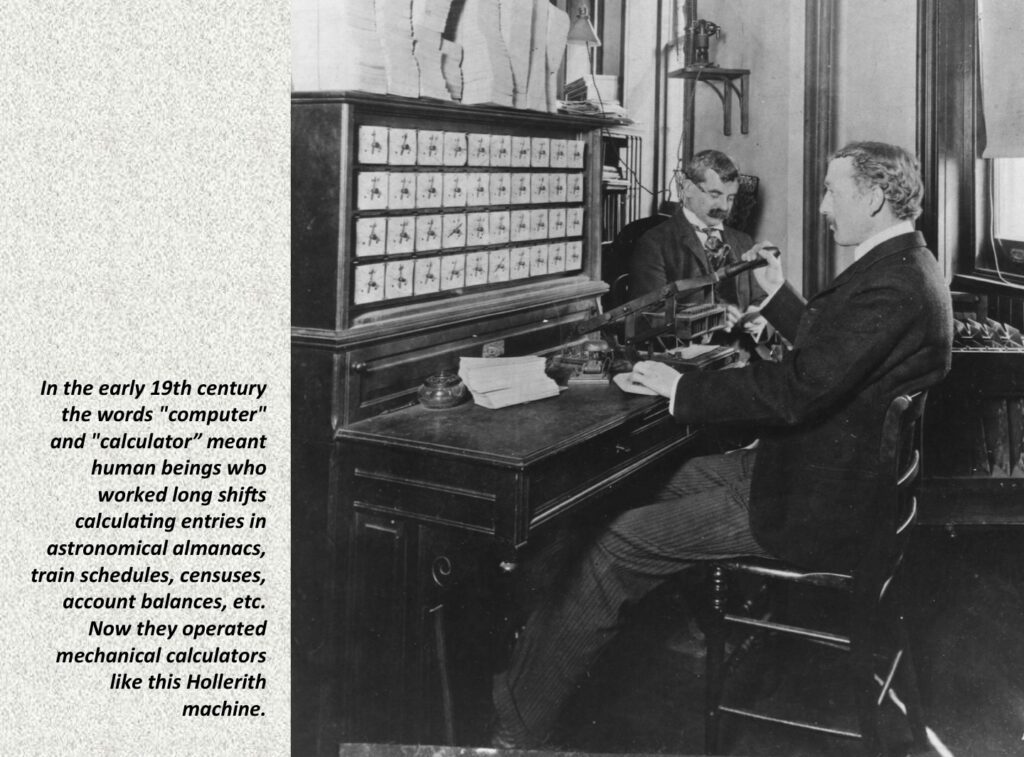
(19) Progressivism was firmly rooted in the new middle classes. The new middle classes arose in the 19th century with the exponential increase in the number of professionals like doctors, lawyers, architects, accountants, teachers, professors, engineers, technicians and other specialists, and, of course, the salaried employees of the growing corporations and state agencies, the middle-managers, bureaucrats and secretaries. The traditional middle class, which remained, consisted of small owners, shopkeepers, small farmers, artisans and trades-people. The new middle classes tended to be more urban, with more formal education, and at this time younger than the heads of household of the traditional middle classes.
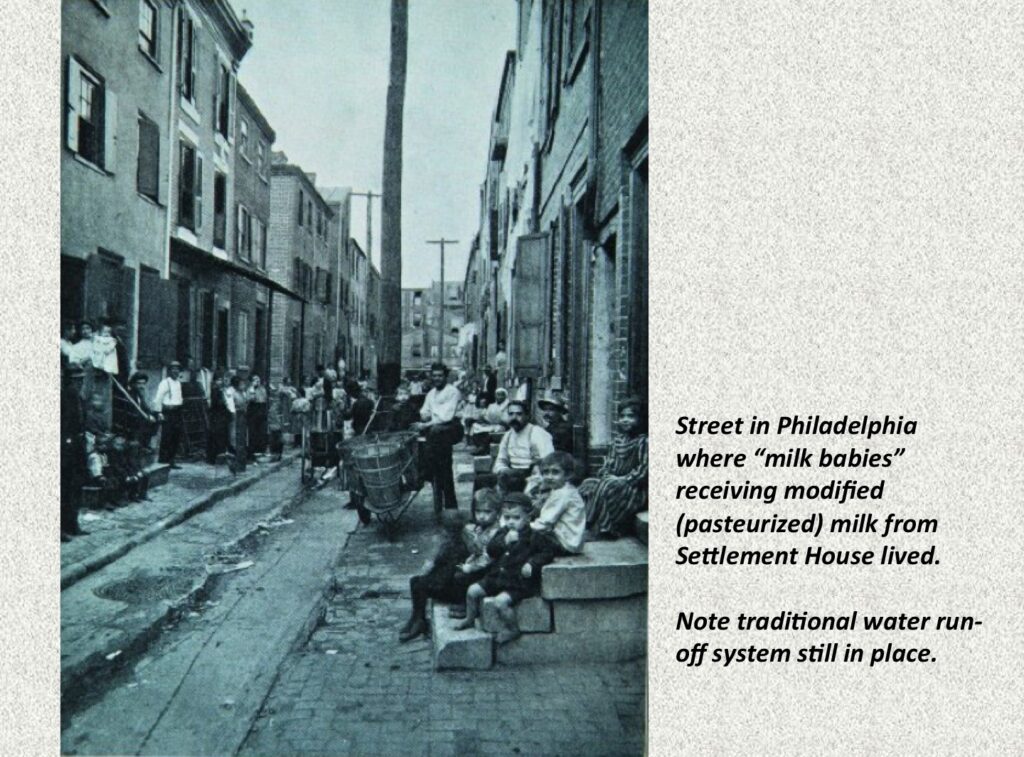
(20) In reality, given the circumstances of the new industrial society, many reforms were considered urgent and overdue. To put it bluntly, going into the 20th century, city streets were open sewers, apartment houses for the poor were tinderboxes, and death from preventable contagious diseases was still common. Urban populations were concentrated like never before. Growth in cities at this time was driven by mass immigration from abroad and new residents moving from rural areas and smaller towns in the U.S. While the ‘mortality revolution’ of the 19th century had massively decreased death rates from disease, especially among infants and children, death rates were still much higher in cities than in the country.
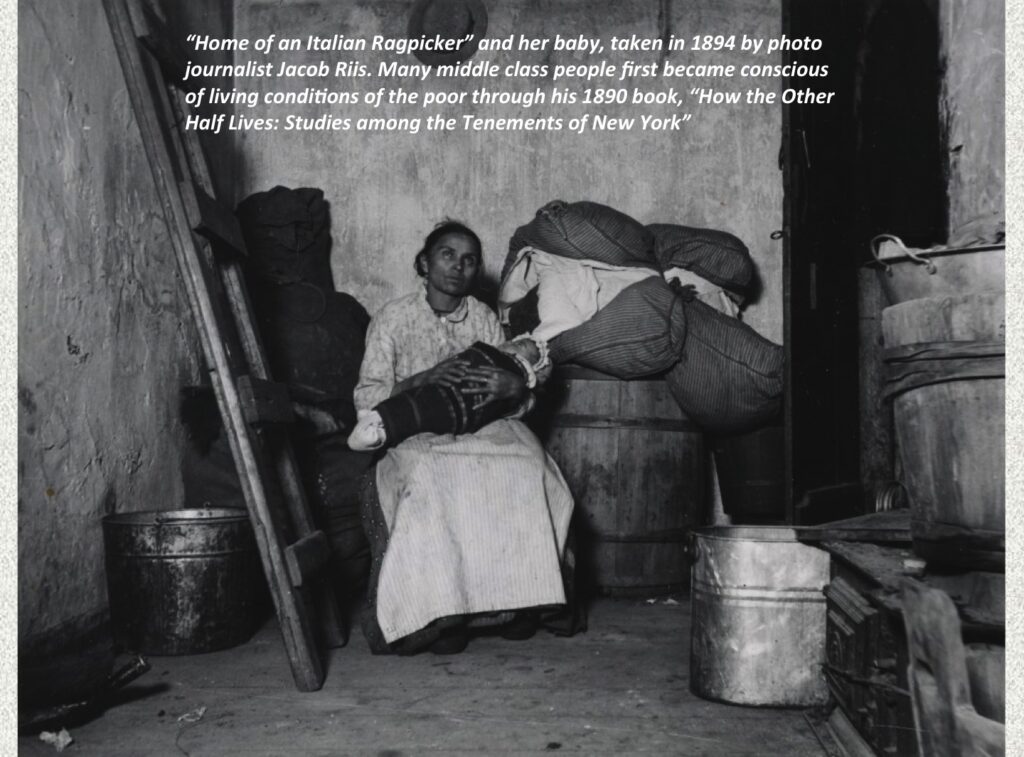
(21) Millions lived in tenements with minimal sanitation. Middle and lower classes could hardly avoid each other. New York City and Chicago both had population densities far higher than today, and both were majority immigrant. New York reached a population of four million in 1900, three times the level of 1860, and even as the infrastructure grew it was still strained to accommodate them. Cities were home to opulent wealth alongside desperate poverty.
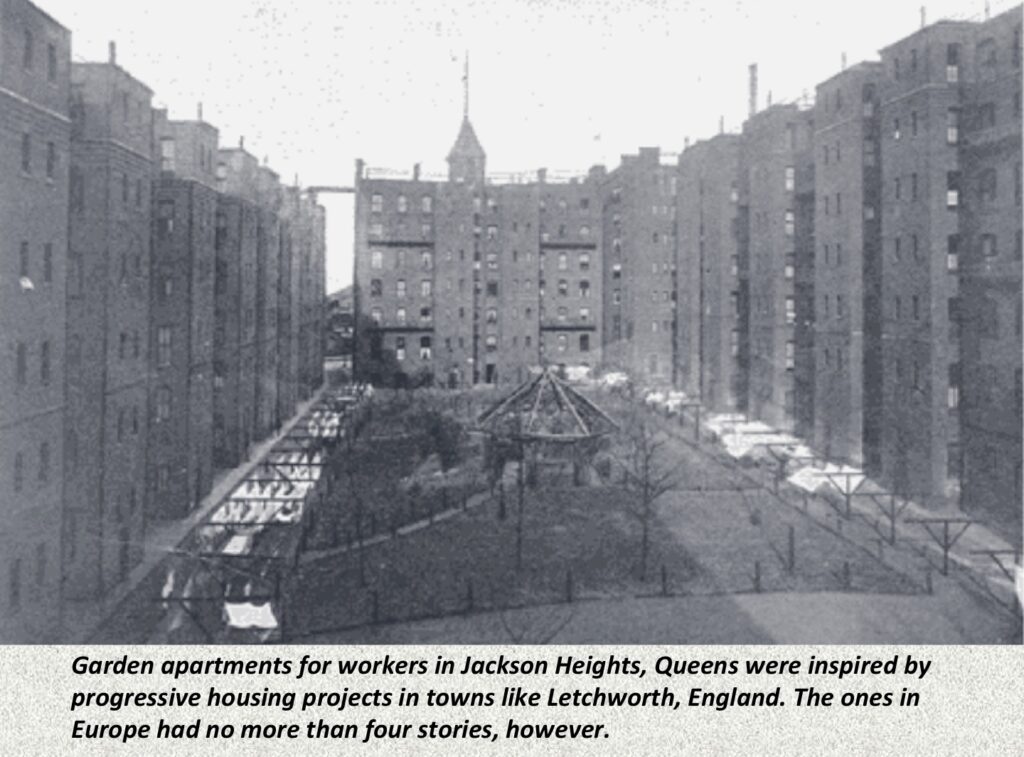
(22) All this created enormous demands and also an economic need for rational reform, for initiatives to improve and expand education, public health, and other infrastructures. This period saw similar, primarily urban reform movements in the cities and towns of both the U.S. and Europe. Progressive (as well as not-so progressive) ideas and thinkers traveled back and forth across the Atlantic. This, for example, is how the idea of “garden apartments” traveled from England to Queens, New York, although it did mutate in the process (photo above).
(23) Progressive citizen initiatives sought to end child labor, to raise public health standards, to build working sanitation systems, to establish food safety standards, to improve housing and write the first building codes, to mandate safer workplace conditions, to alleviate poverty and child hunger, to address wealth inequality through taxation of the rich, to expose and combat political corruption, to legalize family planning and birth control, to open more hospitals, schools and universities, and to expand public schools.
*
Progressive Successes

(24) Many progressive social demands, if far from all, were met in some form during the first two decades of the twentieth century, and were put into law by municipalities, states and the federal government. The first federally-protected wilderness areas were designated starting in 1903 under the nature lover Roosevelt, although the ideal of land conservation (protect the land while also using it for economic purposes) mostly prevailed over the idea of land preservation (keep wilderness and habitats as they are).
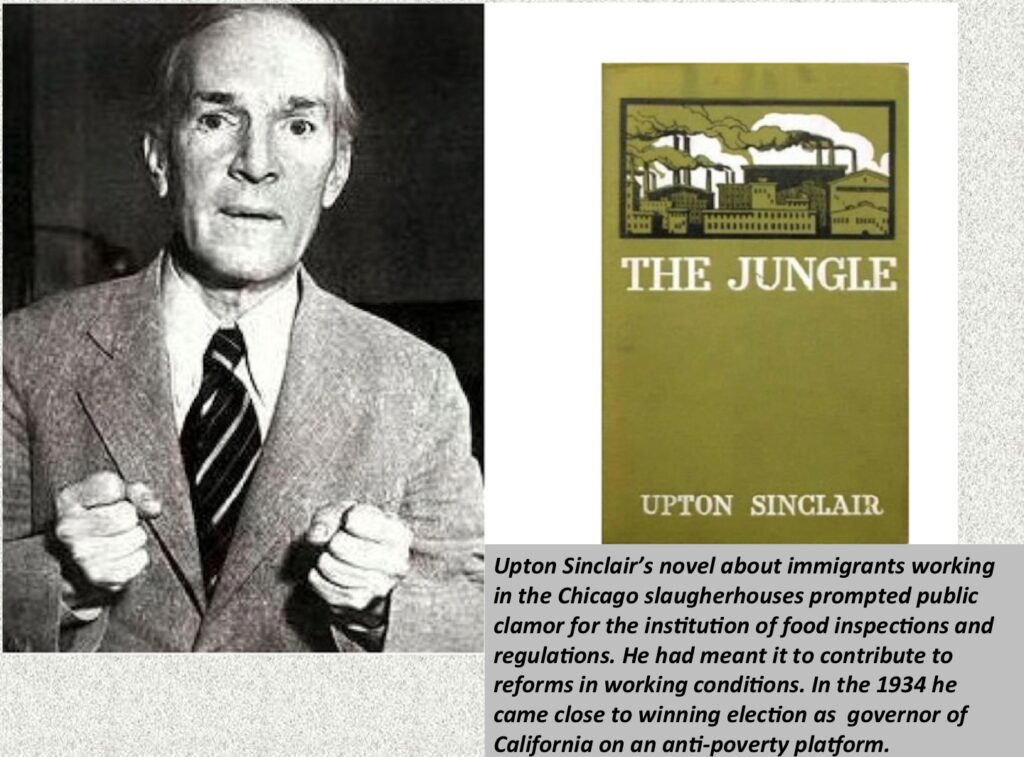
(25) Starting in 1905, New York City pioneered fire and building codes to alleviate the overcrowded, unhealthy, and dangerous conditions of its tens of thousands of tenement buildings. Federal agencies were established to oversee food safety after the uproar set off by Upton Sinclair’s novel about conditions at the Chicago slaughterhouses, The Jungle.
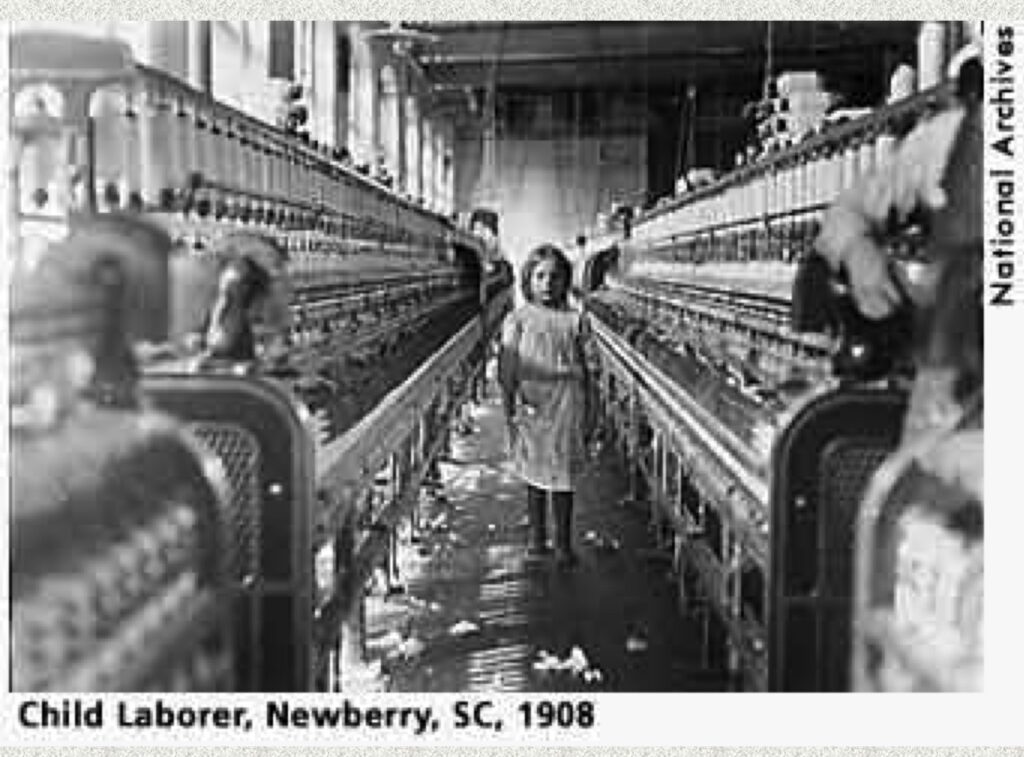
(26) Industrial child labor was gradually but almost entirely banned.
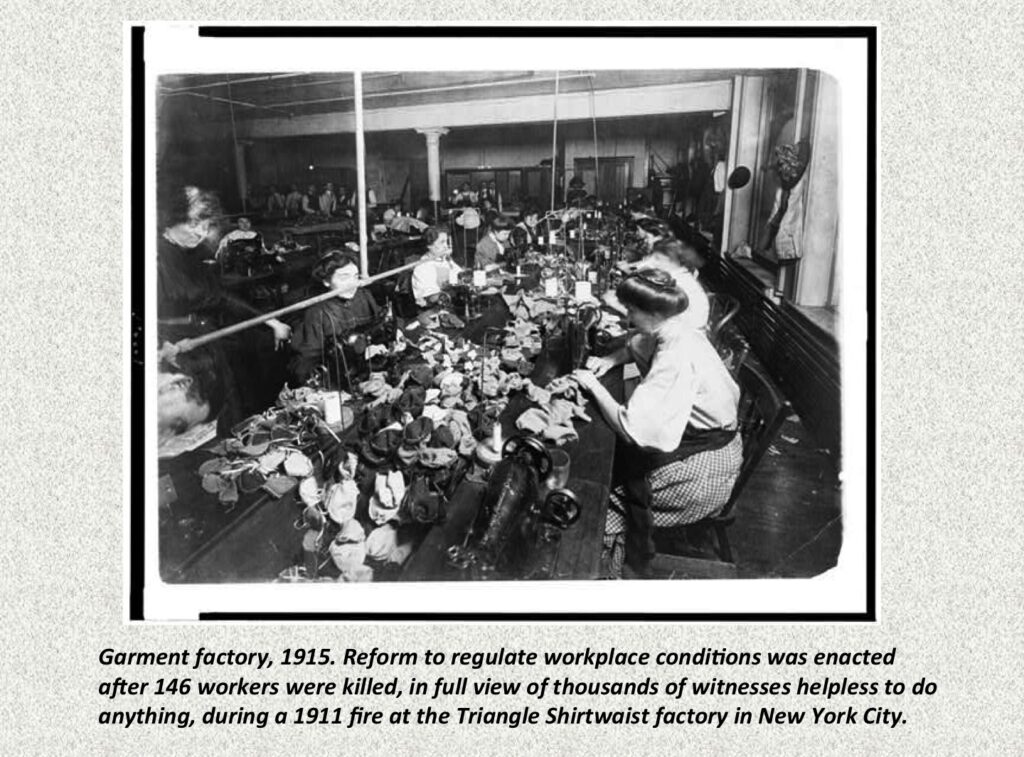
(27) New York City passed workplace safety regulations and new fire and building codes, but the story involved a major public tragedy…
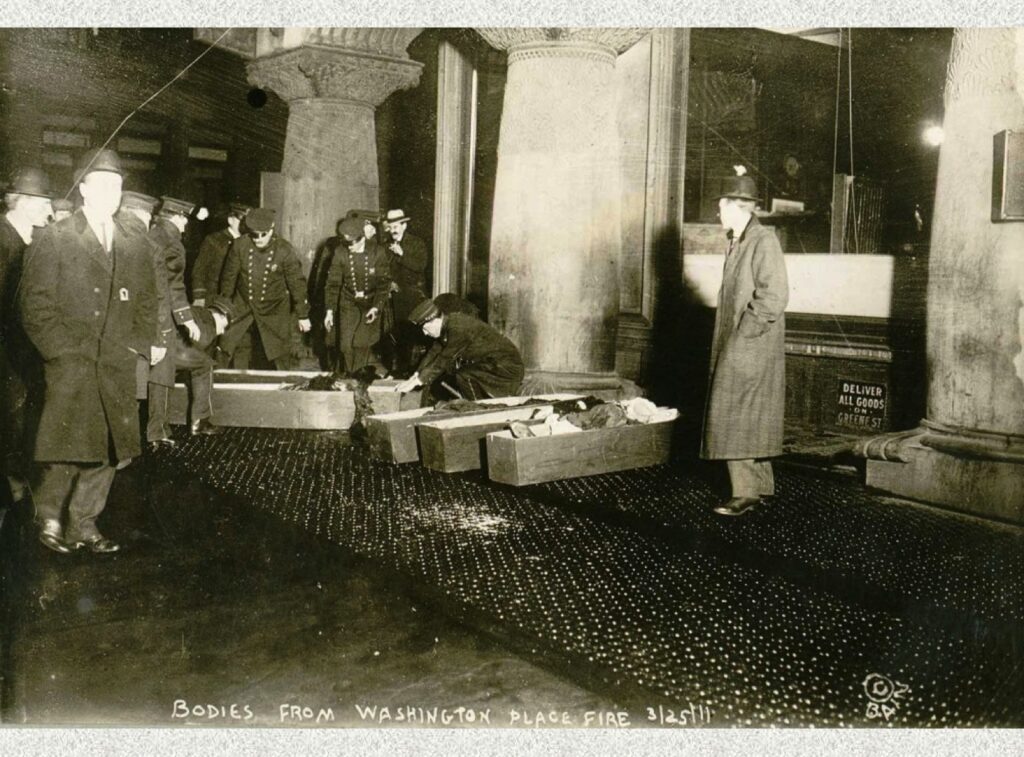
(28) Workplace safety and building regulations were among the demands of the huge strike of workers in the New York garment industry in 1908, once again defeated after a long winter struggle. It took the horrific Triangle Shirtwaist fire in 1911 to mobilize enough outrage among the general public and to finally force the New York political machines to pass such measures.
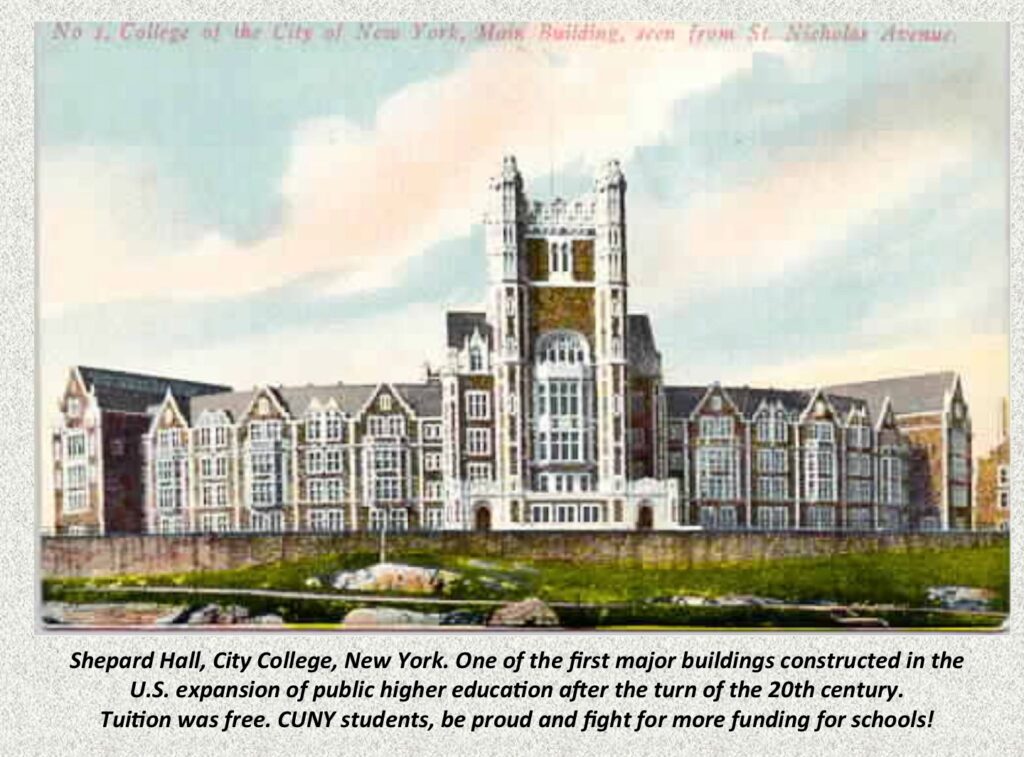
(29) Spending on public schools, hospitals, and universities increased in many localities. One example is the expansion of City College (the image shows Shepard Hall, built at this time). City College was shaped into the premiere college in the New York public university system that became CUNY. The city universities became open to the children of immigrants, especially Italians and Jews, who were excluded from the Ivy Leagues. In this way, many families made the jump from Ellis Island to professional careers in one generation.
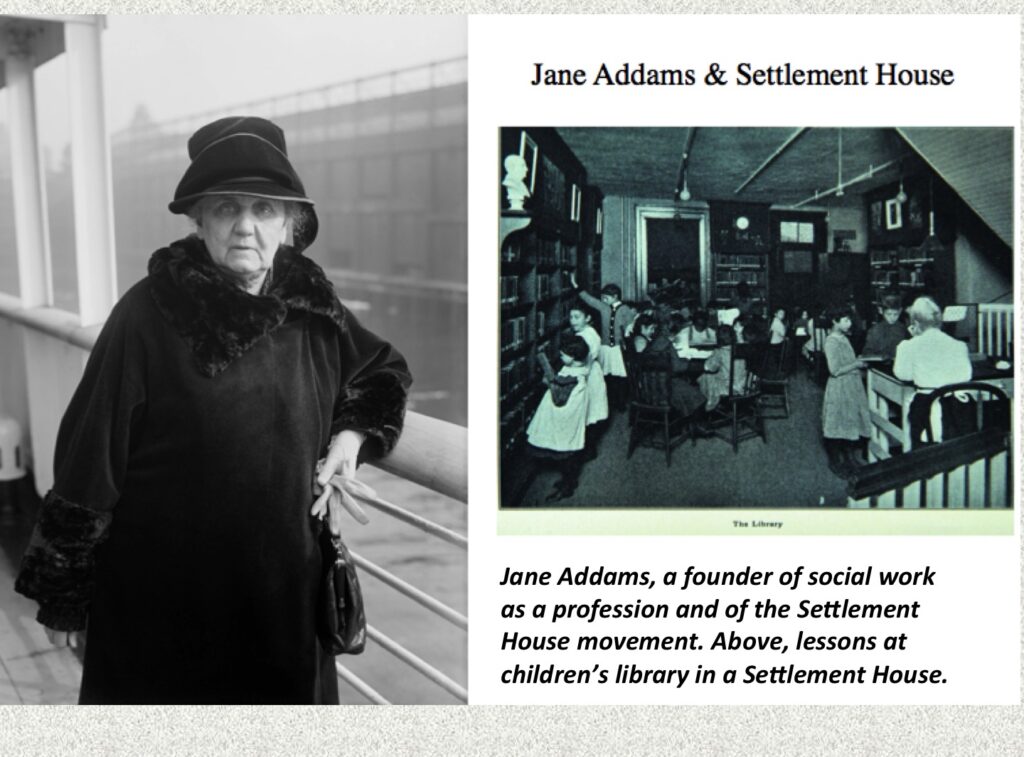
(30) New philanthropies run by progressive reformers like Jane Addams opened settlement houses for orphans and extremely poor or abandoned children. These were new in that they served as schools rather than human warehouses or child workshops.
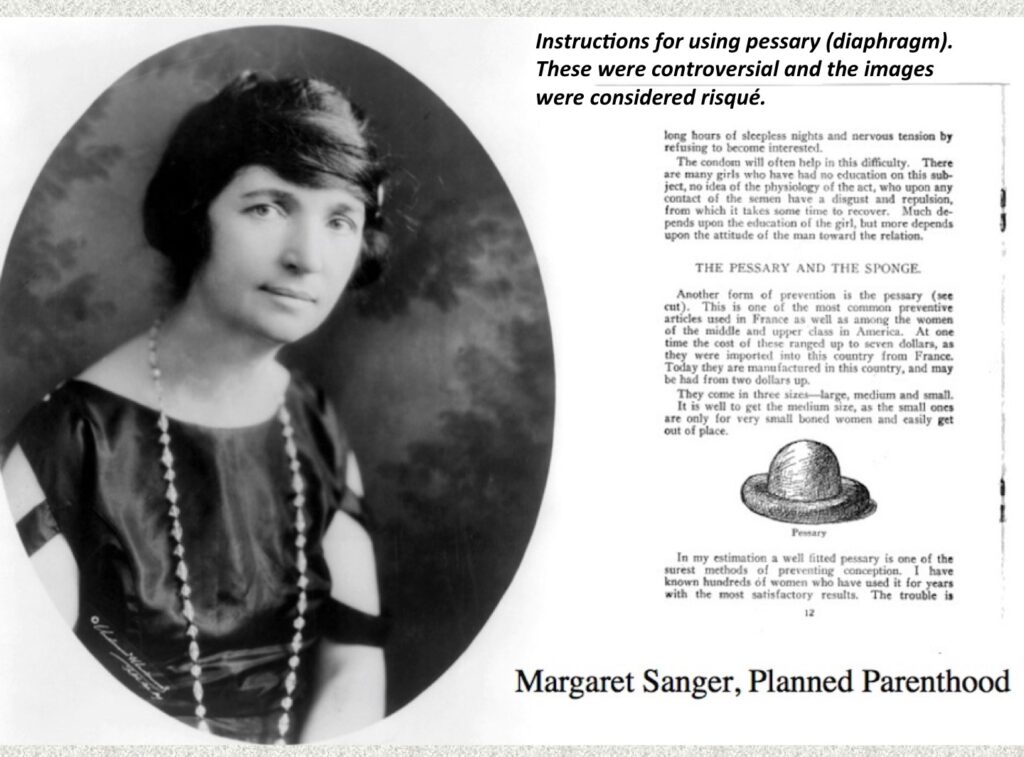
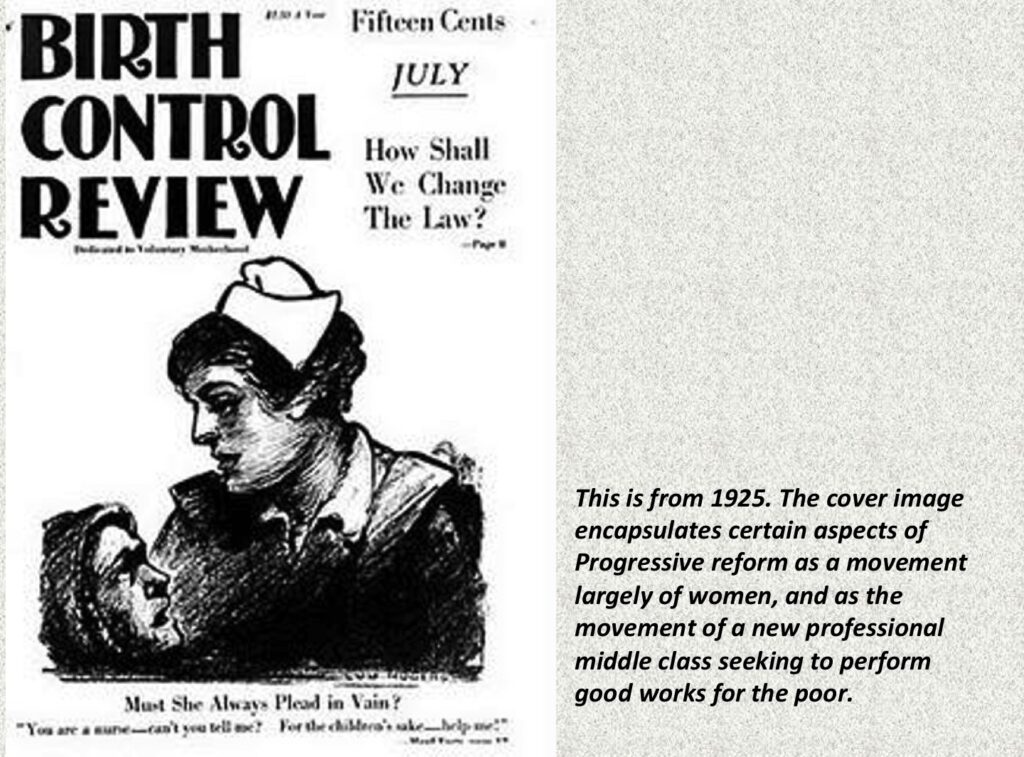
(31, 32) The organization that became Planned Parenthood waged a long campaign to educate about family planning and, often by underground action, provide contraception to women.
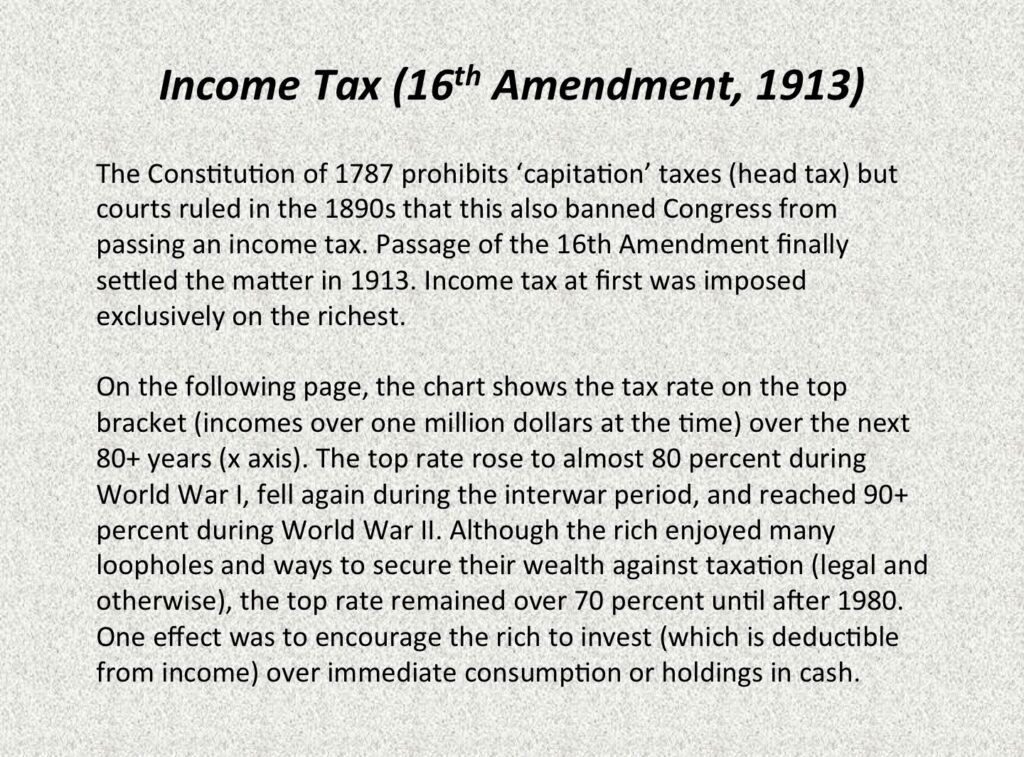
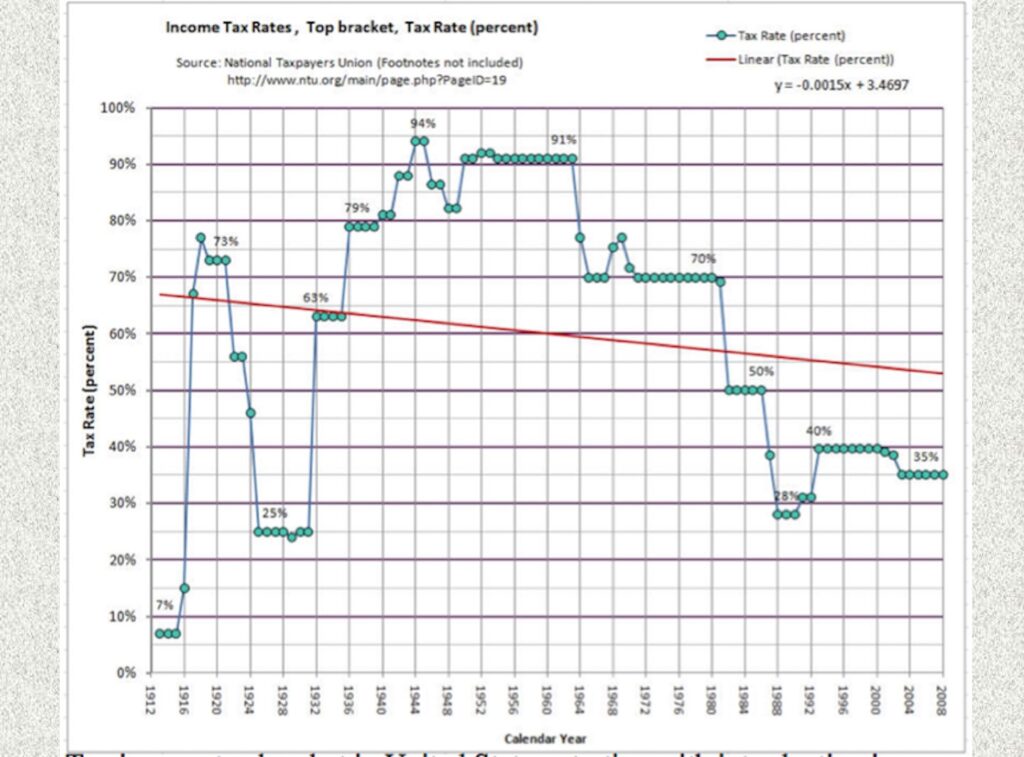
(33, 34) By 1913, two constitutional amendments were ratified, the first two in the more than 40 years since the Reconstruction amendments. One mandated that federal senators be elected by a state’s popular vote. The other allowed direct income taxes, which at first were applied almost exclusively to the highest incomes. The chart shows how the income-tax rate for the top marginal tax bracket (originally, starting over 1 million dollars) changed through the decades.
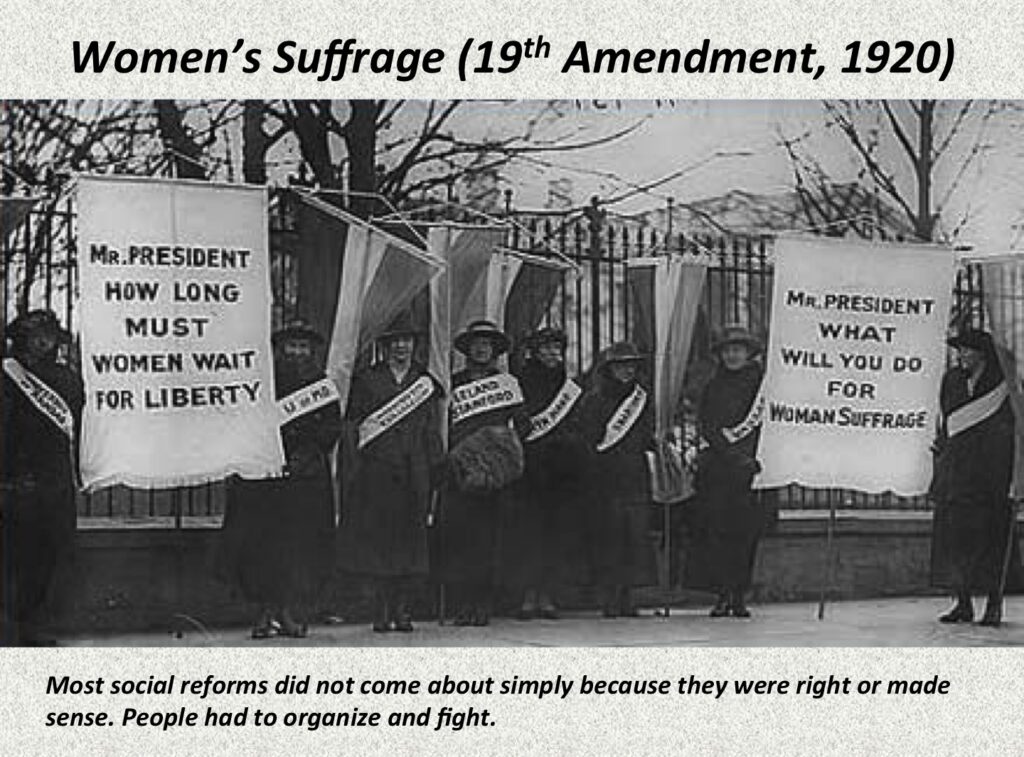
(35) By 1920, the 19th amendment established universal suffrage for women, finally achieving a key and long-fought-for demand of the 1848 Seneca Falls conference.
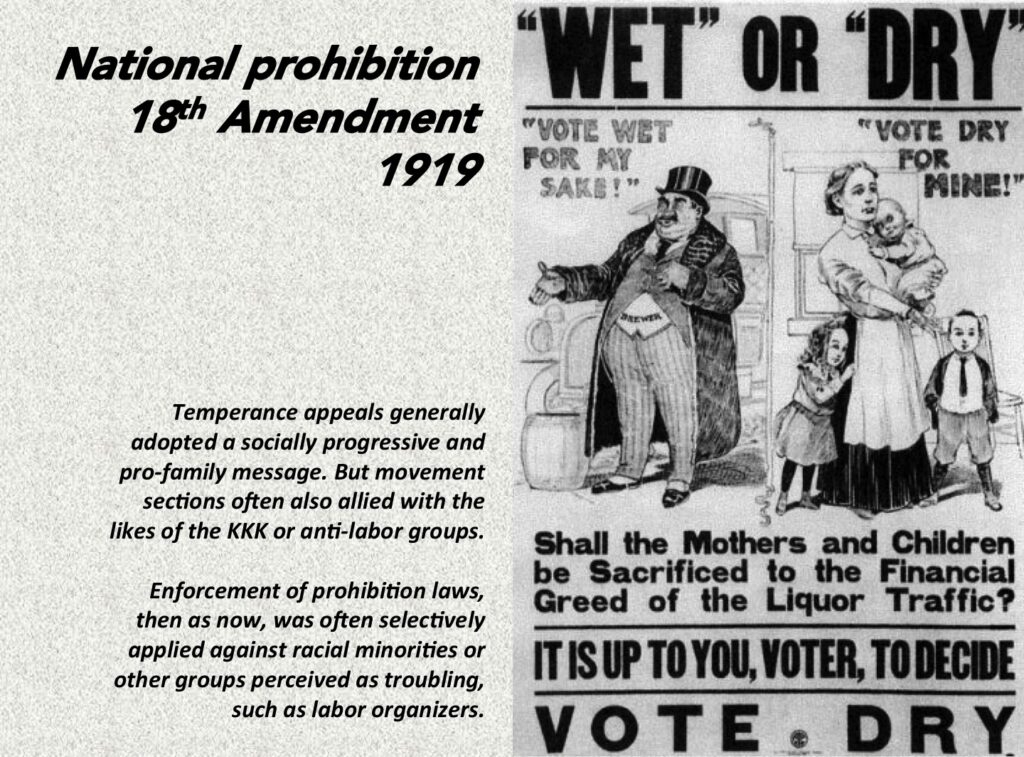
(36) One year earlier, the national prohibition of sale and distribution of alcohol was also constitutionally enshrined in the 18th amendment, culminating the efforts of a century of temperance movements.
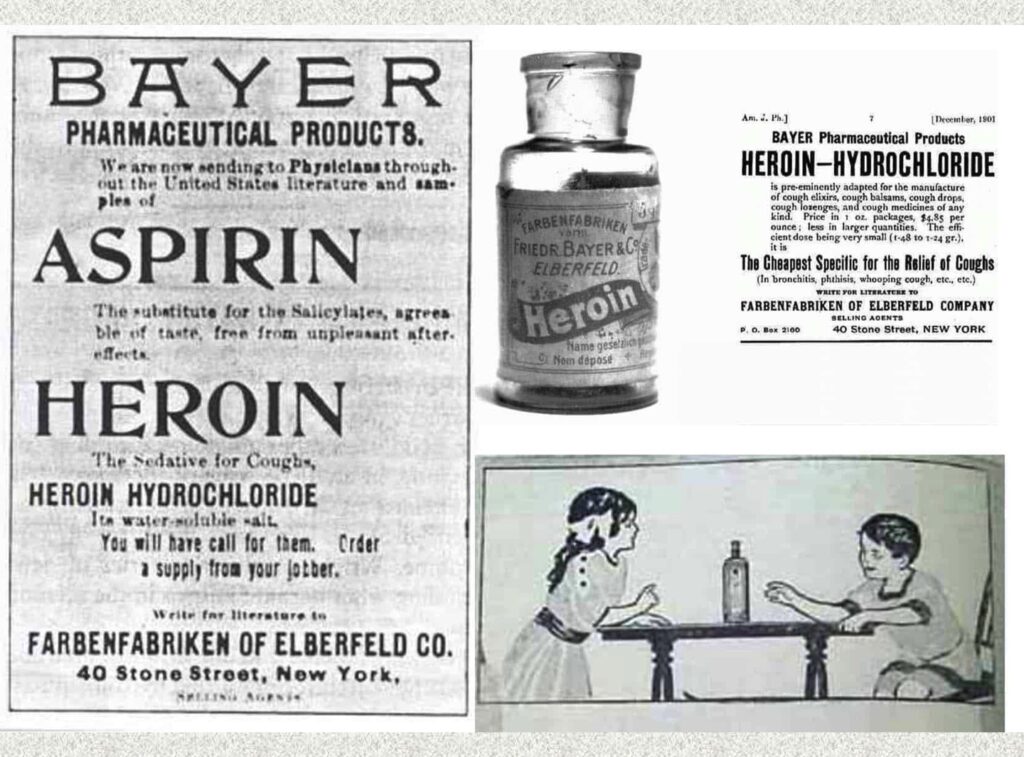
(37) The original version of the later wars on drugs had begun in 1914, with the prohibition of the until-then widely available medicinal pharmaceuticals known as Heroin (a registered trademark) and cocaine, which had caused widespread addiction.
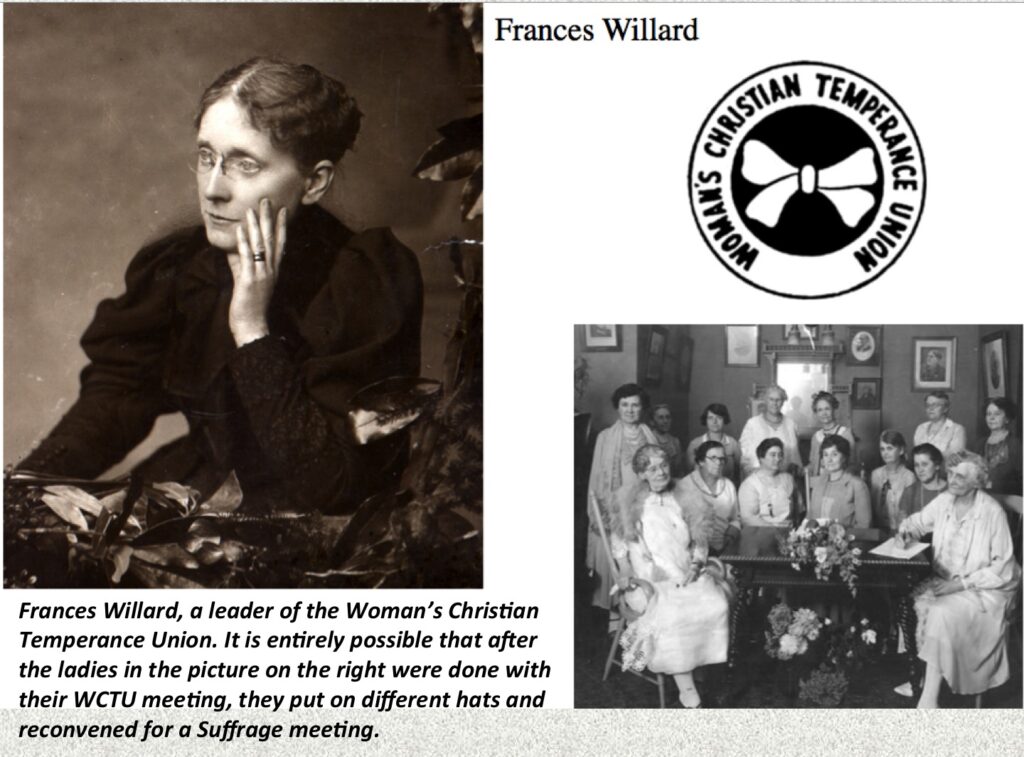
(38) It was not coincidental that Suffrage and Prohibition achieved these victories within a year of each other. Women were prominent and central in organizing both efforts, although increasing numbers of women came to oppose Prohibition after its implementation, and more than a few women had opposed Suffrage.
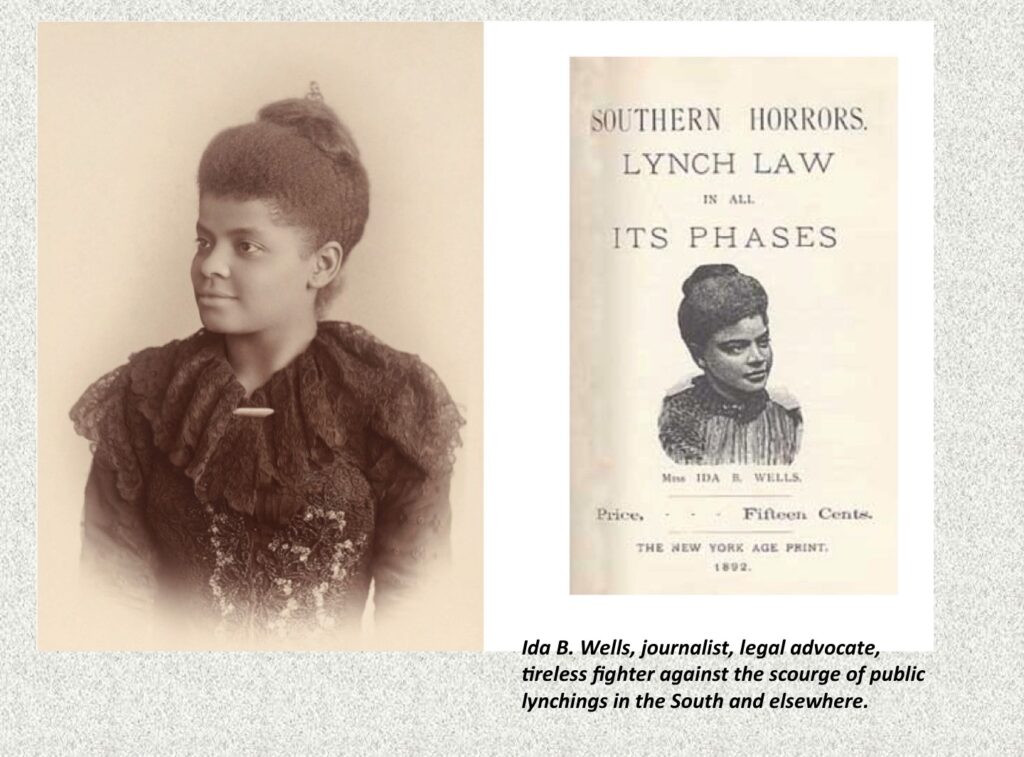
(39) A woman of relentless spirit amid these movements was Ida B. Wells, who was born into slavery and grew up a free woman, writer and legal expert. She became the country’s most tireless advocate against the scourge of public lynchings in the South and elsewhere, and another one of the best known muckrakers, as journalists dedicated to opposing corruption and injustice were called. This example, unfortunately, is one of several things to remind us that this is also a not-so progressive era.
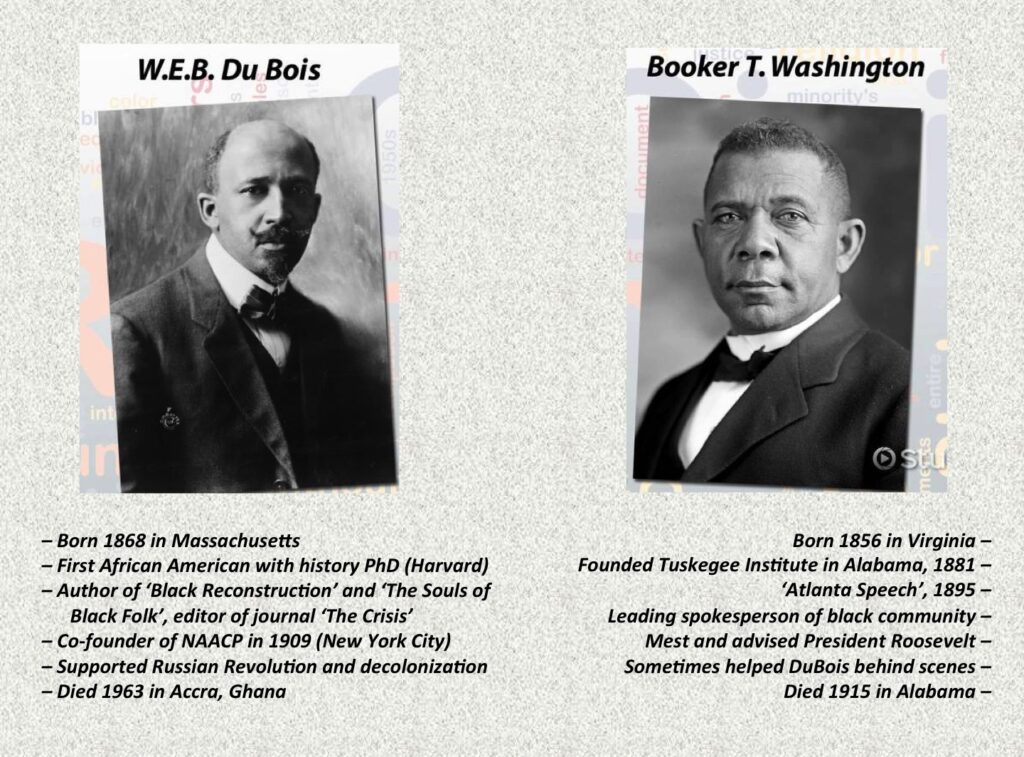
(40) Wells was a founder of the NAACP, together with W.E.B. DuBois. This is the period of DuBois’s debates about the strategy black people should pursue to regain civil rights with Booker T. Washington. Washington was the founder of the Tuskegee Institute providing agricultural and industrial training to African Americans. He was associated with a so-called accommodationist position, especially after his 1895 Atlanta address to white elites. The speech did not endorse the racial order in the South but accepted it as a reality, and urged black advancement within the existing order. The speech was delivered a year before the Plessy v. Ferguson decision cemented the ‘separate but equal’ doctrine as an underlying legal justification for the Jim Crow system of segregation. DuBois later spoke out passionately against Washington’s views. Behind the scenes Washington sometimes channeled money to the more radical and confrontational causes and legal cases pursued by DuBois. One sad truth is that the Question of the Color Line, as DuBois put it, may as well have been happening on a separate planet from most, though not all, of the progressives’ concerns.
*
New Cultures, Culture War, Regressive Successes

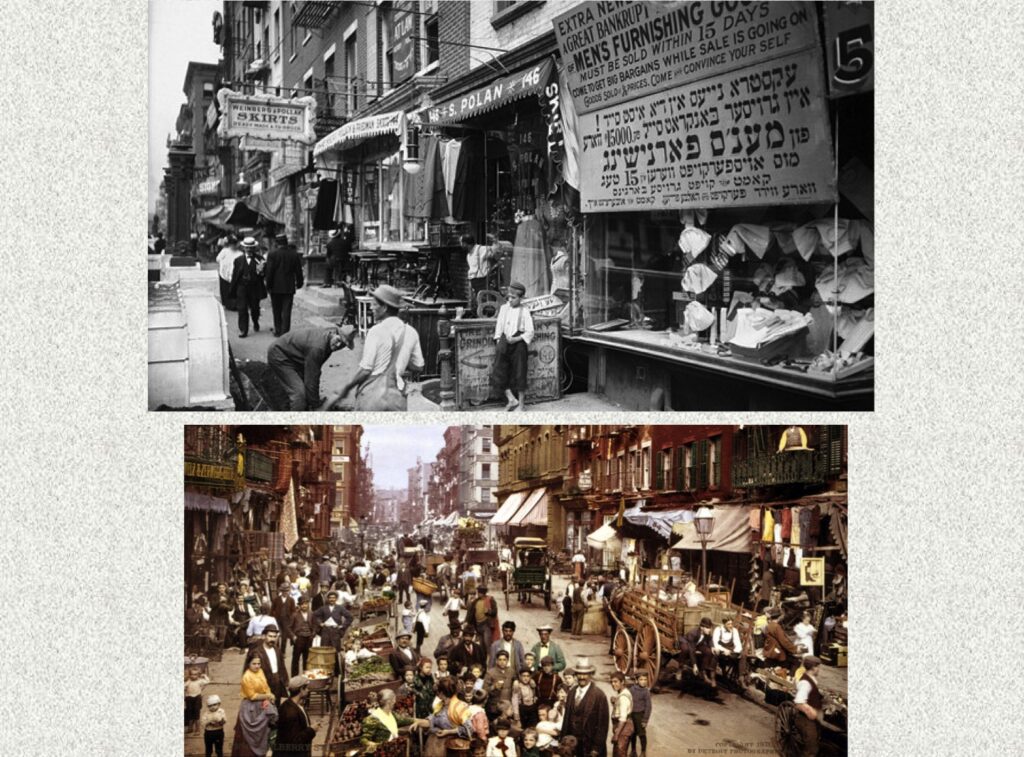
(41,42) The new immigrant communities grew, started their own institutions, churches and synagogues, schools, newspapers, businesses, mutual aid societies. They produced writers and artists and popular entertainments like vaudeville, theater, and opera. They sought to establish themselves in society, changing the face of politics, especially in big cities. They became more ‘American’, as was demanded of them by many in the majority society. But they also transformed the meaning of ‘America’, at a time when the form of the culture and the national identity was both in flux and a widespread subject of obsession.
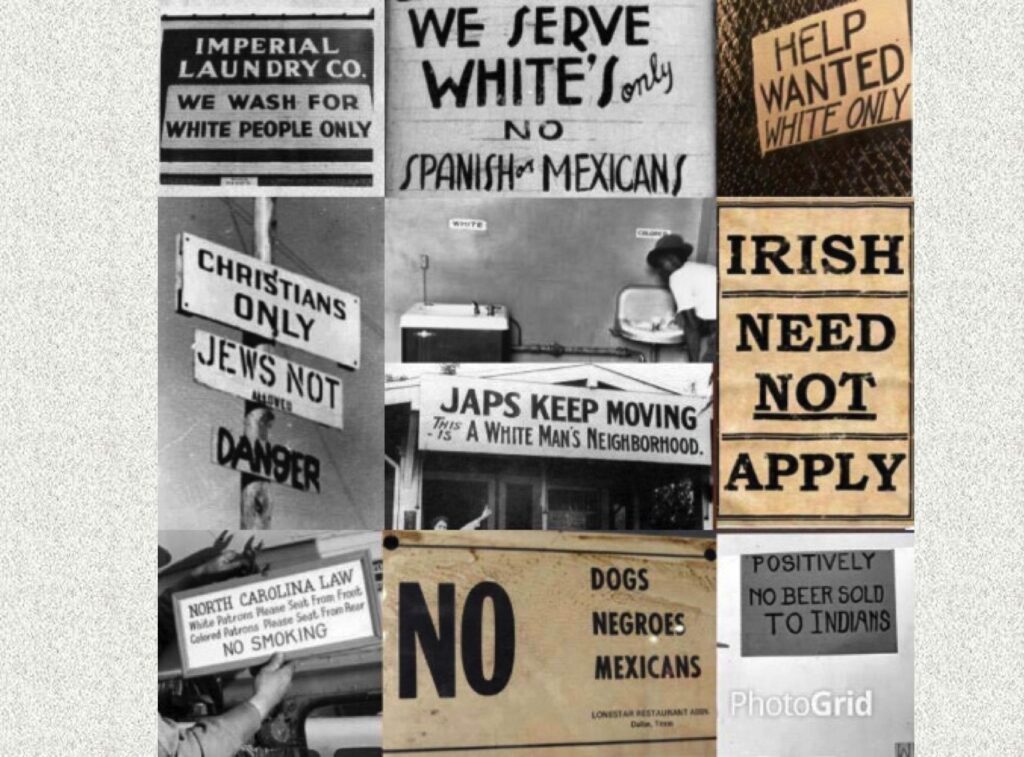
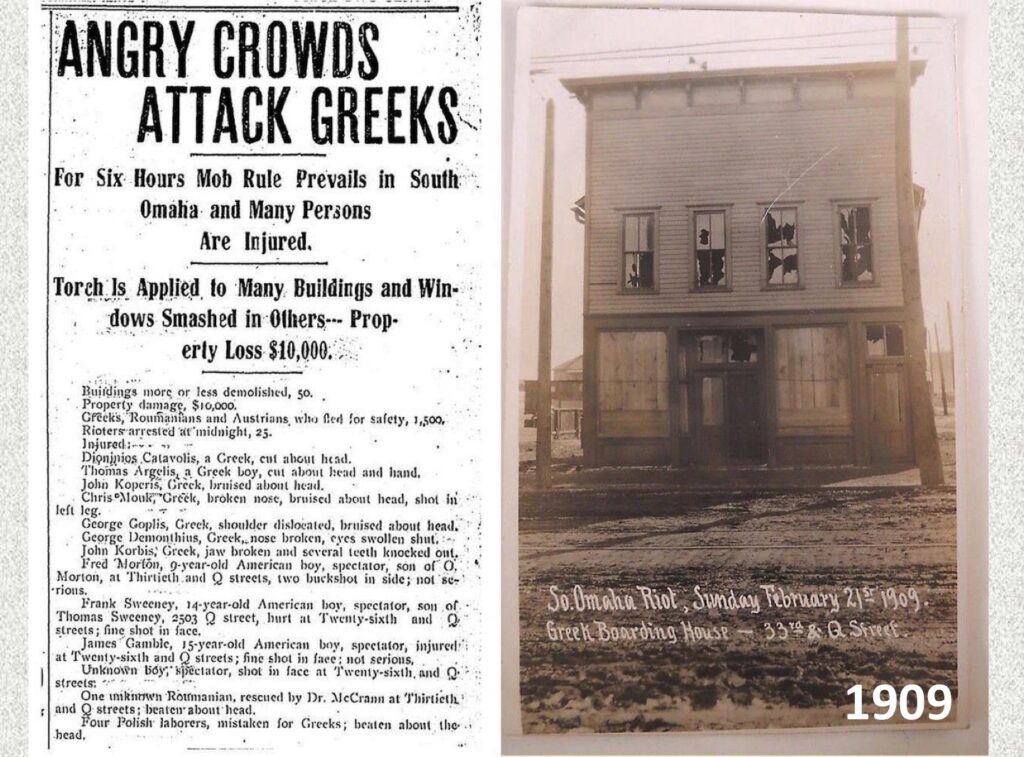
(43,44) The power and normalcy of anti-immigrant nativism and forms of open racism also grew during this time.
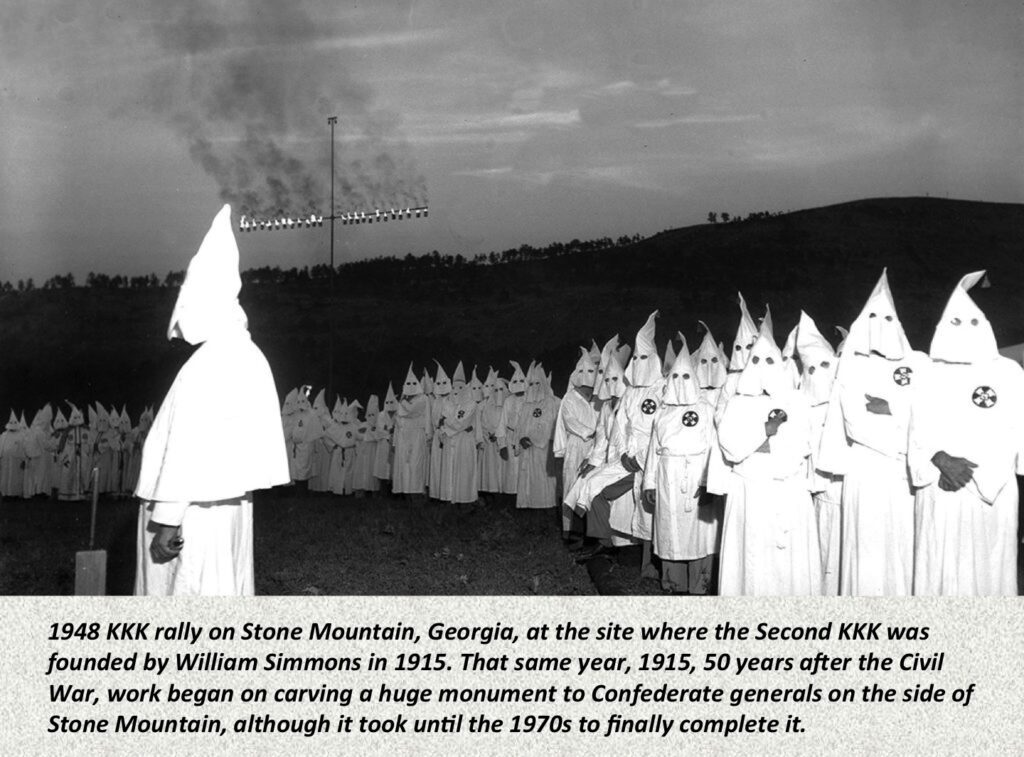
(45) After 1915 a refounded, openly organized, media-savvy Ku Klux Klan, anti-immigrant as well as racist, and following the model of a corporation, grew to millions of members in the North, where it was more active than in the South.
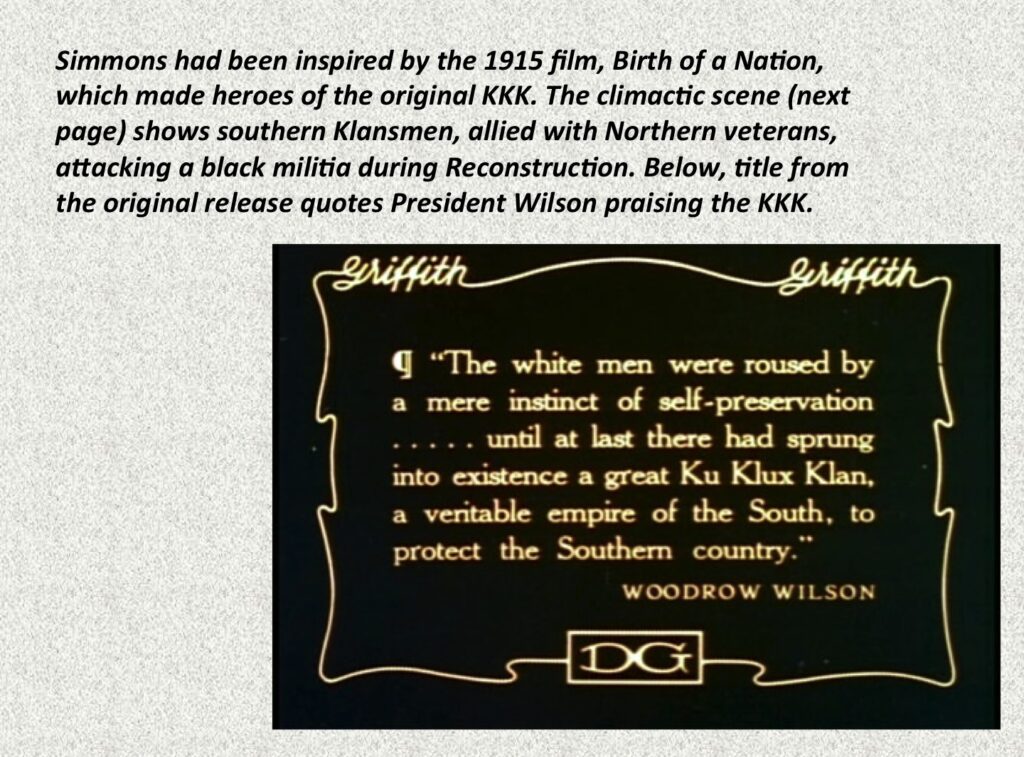
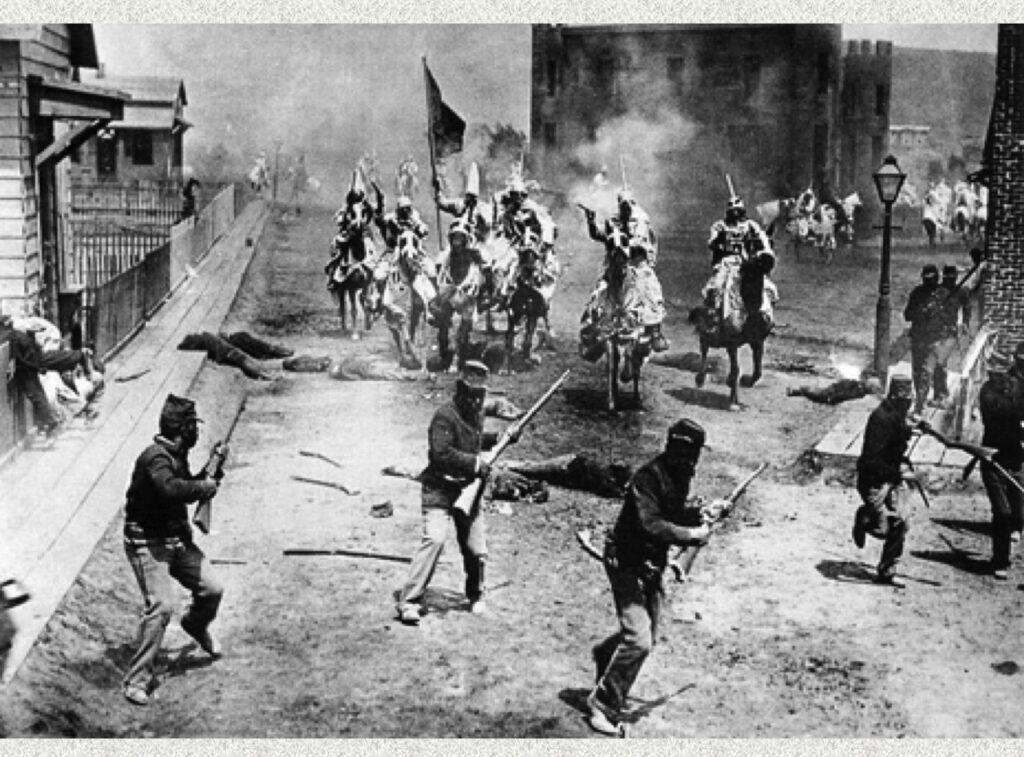
(46,47) The new KKK’s founding was inspired by the success of the first Hollywood blockbuster movie, Birth of a Nation. The film adapted a best-selling novel depicting the original KKK of the Reconstruction era as heroes who liberated the South from oppression by Northern Republican carpetbaggers and African-American freedpeople. The original novel was actually called The Clansman. The three-hour epic was released in 1915 and endorsed by President Wilson. As it happens, Wilson was an arch segregationist who ordered that African-American employees be fired from their federal government jobs. A caption of him praising the film was actually put into the movie and the trailers (above). Birth of a Nation was subjected to boycotts and protests, however, and Wilson withdrew his endorsement. The director, D.W. Griffith, later issued statements of regret.
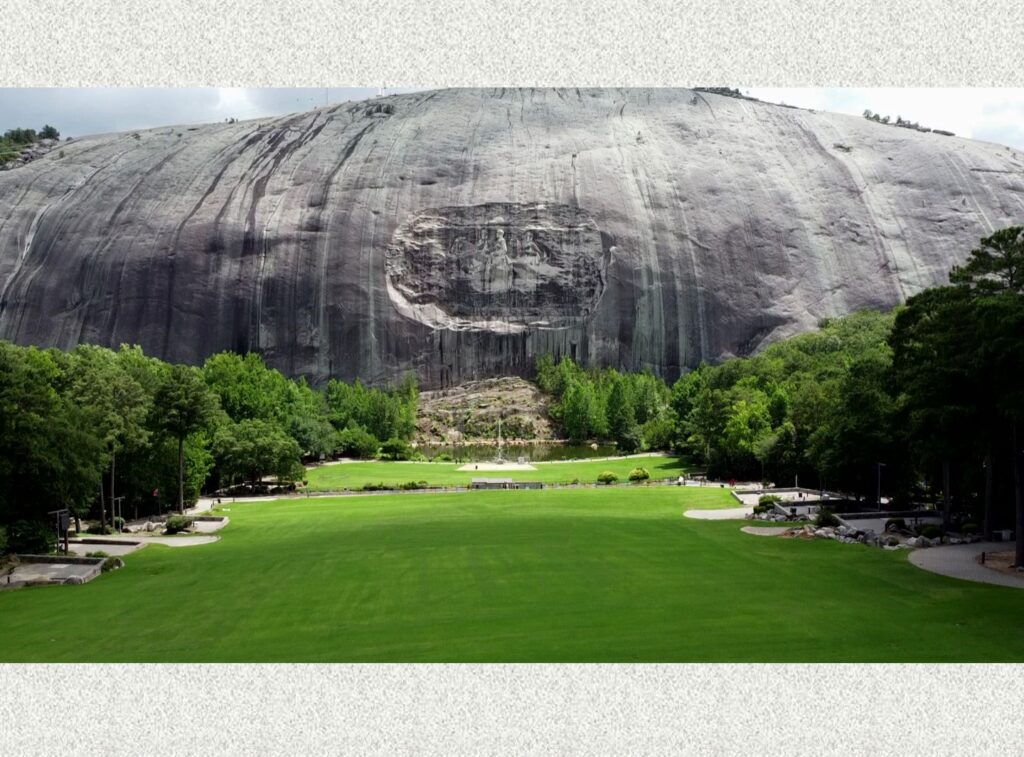
(48) The new or ‘second’ KKK supported the wave of monuments built during that era to commemorate the leaders of the Confederate rebellion. The second KKK’s popularity would peak in the 1920s. It declined due to its association with lynchings. It was also a pyramid-scheme, with a ‘multi-level membership finance plan’ in which members would receive a percentage of the fees of new members they recruited. It went bankrupt in 1928.
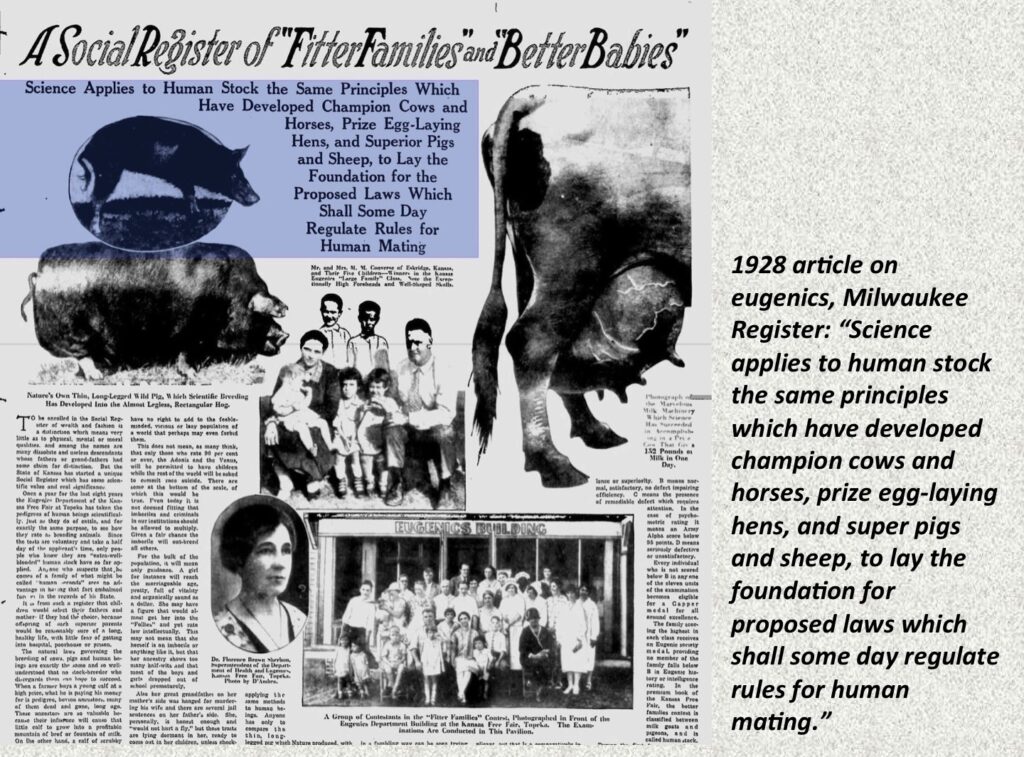
(49) Wilson had won the 1912 election on a platform of clean government, anti-corruption, and measures meant to help small business. The first university academic to become a president, and the first Democrat who was a native of the south to be elected president since the Civil War, he oversaw the purging of African American employees from almost all positions in federal service. Fifty years after Darwin’s publications, elite opinion largely adopted ‘scientific racism’ and the science of ‘eugenics’ or ‘racial hygiene’. These views were found across the political spectrum, including among many on the left, and throughout the country. Northern Europeans were considered the superior race, while all others, including southern and eastern Europeans, were inferior. Many ethnicities were categorized as separate races and various hierarchies of racial quality were proposed. Many states, North and South, encouraged the medical sterilization of people judged to be ‘unfit’, and had laws against ‘miscegenation’ (mixed-race coupling). ‘Race science’ generally stopped short of publicly advocating ideas like ‘euthanasia’.
Among white elites and middle-classes there were assuredly voices dissenting from the racist consensus. They were often isolated, but also to be found in every quarter.
*
Industrial Revolution, Henry Ford, Automotive Revolution

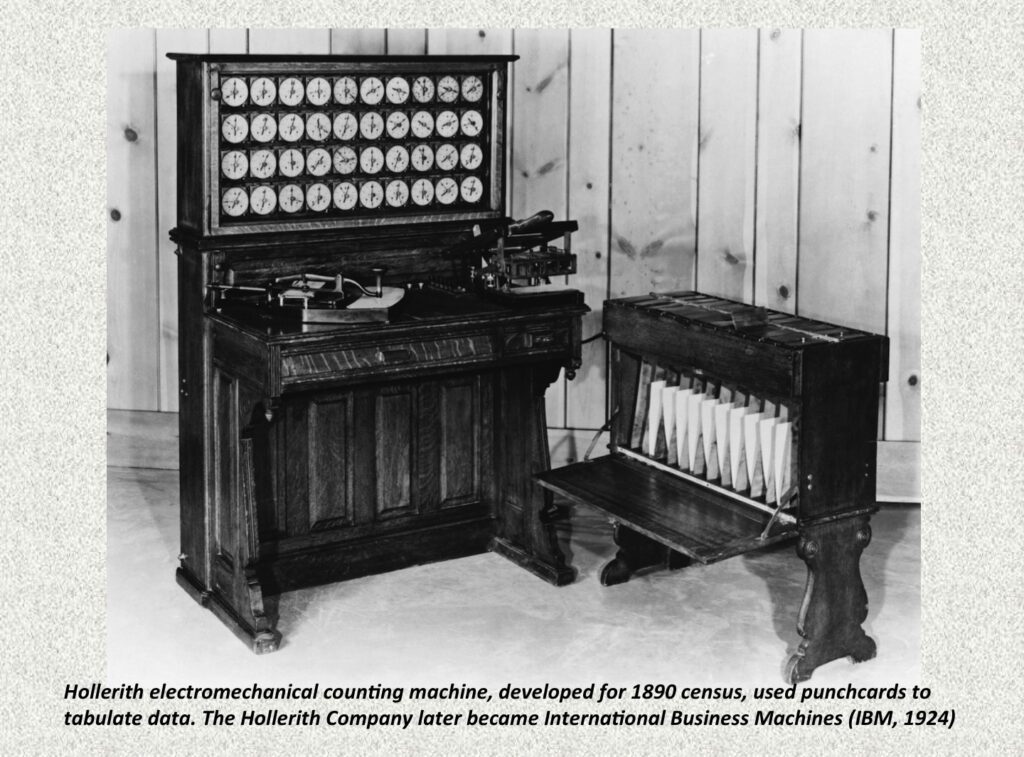
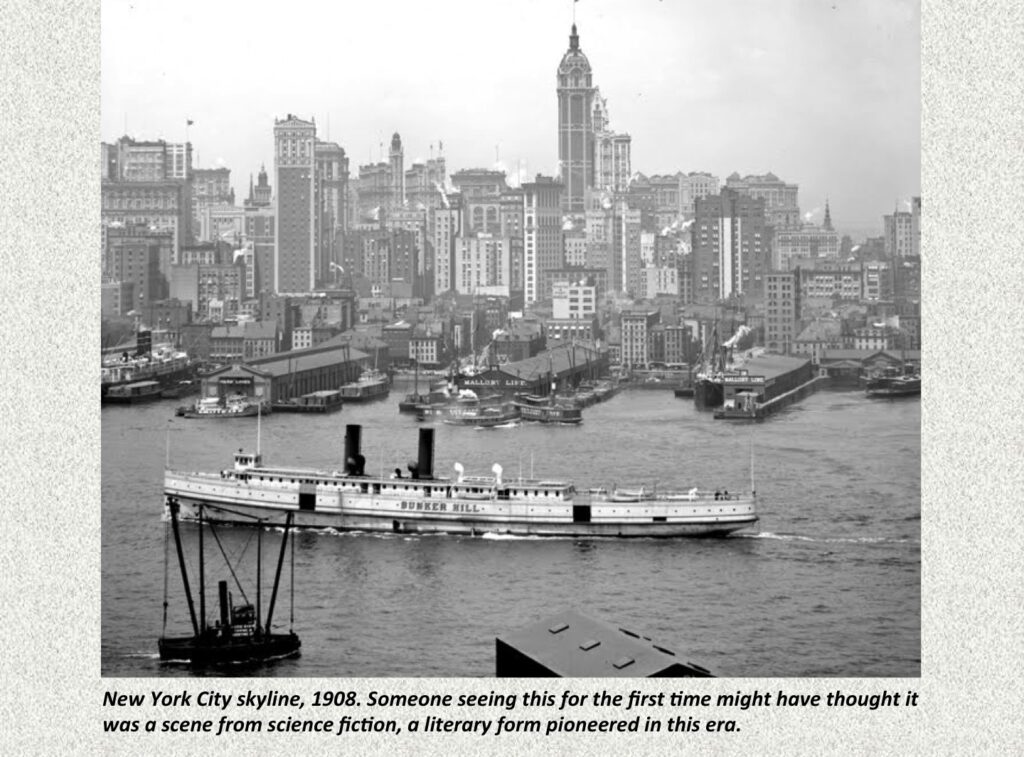
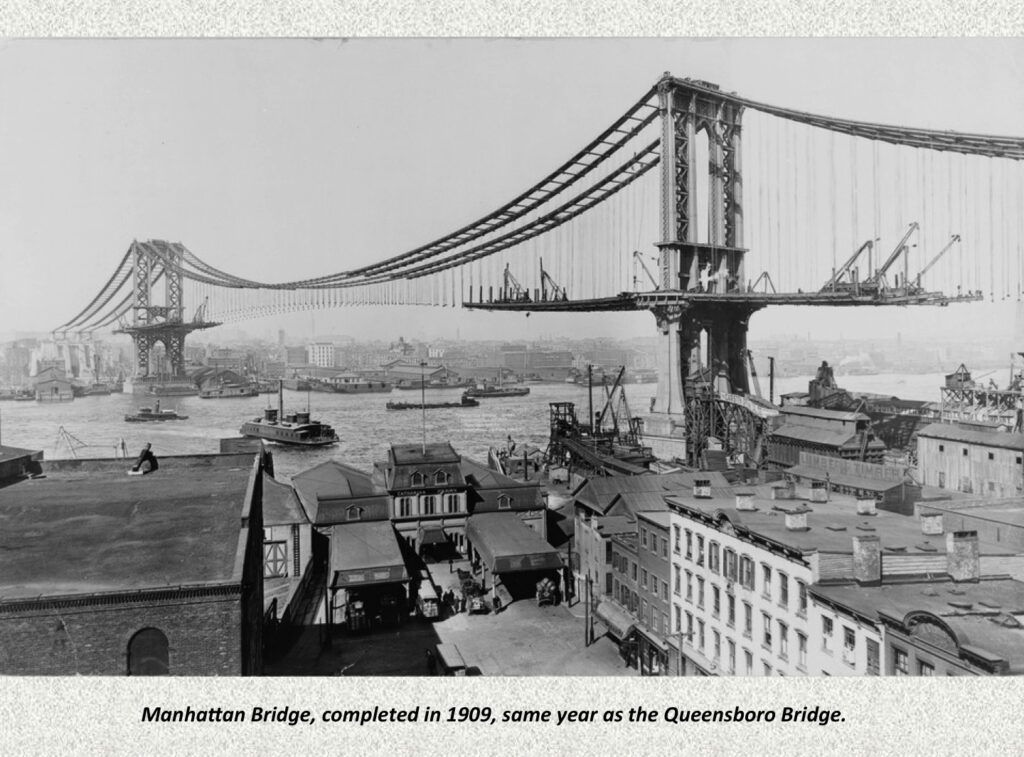
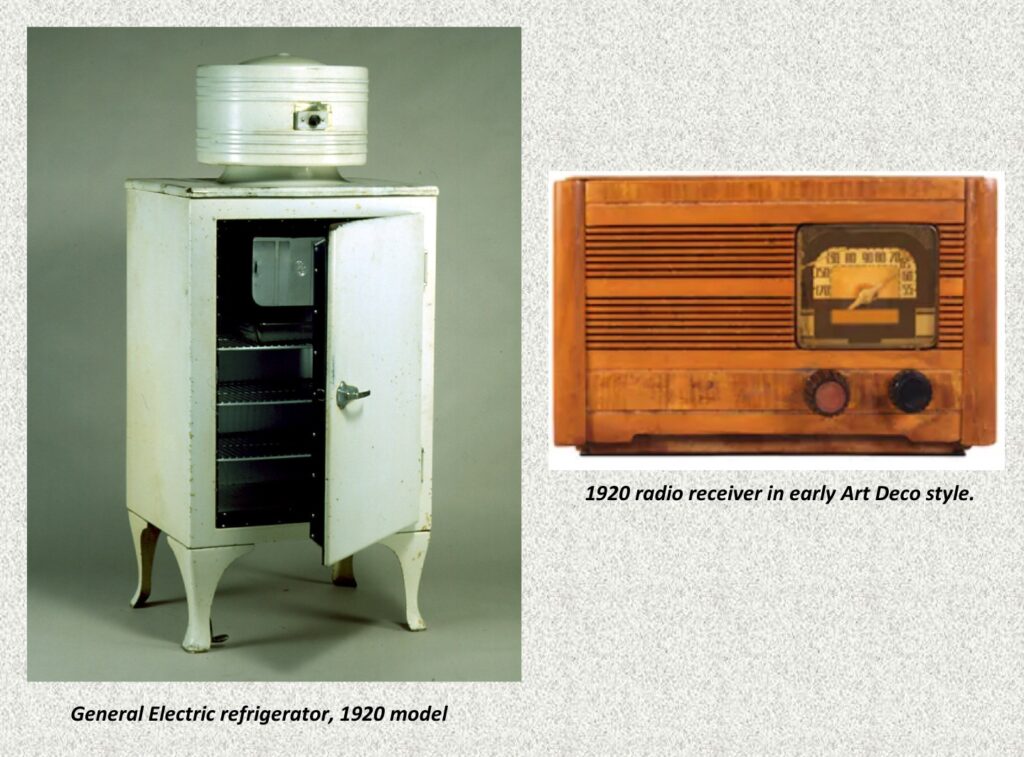
(Slides 50-54, above) The new technologies kept coming. In the early twentieth century, these included ever-more sophisticated counting machines, the advent of aviation (1903) and electric refrigeration (1913), vacuum tubes and the start of commercial broadcast radio, just in time to premiere with news of the 1920 presidential election results.
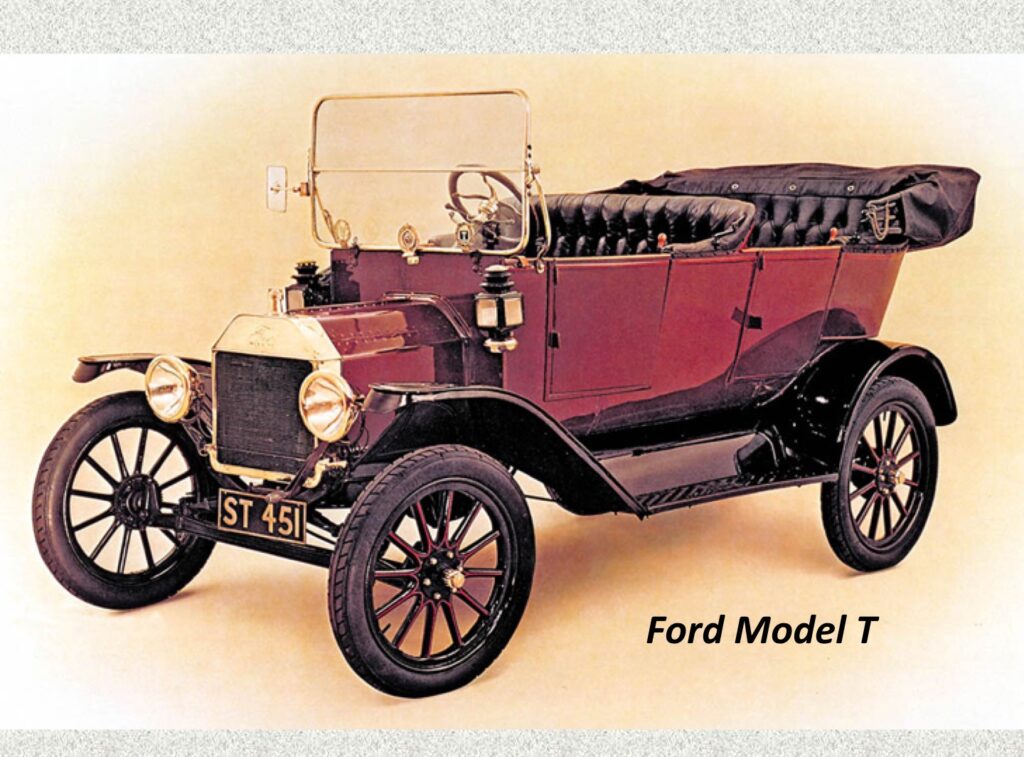
(55) The second industrial revolution morphed into a third: mass production on moving assembly lines using fully standardized, replaceable parts. These methods cut the labor time required to make an automobile by 90 percent. They are associated above all with the newest and for a time biggest captain of industry: Henry Ford. Many came to see Ford as the informal pope of the new age. International competitors studied and hoped to learn the secrets of ‘Fordism’. He was also associated with the elementary idea that paying higher wages to his workers would help create bigger markets for the products that workers produced (by the 1920s this was also achieved through the advent of easier consumer credit).
(56) The automotive revolution, initially set off by the Ford Motor Company’s introduction of serial assembly of the Model T in 1908, took off over the next twenty years. It would completely transform the material landscape of the country, at least as dramatically as had the railways. The number of automotive vehicles in the U.S. jumped from about 50,000 garage-made ‘horseless carriages’ by 1908 to about 28 million factory-produced cars and trucks in 1928, with massive road-building and street paving to accommodate the new traffic.
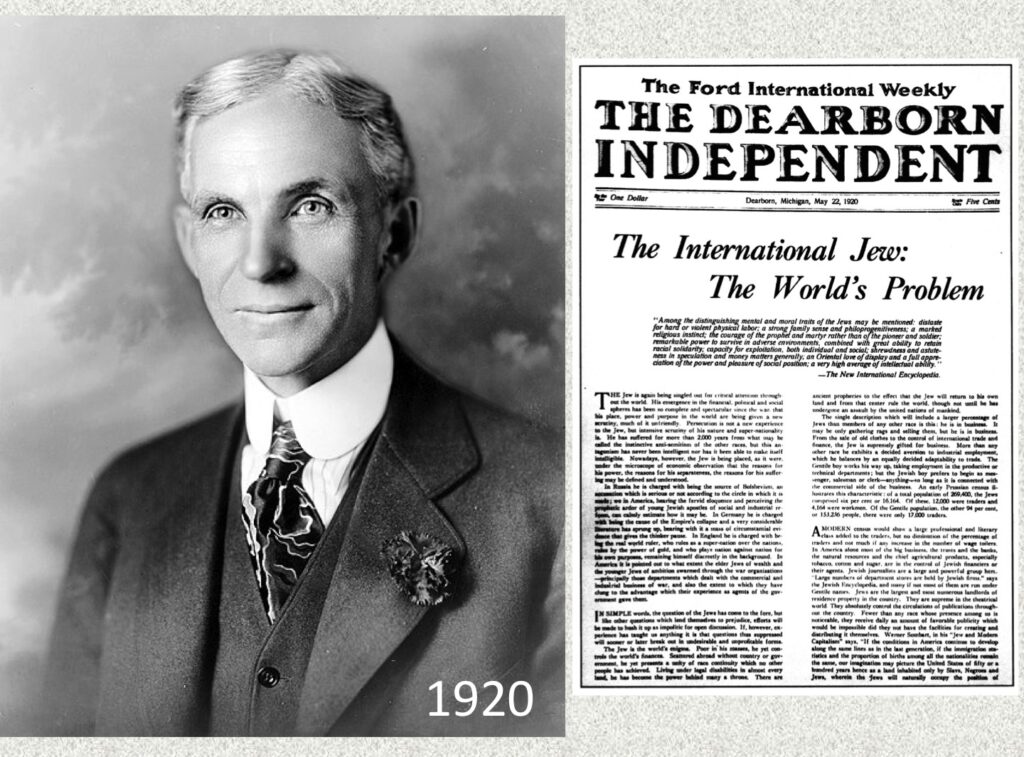
(57) Ford was further associated with a strict behavioral regime imposed on his workers and enforced by agents of his ‘Sociological Department’, who were sent to workers’ neighborhoods to monitor them during their off-hours. (Starting in 1920, Ford also wrote The International Jew, a series of anti-Semitic essays, published over the next seven years in his own newspaper, in which he claimed a vast global Jewish conspiracy aimed to destroy the ‘Nordic’ race. Ford’s essays blamed Jews for banking, communism, trade unionism, atheism, sexual freedoms, jazz, modern art, and ideas of racial equality. He funded translations of this work into dozens of languages and publications throughout the world in many editions. He claimed to renounce these views in 1927, following boycotts and protests. But in the next decade he would accept a high award from the National Socialist government of Germany, a special medal they had created for foreigners who had done great service to the Reich.
*
Corporate Reconstruction
(58) More than ever, the assembly line meant that human workers became part of the machine, their movements while working specified by engineering studies to maximize efficiency. This development was called ‘Taylorism’, after one of several industrial engineers who pioneered it using stop-motion film studies enabled by the new motion-picture technology. Corporations developed workplace organization, ‘sociological’ and ‘scientific’ control over workers, bureaucratic management with ever more layers of middle management, and ever-more sophisticated forms of public relations and mass-marketing techniques. By the 1920s Ford Motor would be surpassed by a new image of the faceless, horizontally-integrated corporation, General Motors. (Horizontal integration means gobbling up or beating out one’s competitors within an industry. Vertical integration means seeking control of every stage in production and value-creation, from the iron mine and the rubber plantation to the parts suppliers to the main factory to the dealership.) The increased regulations brought about by progressive reforms meanwhile had the perhaps unintended effect of tending to favor big corporations over smaller businesses. Small businesses could ill-afford to pay for whole office floors staffed with regulatory lawyers, compliance officers, and secretaries filling out forms, and equipped with mechanical computers. This is among the reasons that historian Martin Sklar ironically relabeled the Progressive Era as ‘The Corporate Reconstruction of America’.
*
Financial Reform
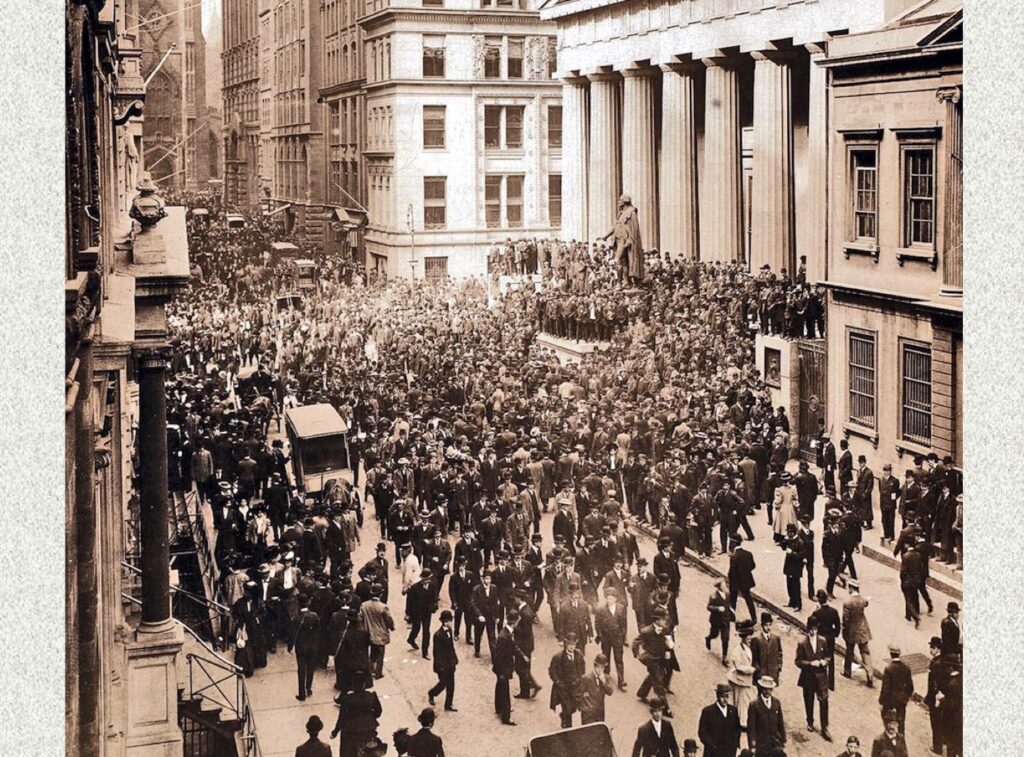
(59) The slide shows a crowd gathered at Wall Street in the wake of the 1907 financial crash. Like other economic sectors, banking also re-organized itself and made use of state intervention to do so. An internal near meltdown of the financial system took place in 1907. This set off a sharp but relatively short economic recession. As Wall Street’s informal supremo, J.P. Morgan found himself forced to organize a rescue package, using his own money, so that the bankruptcies of a couple of debt-underwriting institutions who had themselves over-borrowed would not cause the entire system to fail. (If one big bank fails and defaults on its debts to other banks, they may also fail, causing more banks to fall over like dominoes and leading to a general panic and crash.) The top bankers didn’t like carrying the risk for the system as a whole. They therefore supported the creation by Congress in 1913 of a public-private system of regional central banks, known as the Federal Reserve. (We may get more into this sometimes complicated matter in future sessions. For now, the short history is that the Federal Reserve system proved useless in preventing the 1929 crash and ineffective in the early years of the Great Depression, but then began to take on a more muscular role under the New Deal and, after the abandonment of the gold standard in 1971, became a central institution in the maintenance of a world financial order centered on the United States dollar as reserve currency.)
*
Great War, Boom Economy, Great Migration
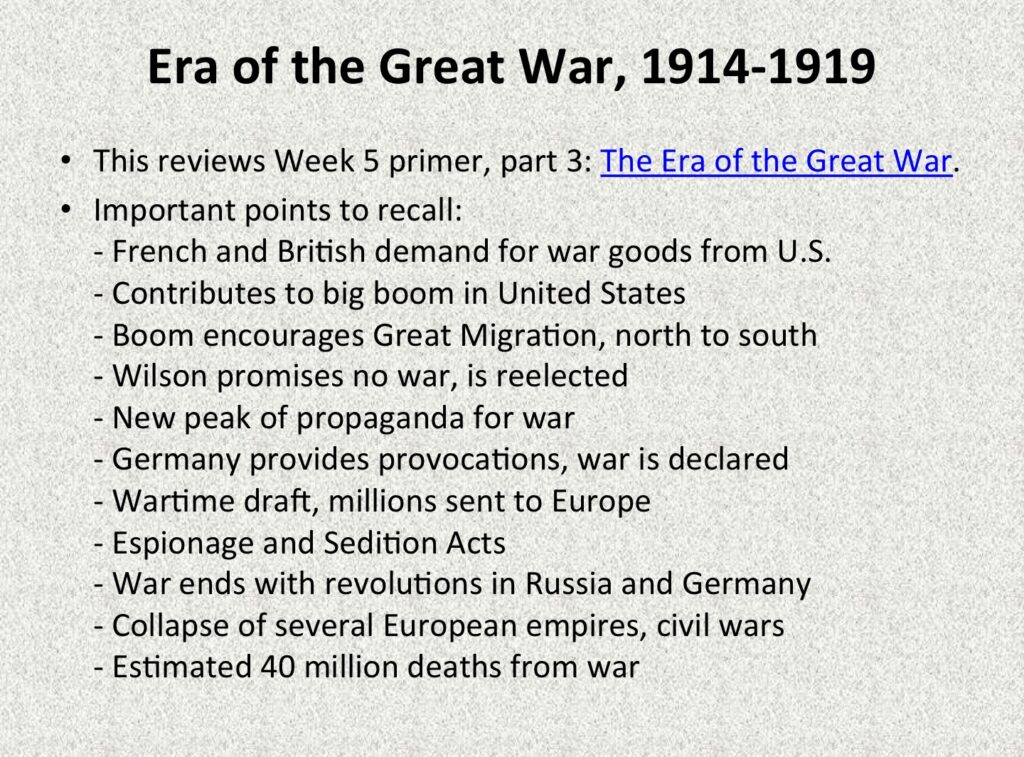
(60) World War I added significantly to an ongoing economic boom in the United States. America became the primary backstop of war production and finance for the Entente Powers (Britain, France, Russian Empire, Italy, and allies) against the Central Powers (German Reich, Austria-Hungary, Ottoman Empire). Despite their own large overseas empires, Britain and France were desperate for resources and labor (including soldiers) in the war. They borrowed billions of U.S. dollars from American banks and spent the money on paying for the products of American industry and agriculture. The Europeans went ever deeper into debt to the U.S. economy. The Americans made the profits on both ends of the transactions, finance and production. The boom encouraged the internal migration of about a million African Americans and a million white people from the South to the North and the West, in the hope of finding jobs and escaping the Jim Crow reality. This was the origin of far larger Black communities than had existed previously in Detroit, New York (Harlem), Milwaukee, Chicago and Gary, Indiana, and other cities from Newark to St. Louis to Los Angeles.
(Still 60) Wilson campaigned for reelection in 1916 on, among other things, the slogan that he had kept the United States out of the European war. His victory was followed by the unleashing of a massive federally-led propaganda campaign to gain support for war entry, representing a new peak of innovation in the emerging sciences of public relations, psychological persuasion, and message management as pioneered by the likes of Edward Bernays (author of a volume titled Propaganda, although the word got a bad reputation so he later started calling it “public relations”). Germany provided legitimate cause for war with an ill-advised escalation of submarine warfare against international merchant shipping on the Atlantic, and a clumsy attempt to encourage Mexico to invade the United States if the U.S. declared war on Germany, which was intercepted and publicized by the British. (Of course no Mexican government would contemplate anything of the sort!) Congress voted to declare war in April 1917.
(60, continued) The U.S. instituted its second wartime draft, the first since the Civil War, and passed an Espionage Act and ‘sedition acts’ designed to lock up those who spoke out against it. Long-time Socialist presidential candidate Eugene Debs was imprisoned for several years for an antiwar speech delivered in Canton, Ohio. To help fund the war, the government raised income taxes on the richest percentile to nearly 90 percent. Millions of soldiers were sent abroad.
Nearly 120,000 American soldiers died during the country’s brief but decisive involvement in the European war. About half of them succumbed to the novel viral influenza outbreak that, according to our best historical findings on the matter, American soldiers inadvertantly brought to Europe from a military base in Kansas. (The influenza, news of which was at first censored in belligerent countries, caused the deaths of an estimated 675,000 people in the U.S. in 1918-19, and many more millions around the world.) The war ended with the Bolshevik communist revolution in Russia in 1917, mutiny and partial revolution in Germany in 1918, and the rapid and total collapse of several large territorial empires. Years of civil wars and wars between new nations and would-be nations followed throughout the former territories of Austria-Hungary, the Russian czardom, and the Ottoman sultanate. In the war’s wake, both the Russian Bolshevik call for a world communist revolution and the US government’s proposals for a new international order were frustrated. The United States contributed 10,000 soldiers to the Western coalition supporting the counter-revolutionary forces against the Bolsheviks in Russia, although these were withdrawn after a few months. Wilson’s brainchild, the League of Nations, meant to to avoid a recurrence of world war by conducting a joint management of imperialist holdings and new nations, came into being. But the Senate rejected U.S. membership.
*
The Postwar Crisis
(Slide 61 – title only) At home, the war’s end brought a severe economic downturn and the climax of several ongoing social and political crises. The American war losses were a small fraction of the world war’s overall casualties, but as inexperienced soldiers in the trench hells of France, the Americans suffered high casualty rates in a short period of combat. Many who survived came back horribly wounded, poisoned by gas, or traumatized with what was called ‘shell shock’. This caused many if not most Americans to sour on the adventure of war, generally. A later popular movement that attracted many of the earlier progressive activists eventually called for the abolition of war. (The abolition of war actually happened, by international treaty, in 1928. More on that later.)
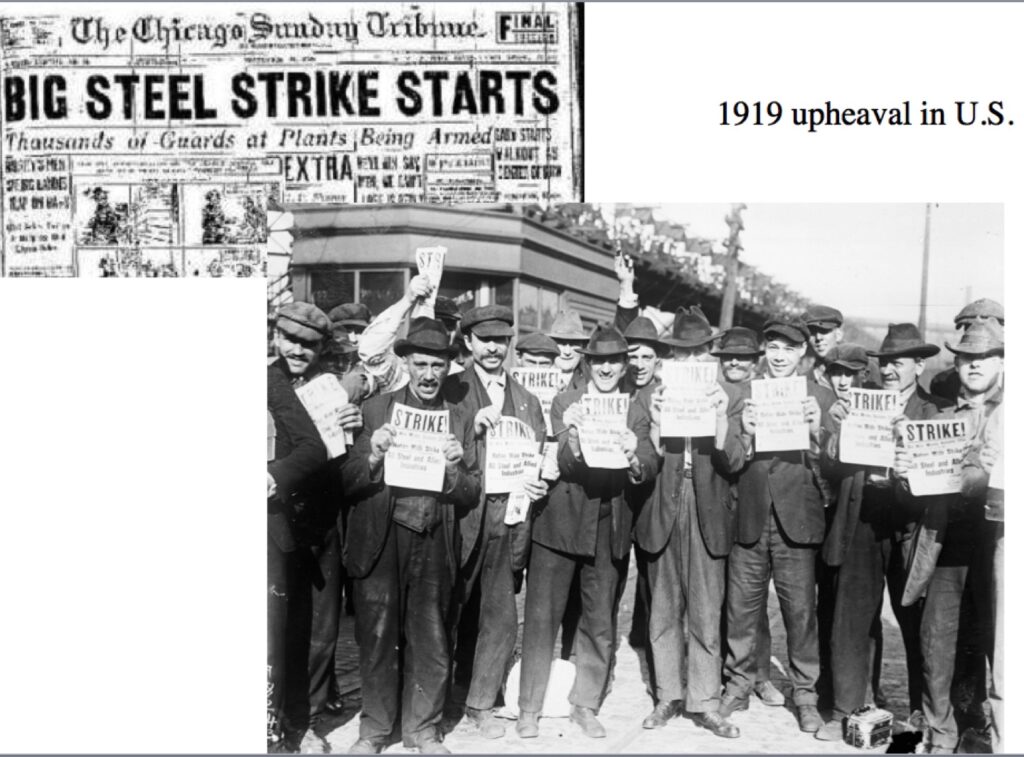
(62) 1919 saw the start of a dramatic set of national upheavals. The nation was swept by a militant strike wave by workers demanding higher wages to make up for their acceptance of lower wages during the war. General strikes broke out in Seattle and other cities, and a long-running mine war in West Virginia reached its climax. All of these actions were violently suppressed.
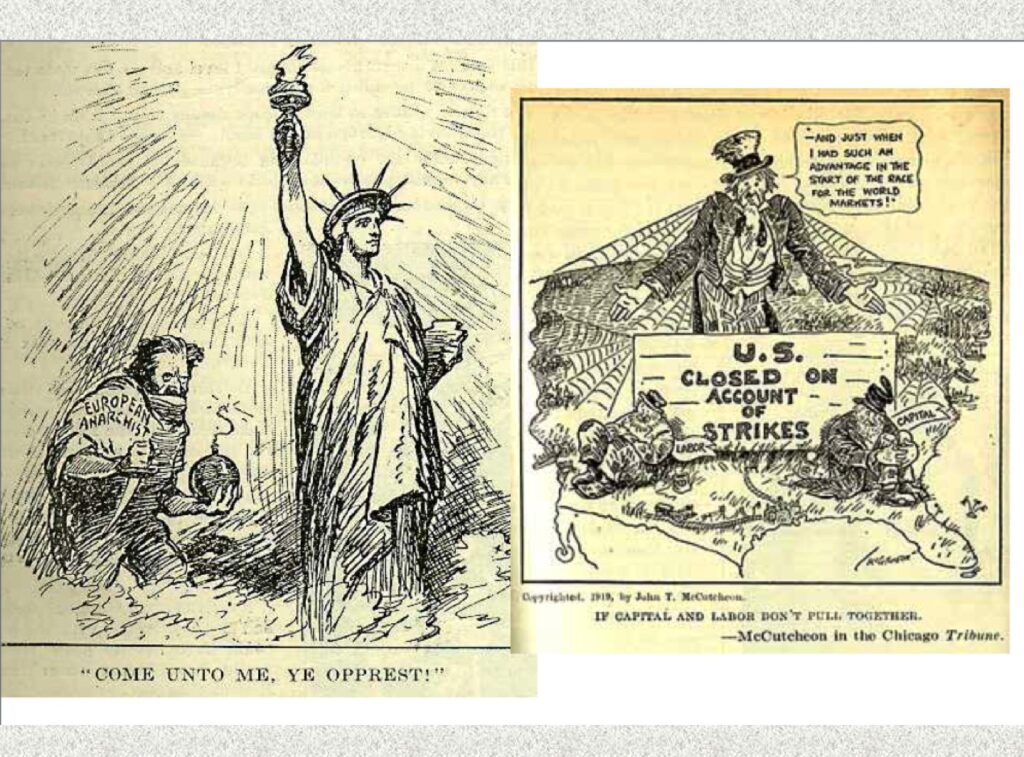
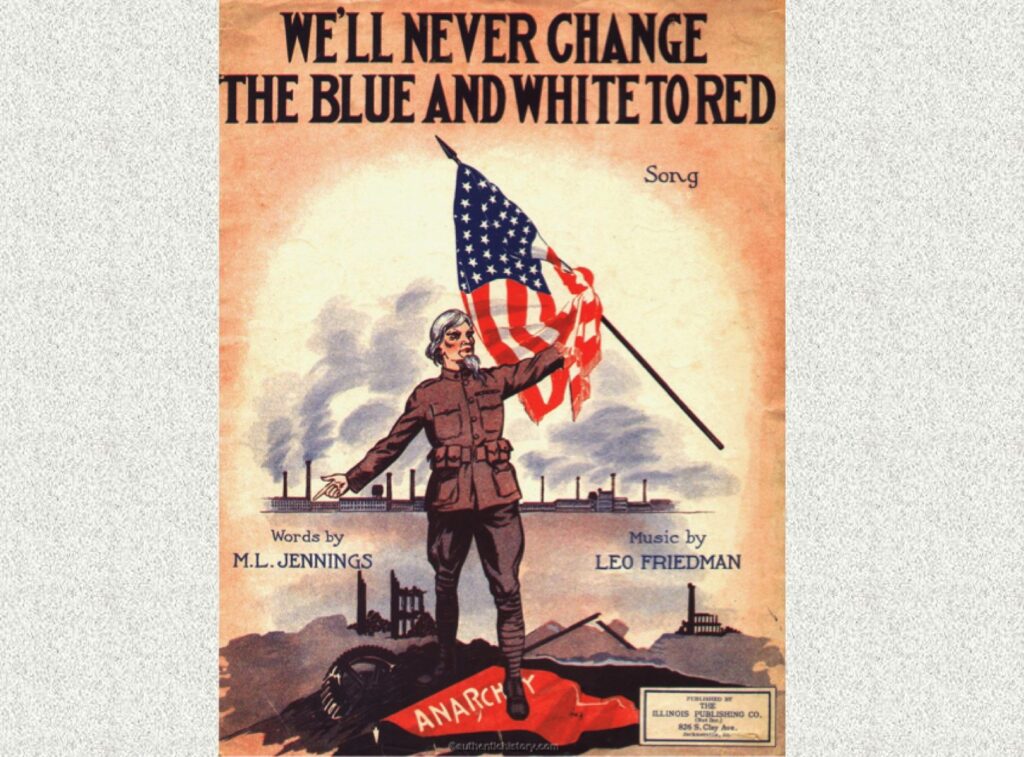
(63,64) Newspapers ran cartoons about America being closed for business, or anarchists wanting to bomb Lady Liberty. Was Bolshevism coming to America? Hardly.
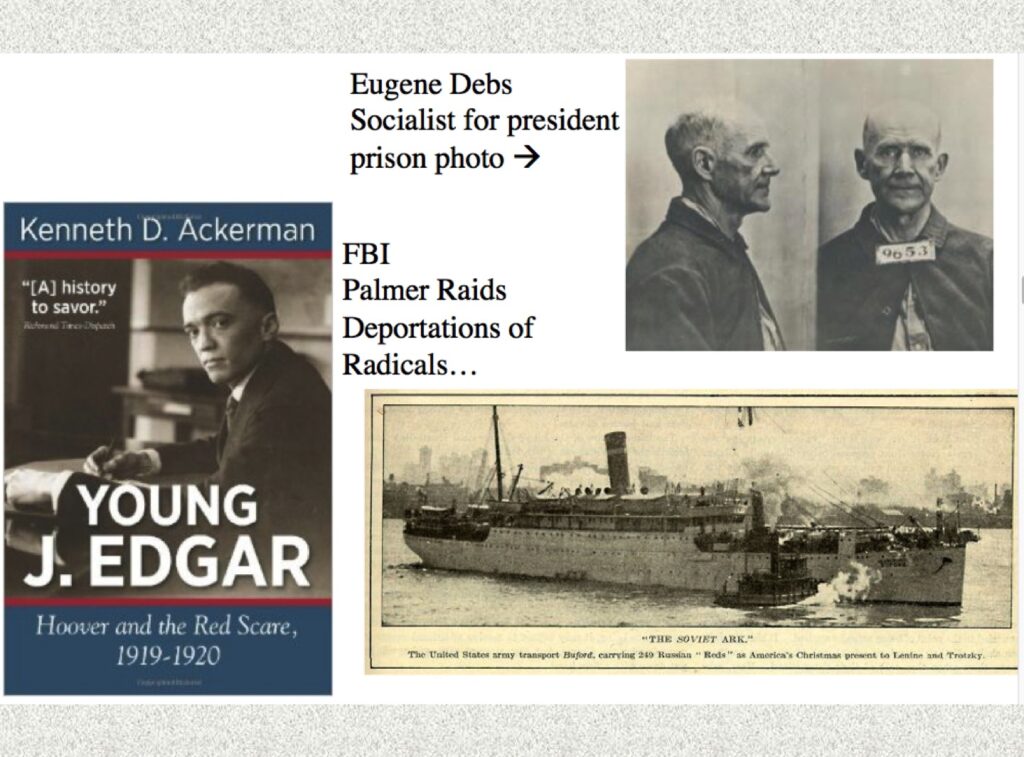
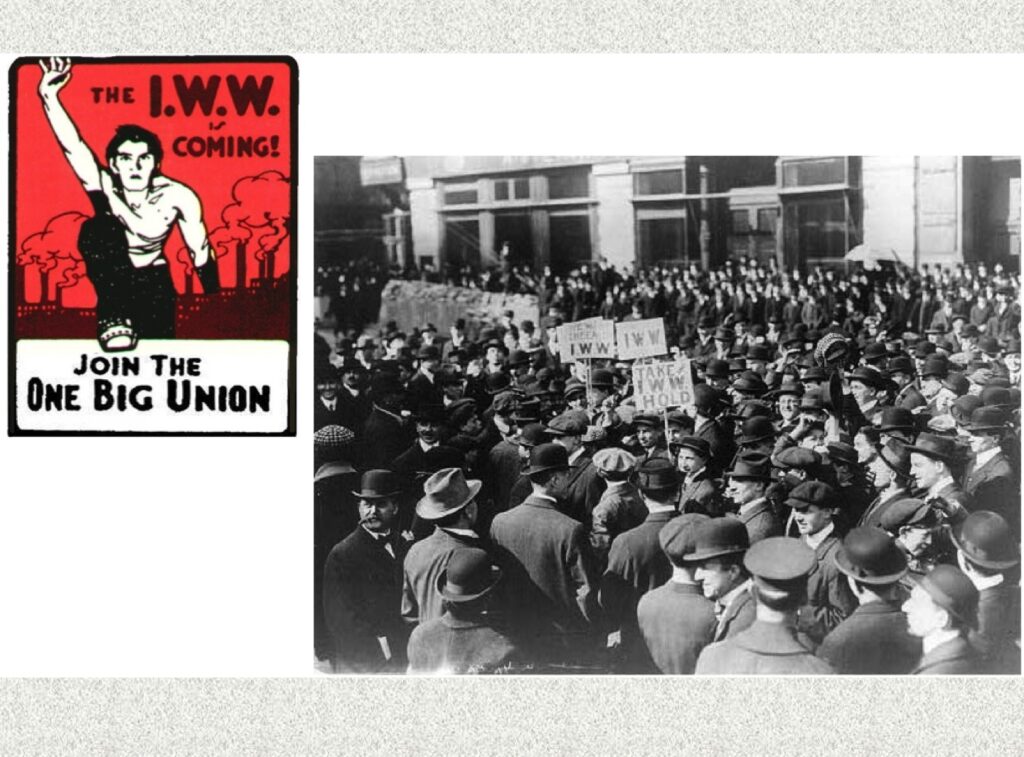
(65,66) But a nationwide, federally-led ‘Red Scare’, endorsed with enthusiasm by most of the news media and put in the hands of J.Edgar Hoover as the top cop, waged a broad attack on labor organizers and leftist movements, with thousands of arbitrary arrests and imprisonments. Hundreds of already naturalized U.S. citizens who were considered to be anarchists or communists were summarily put on ships and deported to the Soviet Union. The ‘one big union’ of the Industrial Workers of the World (IWW) was shattered. The Socialist Party later broke up into pro-and anti-Bolshevik factions.
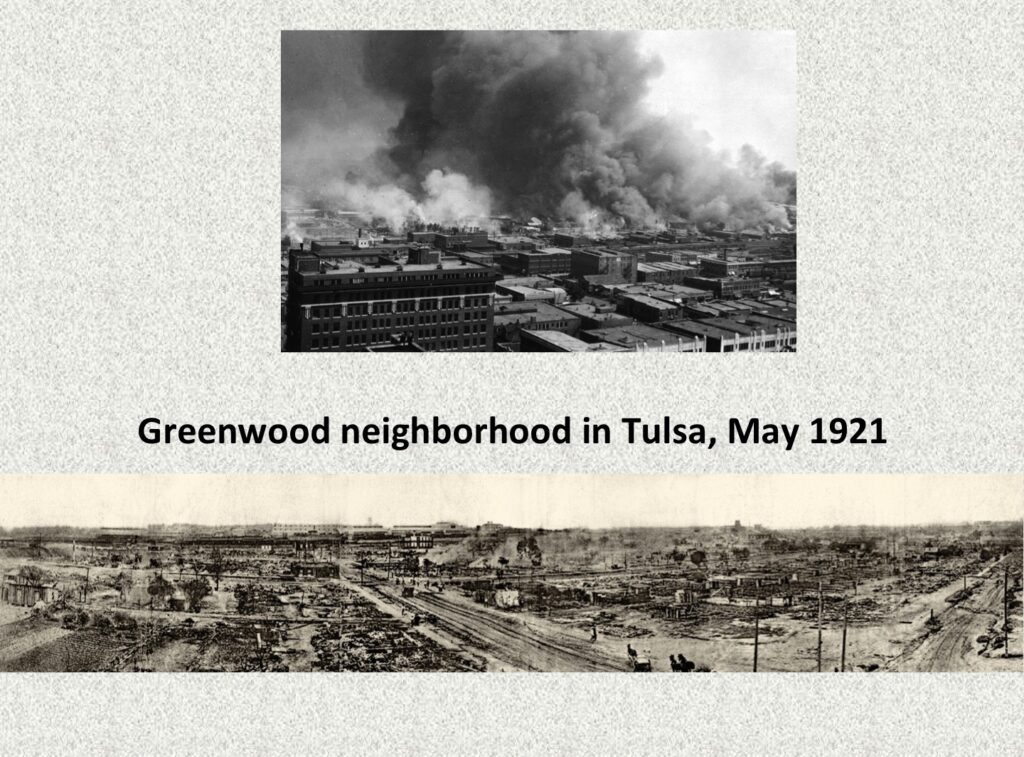
(67) Worst of all were the many lynchings and outbreaks of mass racist violence against African Americans starting in the ‘Red Summer’ of 1919. Black pepole were often seen as allies to communism, usually without basis. But for many whites, there was no need of a pretext to target them. Black veterans were murdered for wearing their military uniforms with pride on the street. This extended to attacks on communities as wholes, including an outright pogrom in May 1921, when members of the white majority of Tulsa, Oklahoma burned down a prosperous Black neighborhood (Greenwood, called the ‘Black Wall Street’) and killed and buried an unknown number of people, estimated in the hundreds.
*
‘Normalcy’
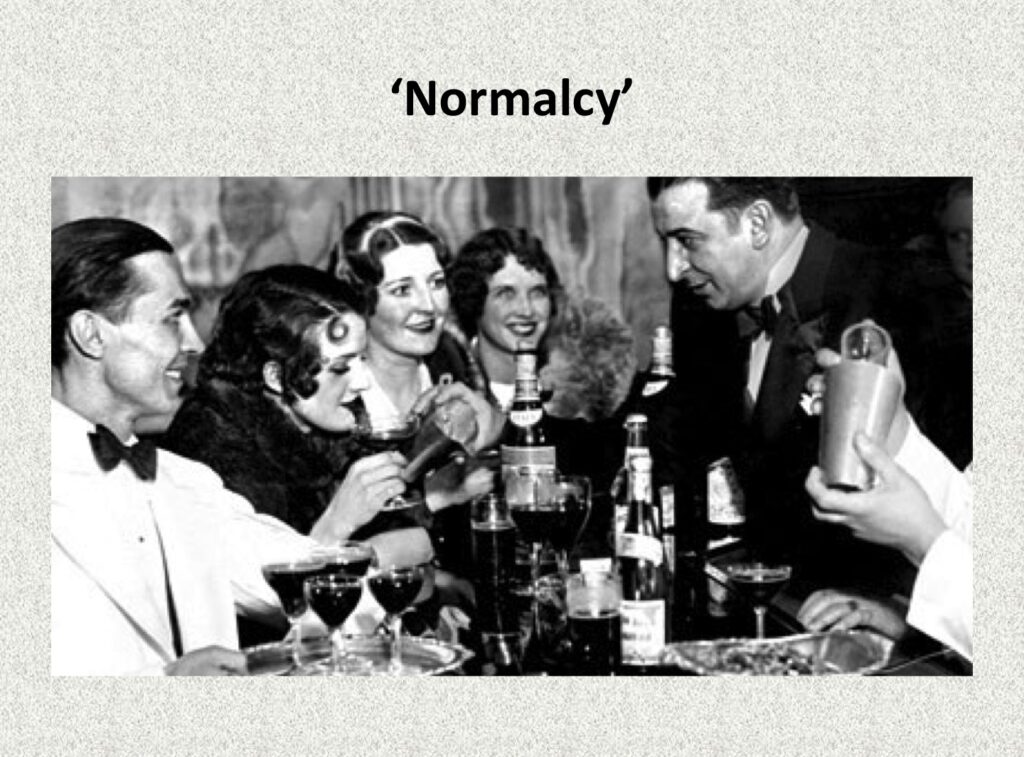
(68) The upheavals subsided, the economy turned back up, and a kind of stability was restored. Within the next couple of years, the rollbacks of civil liberties during the war and the ‘Red Scare’ were rejected as excessive by courts, legislatures, and public opinion. The American Civil Liberties Union (ACLU), founded by liberal, leftist and progressive lawyers during the years of persecution, came to the forefront of the fight to protect constitutional rights. Use of the Espionage Act as a means to suppress speech was put into mothballs until the 1970s, and it has had a big revival in the 2010s.
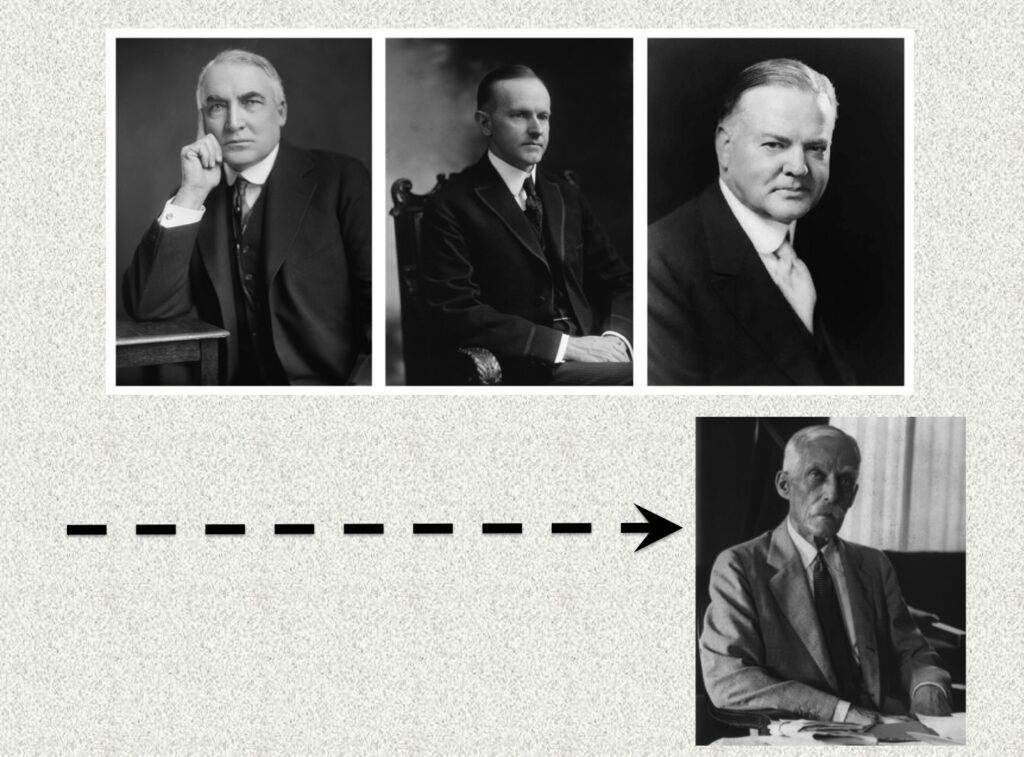
(69) The war and the aftermath had soured most Americans on liberal internationalism and the image of progressivism represented by Wilson. A majoirty of women and men now voted for the Republicans. Wilson was succeeded after the 1920 election by a series of three Republican presidents who promised ‘normalcy’ and prosperity. Over the next twelve years the presidency rotated from Harding to Coolidge to Herbert Hoover (pictured in top row), but the secretary of the treasury was always Andrew Mellon (second row), a Pittsburgh banker who had built the aluminium cartel, Alcoa. Mellon led the way in formulating a consistent Republican policy of lower taxes for the rich, less strict enforcement of business regulation, no spending above tax revenues, and belief in laisez-faire market economics.
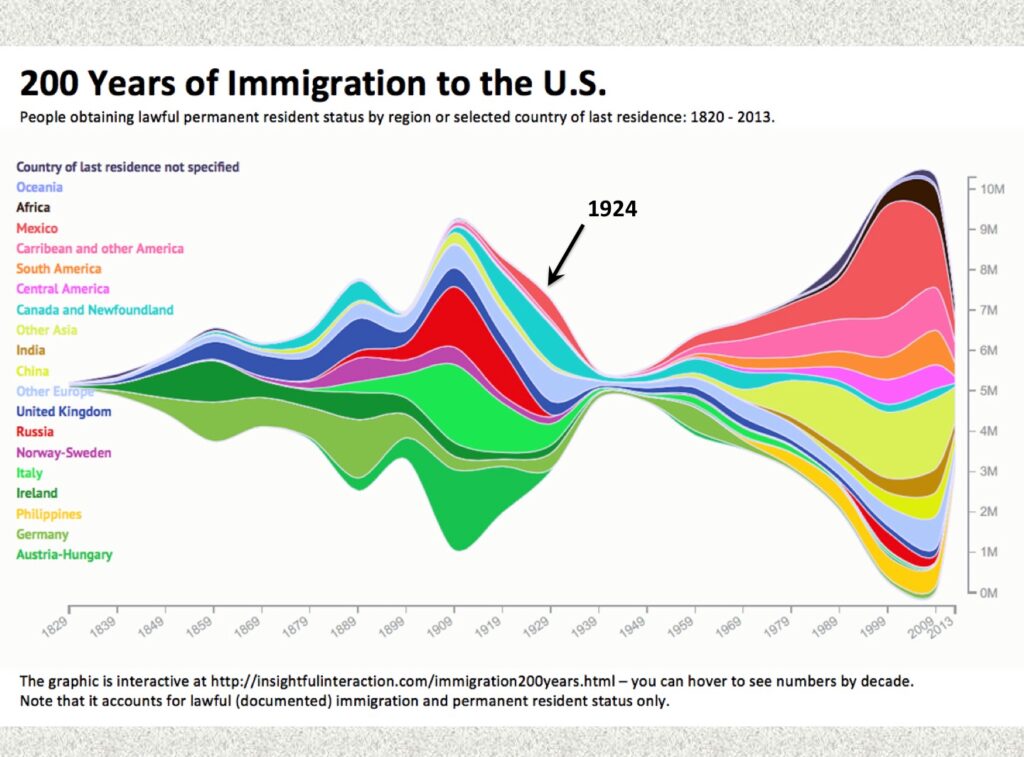
(70) Nativists and scientific racists won their victory against immigration, as Congress acted starting in 1924 to impose strict entry quotas on all of the peoples considered to be culturally suspect or genetically inferior to Northern Europeans. The Ellis Island age of mass immigration came to an end. A system of visas issued by American consulates abroad replaced the former open entry policy. (In the above graphic, see the bottleneck following the year 1924 to get an idea of the effects of the anti-immigration law as measured in statistics.)
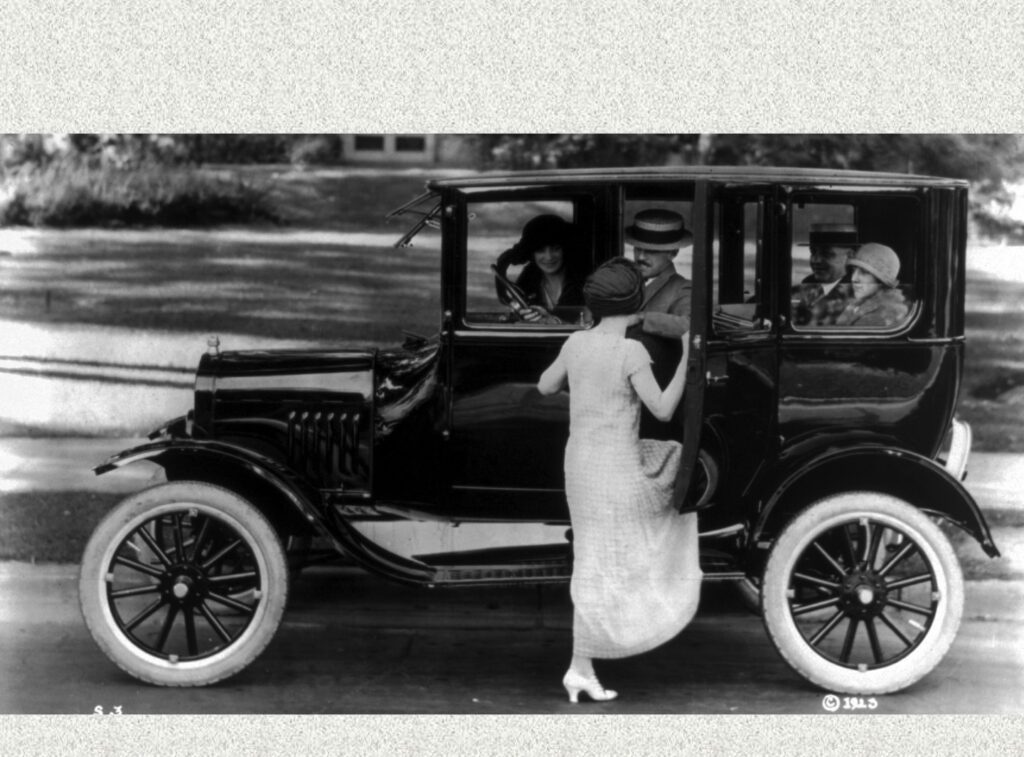
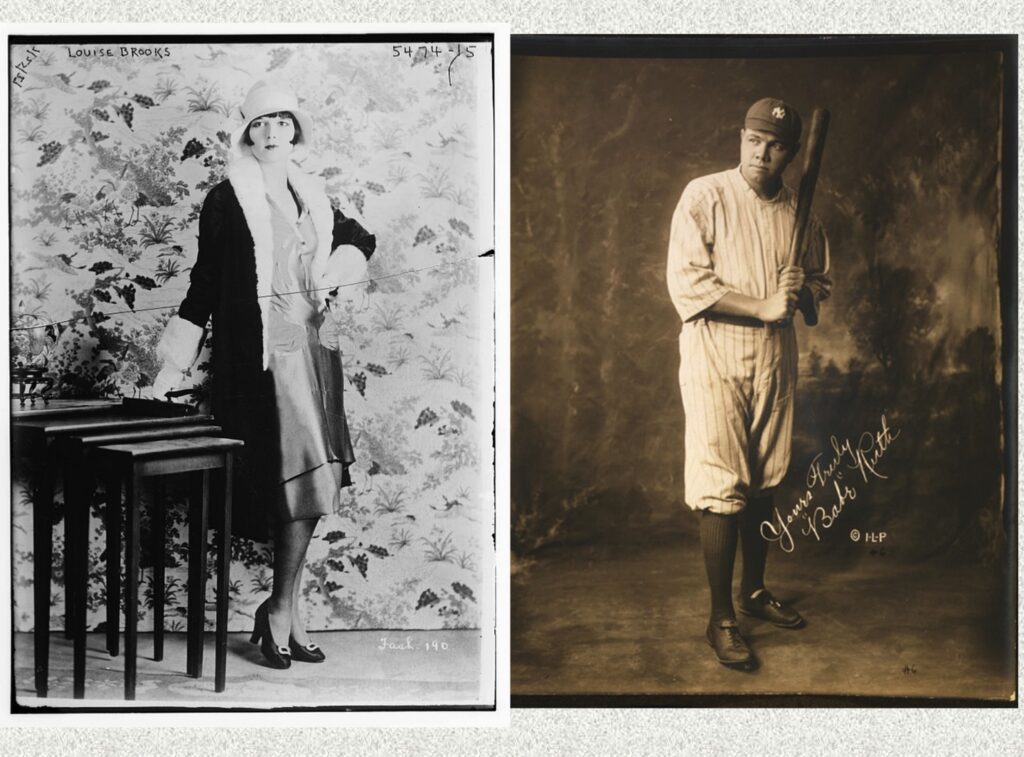
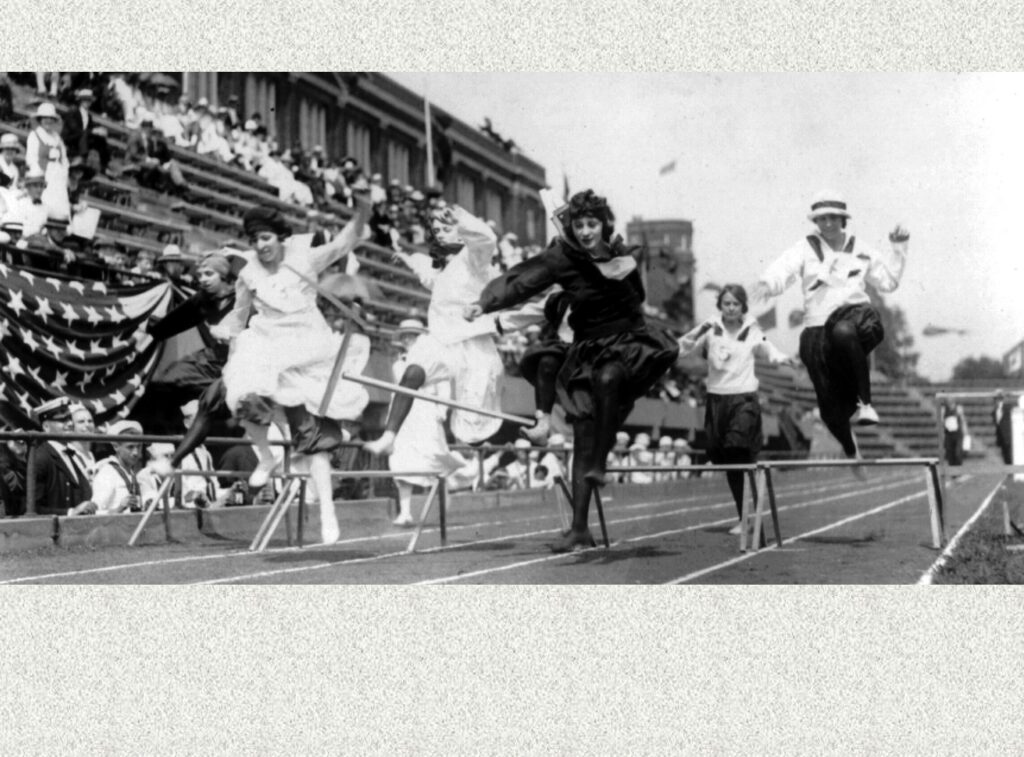
(71-73) The 1920s saw a widespread feeling that the nation was turning-inwards, away from foreign entanglements. Workers were thought to have turned away from labor struggles for higher wages to vesting their hopes in easier consumer credit for cars, refrigerators, and a wave of home building in new suburban towns (creation of suburbs was significant but modest compared to the 1950-60s).
By the middle of the decade, with some rise in wages and increased credit including mortgages for households, a new consumer boom was underway. There arose a general sense that a ‘new era’ of consumerism and prosperity had begun. Home ownership and life in the suburbs became ideals, although the reality was on a much smaller scale than it would be in the decades after 1945. More women worked. They could vote. Fashions changed. The movies were everywhere and millions of households got their first radio sets and refrigerators. Wages crept up. Millions of cars were sold, traffic became a thing. The New York subway grew. Advertising went up everywhere. The Jazz Era and the Roaring Twenties were declared. It was a new era, in many ways, although it would prove to be short-lived.