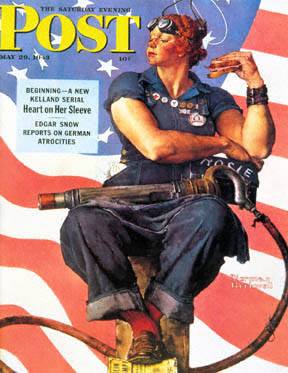
From Homefront to American Dream, 1941-1957
CLASSES: Tue 3 Nov & Thu 5 Nov
Slideshow
[pdf] – [ppt]
Options
Following optional items are in roughly chronological order:
1. View FILM: The Life and Times of Rosie the Riveter by Connie Field (1980), see below. This is the most important item for this week.
2. Alexander Han, “The Impact of the Great Depression on Different Racial Communities,” Student Paper, 2018.
3. Go through the Extras, below.
4. Donald Fagen, I.G.Y. (International Geophysical Year): listen to the song, read the lyrics, and read the accompanying short texts, including the item on ‘The Baby Boom’.
5. TEXTBOOK: Yawp chs. 23 on WWII and 24 on ‘Affluent Society’.
GROUP A: Life and Times of Rosie the Riveter
Optional
6. Plutocracy V, second part (48 minutes).
Plutocracy V
From 59:45 (at the title, ‘Part II’) to 1:47:45 (end of Part II)
EXTRAS
The Andrews Sisters Go to War
The Andrews Sisters sing Boogie Woogie Bugle Boy in Buck Privates, their first major film appearance. The 1941 movie starred the comedy duo of Bud Abbott and Lou Costello, who made close to 40 films together in 1941-1956. Buck Privates was their second movie and one of three Abbott and Costello movies released that year, all of them produced in partnership with the U.S. military as recruitment propaganda. All three hit the theaters well before the Japanese attack on Pearl Harbor in December 1941. While the Draft Act had passed, requiring men of military age to enlist, the government had not yet begun conscripting them. The plot of Buck Privates has the duo joining the Army more or less accidentally, when they run into a recruitment centerto get away from dangerous loan sharks to whom they owe money. At first they aren’t happy to be in the infantry but soon discover that it is actually a fun and rocking scene where you might see a trio of singing sisters from Minnesota in uniform spontaneously break into a fabulous number.
The Andrews Sisters were the daughters of immigrants, a Norwegian mother and a Greek father (who changed his last name from Andreas). Both of their parents were musical, but the girls learned to do their close-harmony thing in a Greek Orthodox church chorus. The style also exists in Finnish folk music. After the United States entered the war, the Andrews Sisters toured U.S. military bases around the world and held domestic concerts to sell war bonds. They were the biggest musical act in America and a fixture of the U.S. soldiers’ soundtrack at bases around the world. My partner’s father grew up in Algeria. He remembered how, as a boy in the 1940s, long before he learned to speak English, he heard these songs played by American soldiers stationed in Algeria. It was his first introduction to the culture of the country in which he would one day drive a cab.
In this number, Don’t Sit Under the Apple Tree (with Anyone Else but Me), the sisters remind American couples separated by the draft that they should remain loyal to each other until victory is achieved. (The part where the couples get back together and start having postwar babies is left to the imagination.)
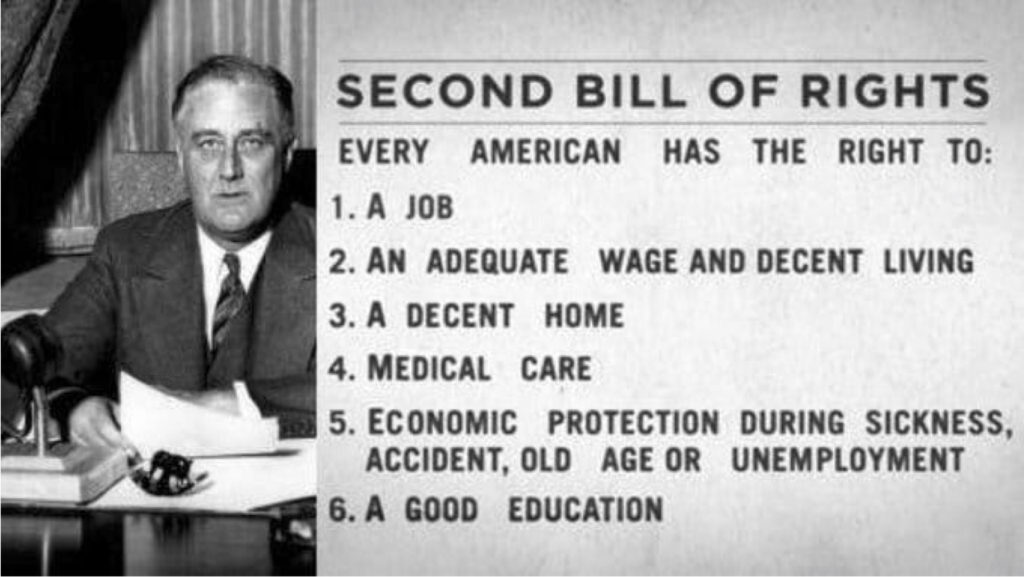
‘The Second Bill of Rights’ – FDR 1944 Election Platform
As Franklin Roosevelt ran for a fourth term in 1944, victory in the war was anticipated and U.S. voters were increasingly concerned about life afterward. The election platform promised the expansion of the New Deal into a rights-based social-democratic welfare state, including a proposal for universal health care that Roosevelt’s successor, Harry Truman, would fail to get through Congress. What had passed during the war was the G.I. Bill, which funded college education and guaranteed good house mortgage conditions for returning veterans.
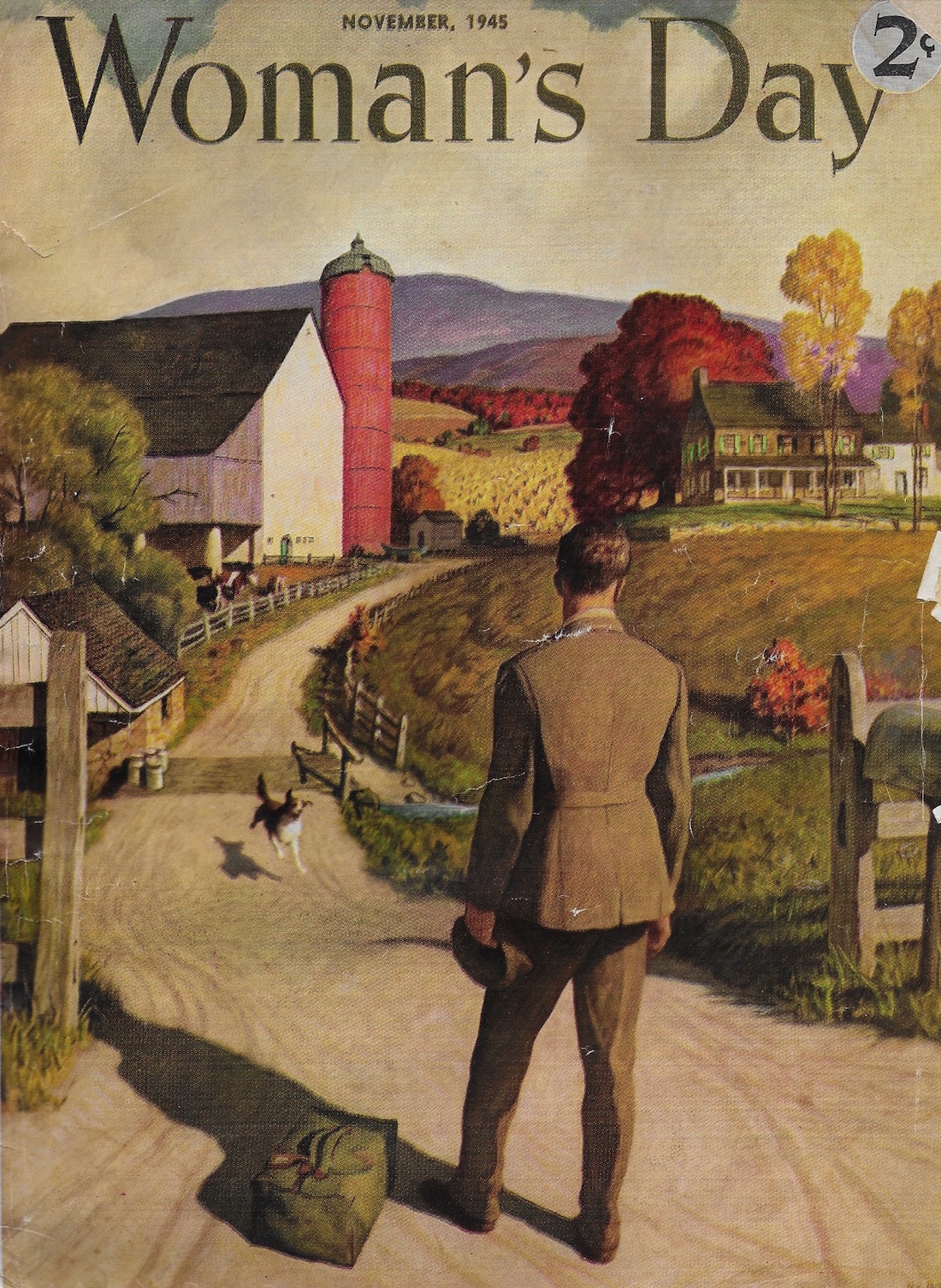
Woman’s Day magazine, November 1945
Woman’s Day was read by millions of women and featured sometimes more than a hundred pages of self-help advice, recipes, and household tips alongside related feature stories and advertisements for clothing, foods and kitchen tools, all in closely-printed black-and-white four-column pages. The issue in my possession is so thick that it is bound, not stapled. I find the cover very moving: the men are coming home from the war. Who is the first to recognize the returning soldier?
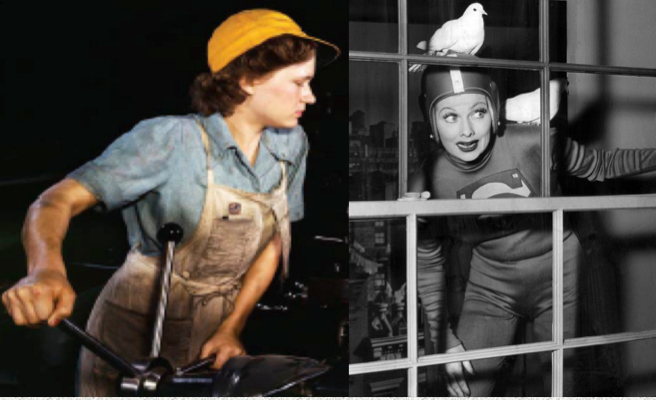
Collage of Industrial Worker & Lucille Ball in I Love Lucy
The Baby Boom
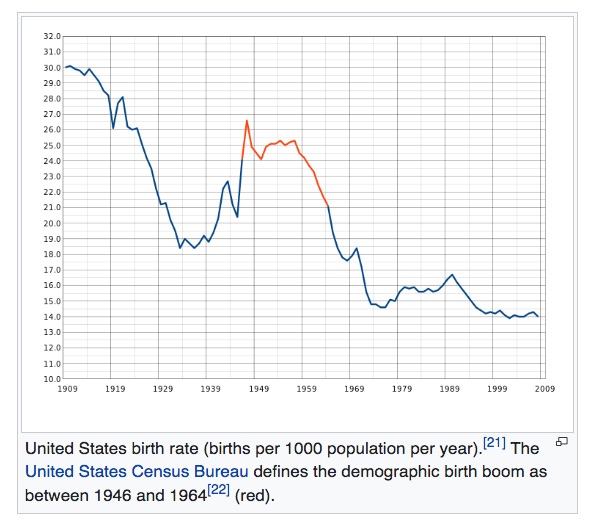
In 1909, as the above graphic indicates, birth rates in the United States remained at the high levels of the 19th century, with 30 or more births per thousand people annually. Birth rates began to decline through the 1910s and 1920s. This is attributable to the changing roles and status of women, greater access to education generally, urbanization, and other social changes. The downward trend was only briefly interrupted by the baby boomlet of 1920-21, after the return of World War I veterans. Birth rates continued to plunge throughout the 1920s and reached a far lower plateau in the 1930s, throughout the years of the Great Depression.
Birth rates began to rise with improved economic times, already during World War II. They shot up dramatically starting in 1946, as an estimated 18 million American soldiers began returning from the war. The U.S. Census Bureau defines the ‘Baby Boom’ period as running from 1946 to 1964, which is marked in red on the chart.
The postwar peak-birth year was quickly reached, in 1948. Note that this was still well below the historic 19th century levels. The later cliche about the postwar American middle-class suburban nuclear family (by no means applicable to all households) is that it has a single-family home with a garage, two cars, a TV and 2.5 children. Historically speaking, that is a low number of children. But given the country’s far higher population, the relative baby boom meant that the early postwar period saw the childhood of the largest single generation in U.S. history until then.
Unlike most earlier generations, these children were seen from the start as a distinct group, because they were growing up in what was generally thought to be a new world, with an American lifestyle that was unprecedented and prosperous, despite the many exceptions we could name. It is worth noting the correlation that 1948 was also the year when regular commercial television broadcasts began. The Baby Boom was the first TV generation, and also the first in which the vast majority would attend high school. High school graduation rates for the 16-20 group rose from less than half in the 1940s (it had been 17% in 1920, and far lower before then) to near 80% in the mid-1960s, when the 1948 generation became adults.
Note that the curve shows a sudden drop in 1970. This is a statistical artifact. That year the government birth-rate statistics began to exclude births to immigrant and migrant ‘non-residents’, which had begun rising at that time.
As of 2020, when people born in 1948 had their 72nd birthdays, about 72 million out of the estimated 330 million people living in the United States were born in 1946-64. The ‘Baby Boomers’, now mostly in retirement, were still roughly tied with those whom demographers call ‘Millennials’ as the largest generational demographic of people living in the United States.
==================
OLD LECTURE