The US Constitution: A Brief History for Students
Part 1. From Revolution to the Crisis of the 1780s
*
THE POLITICAL REVOLUTION AFTER 1763
In the decade after the end of the Seven Years’ War (1754-1763 in North America), the English subjects living in the thirteen East Coast colonies—we will call them Americans—turned more political and active in public life than they had been before. Many of them openly opposed the expanded British Empire’s attempts to institute reforms in the mainland colonies. They rejected the British imposition and attempted enforcement of new taxes. To force payment of taxes in British currencies, the British colonial authorities banned the issuance of paper money by the colonies, causing an economic slow-down. A Proclamation Line limited colonial settlement westward. This was enforced, in theory, by a permanent army of 10,000 British troops in North America. They often required quartering and commandeered colonists’ properties. The troops had the job both to defend against the westward Indians and to stop the Americans from moving west. The Royal Navy and the colonial customs authorities imposed stricter policing on American smuggers and slave-traders who evaded the British Navigation Acts. Meanwhile, among many ‘planters’ (the slaveholding class of large plantation owners), a perception began to grow that London might one day move to abolish slavery as an institution.
In short, organized political activity spread to lower strata of society who in times past (generally but with exceptions) had been less active and less vocal. Public politics was no longer the exclusive domain of elite sets of property-holding men and British colonial authorities. This posed a challenge to those elites who chose to pursue independence from Britain. The Patriot elites needed to get the majority of colonists on their side to win independence, but they also wanted to maintain control over the economic and political order. Lower-class challengers to the British were also often challengers to the established economic order. They mobilized themselves in democratic fashion to defend their economic and political interests against real and perceived British violations—but also against economic injustices among the colonists. These actions were often spontaneous and riotous.
A political genie had been let out of the bottle. It would lead to revolution, war, and the creation of an independent confederation of American states, but the genie did not go back into the bottle. With independence came new and severe crises: political, economic, cultural, regional. The eventual solution would be the adoption of a federal government under the Constitution framed by members of the elites in 1787. This did not come without its own fight, with those advocating alternatives.
SOCIAL CONDITIONS ENCOURAGING REVOLT
By the 1760s and 1770s, most of the free male colonists were literate or semi-literate. Most shared in a common written culture of newspapers, pamphlets, and knowledge of laws and contract. They also took part in a related oral culture of public rhetoric, town halls and church sermons, performances, and readings of newspapers and pamphlets in town squares, taverns and inns. This helped link them across a diversity of origins, ethnicities, religious confessions, professions and class, and lifestyles. A commercial or economic outlook on everyday life was common among them. Whether townspeople or farmers, heads of household especially were accustomed to wheeling and dealing, bargaining and trading, keeping track of the prices of crops and horses, imported goods, arms, whiskey and textiles. The decades before 1763 also saw an explosion of interest in Freemasonry, a movement of voluntary civil associations where men met in local and often self-organized lodges to engage in secret but secular rituals, and to talk about deals and the world. Both elites and lower-class men met in such secret clubs. More and more of the free people claimed rights and liberties they believed they possessed by birthright and under natural or British common law, such as the 1689 English Bill of Rights. Some of the well-schooled were influenced by works of French and English ‘Enlightenment’ philosophy, which held that societies of free men can apply reason to shape and reform themselves toward a greater and common good.
After the furor over the British Empire’s attempted reform agenda began, by the early to mid-1770s these free colonists increasingly formed into hostile factions, for and against British rule, Patriot and Loyalist, but also commoner and elite. Political feeling became deeper, more passionate, increasingly militant.
Figure 1. Things Get Political
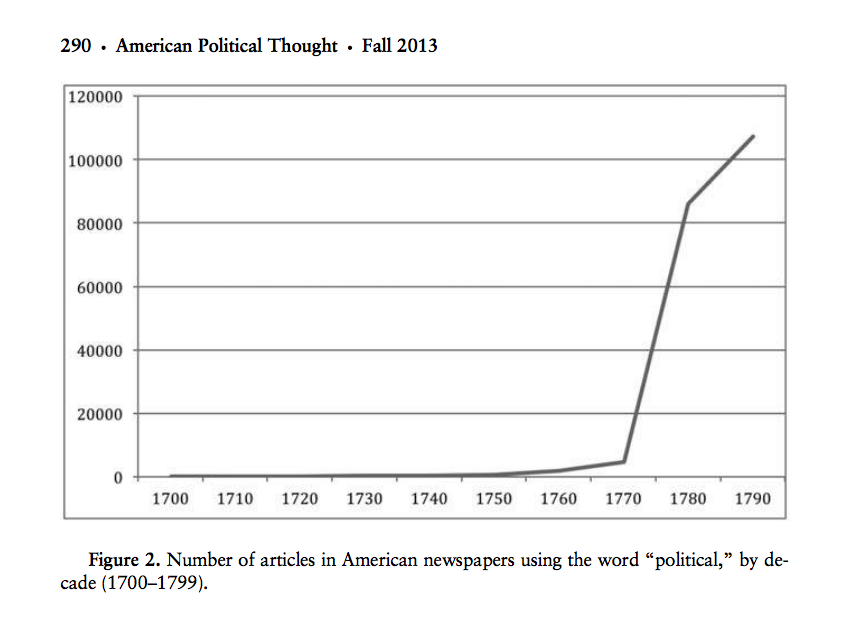
Source: Slauter, Eric. ‘Beard’s “Politics,” Ours, and Theirs’. American Political Thought 2, no. 2 (2013): 283-291.
THE INDEPENDENCE WAR
Over the years London moved to impose imperial authority by escalating force, and resorted to a series of increasingly harsh and desperate measures. Events finally snowballed into armed rebellion of the locally-organized Massachusetts militias, beginning in April 1775. Massachusetts was the great hotbed of the revolt, and led the way in starting the revolution. White colonists in all of the colonies had long been organized in militias to meet the real and perceived threats of Indians, French and Spanish, and slave uprisings. Male colonists generally were armed.
A Second Continental Congress convened in Philadelphia, another hotbed of revolt, in May 1775. Representatives were sent from twelve of the mainland colonies. By the time the Congress convened, war was underway throughout New England and getting started in most of the colonies. The Congress remained in session and eventually declared the colonies’ independence from Britain in July 1776. The Declaration of Independence was written to gain support for the revolution, both domestically and internationally. It was not a governing document but a plea for support. Its first aim was to unite support for independence among the colonists. Just as importantly, it was meant to persuade the French crown that American independence was a viable cause that France could support militarily—that France could win a war against its long-time enemy Britain.
CONGRESS, THE STATES, AND CONFEDERATION
Dominated by Patriot leaders, the Continental Congress had in effect declared itself the provisional government of a new Confederation of the thirteen East Coast colonies. A confederation is a strong formal alliance of independent sovereign states, while federation means that a single sovereign federal government unites semi-autonomous states under its supreme authority.
After the declaration of independence in 1776, the colonies became States and together were informally called ‘the united States,’ with ‘united’ usually in the lower case. In effect, every State—that word was usually capitalized—was an independent country with its own, Patriot-led government. (There was also a small, separate Republic of Vermont, which would join the Union as the fourteenth state in 1792, after ratification of the Constitution.) At the same time, parts of every State were still controlled by Loyalists and British troops.
ARTICLES OF CONFEDERATION <-link
Congress codified the rules of the thirteen-state alliance in the Articles of Confederation. Under the Articles, each group of state representatives in the renamed Confederation Congress cast a single vote, regardless of their state’s size or population. Congress elected a president annually. The president was a procedural position, not an executive. He did not make decisions himself, but “presided” over meetings of the Congress and rubber-stamped the votes of the States. Congress was sovereign, although its authority compared to the States was weak. It could not impose taxes. It was dependent on loans (bond sales), funds from States (which continued collecting the old colonial taxes), and the issuance of paper money (Continental notes).
STATE CONSTITUTIONS
After the July 1776 declaration by Congress, representative bodies were chosen in each state to write and ratify State constitutions. These went into effect and the States became sovereign countries even before the Articles of Confederation were ratified.
How many and which of the free men (not women) in a given State could vote? As was the case under British rule, this depended on different property and other requirements. It depended on the new constitutions and varied from state to state. State governments also followed different policies on taxation. They issued state currencies. They could refuse Congressional requests for funds. Some refused to pay off the debt notes of the Continental Army. They differed in how they took public possession of Loyalist properties, and if or how they redistributed these properties. Many states included bills of rights in their constitutions, modeled on the English Bill of Rights of 1689, the Declaration of Independence, and the Virginia Declaration of Rights of 1776.
In short, because these governments were displacing the British colonial order, there was much conflict and contradiction. State constitutions were written by elected legislatures or conventions led by pro-independence factions. At a time of popular mobilization among so many, most of these new political orders and constitutions were remarkably democratic, at least by the previous standards.
THE PENNSYLVANIA CONSTITUTION <-link
Pennsylvania was a populous state and home to the Continental Congress (a.k.a. Confederation Congress). In the spring of 1776, elections were held under the rules of its old colonial assembly. The vote was limited to a minority of property-holders. The majority of the elected assembly opposed independence. With encouragement from the Patriot leadership (John Adams of Massachusetts in the lead), large crowds of pro-independence citizens gathered to prevent this assembly from convening in May. This cleared the way for the Congress to pass the Declaration of Independence in July.
A new election was held with a broader franchise, and it ratified the first State Constitution of Pennsylvania in September 1776. It was written by a Patriot committee that included Benjamin Franklin, over the objections of other promiment men who still opposed independence. The first Pennsylvania Constitution remained in effect until 1790. It is of interest to us because it was the most radical of the new State constitutions. It established a unicameral (single-chamber) legislature. No upper house, no lower house, just one house. There was also no separate executive branch. All executive offices were elected by the assembly. Elections to the assembly were annual. All men who were paid up on their state taxes payments were eligible to vote. For the time, allowing all taxpayers to vote was a radical democratic idea. It was far less strict rule than any form of property requirements.
The Pennsylvania Assembly met in literally the same building as the Confederation Congress, the State House in Philadelphia (today called Independence Hall). The two bodies followed each others’ activities. They influenced each other both positively and negatively. The expanded Pennsylvania electorate and its representatives tended to include far more of the lower classes than the more elite group in Congress, who sat on the other side of the building. At one point, Franklin, who was a member of both the Congress and the State Assembly, lost his Philadelphia assembly seat to a more popular challenger.
Many of the later Federalists—the men who would draft the federal constitution at a convention in Philadelophia in 1787—regarded the Pennsylvania State constitution as representing the opposite of the kind of government they hoped to create. They started referring to the democratic-minded mass of lower-class white men as “The Democracy.” They came to view too much democracy as the greatest danger to the proposed republic.
We will compare the Pennsylvania Constitution of 1776 and the later federal Constitution of 1787 in class. Perhaps the most obvious of the many differences between these two documents is that the Pennsylvania Constitution of 1776 begins with a Bill of Rights of individual citizens very similar to the US Bill of Rights,
which was added after the US Constitution was ratified. The original federal Constitution did not include a bill of rights. (Certain rights, especially pertaining to property, were included in the main text.) Most of the 1787 framers (called “nationalists” or “Federalists”) opposed the idea. The Federalists were forced to compromise after the proposed constitution was presented to the States for ratification, and met with opposition for not protecting individual rights well enough. They agreed that the US Bill of Rights would be passed as a set of amendments to the Constitution by the first US Congress in 1791. This is why we refer to our legal rights as protected under the ‘First Amendment,’ ‘Second Amendment,’ etc.
MONEY AND DEBT
Again, the Confederation Congress could not pass taxes. It relied entirely on State contributions for funding. Congress issued paper money, known as Continental notes. Because Congress had no power to impose its own taxes, it could not support its own currency. (Taxation can give value to a currency because people want to have the currency in order to pay taxes charged in that currency. A paper currency without taxation is inherently inflationary.)
The main man in charge of Continental finances was the banker and Congress member Robert Morris of Pennsylvania. He was possibly the richest man in the land (either him or Washington), and he had much experience raising capital as a banker and merchant. He also had excellent connections to arms smugglers, so that in theory he could raise the money and buy the arms, like a one-man military industrial complex. Nevertheless, this job was very hard. The war demanded that Congress issue more and more of its unsupported paper money, further devaluing its currency.
Since the States were not sending it enough money to support the Continental Army, Congress (and Morris) therefore turned to private creditors who were willing to lend hard cash (for example: British pound sterling, Spanish dollars, or private notes redeemable in gold or silver). In other words, the private creditors lending money to the Congress were speculating on an American victory in the war. If Congress lost the war, the creditors would never see their money returned, and they would never be paid interest.
Always strapped for hard cash and equipment, the rag-tag rebel Continental Army mostly paid its troops at the end of their service in Continental bonds. These were promissory notes. That means Congress promised it would pay interest on the bond-notes annually, and later redeem the full original face-value of the bonds in cash money or specie (again, specie is a fancy word for gold or silver, or notes redeemable in gold or silver). States varied greatly in whether they honored Continental bonds.
After the war, it seemed far from certain that the Congress would ever be able to pay off the bonds, or that they would be able to pay in hard cash (‘specie’, meaning gold and silver coins or notes redeemable in gold and silver), as opposed to depreciated Continental dollars.
NORTHERN ABOLITION AND BLACK COMMUNITIES, PART I
Starting in 1775, the British promised freedom after the war to enslaved men who escaped from rebel owners, if they enlisted as soldiers on the British side. During the war, at least three times as many black men (an estimated 15,000) served in the British Army than in the Continental Army (about 5,000). Whether they fought for the Americans or the British, most of them were seeking their freedom
Starting in 1776, the Continental Army offered service to Free Black men. A few slave owners also offered freedom to their own enslaved men if they first served as soldiers. Salaries for black soldiers were lower than for whites (true of both the American and the British military). Black men had to serve as soldiers for much longer minimum terms. After years at war, they became the most experienced soldiers, important in keeping the army functioning. But they could not be officers.
The 1777 constitution of the independent Republic of Vermont abolished slavery. Pennsylvania abolished slavery in 1780, although at first this applied only for people born from that year forward. Most of the States in New England followed in the 1780s, even as independence was won and the new republic was formed.
CONSEQUENCES OF WAR
The outcome of the Independence War was far from fixed in advance. The Americans claimed victory in 1781 after eight hard years of fighting. They had their independence recognized by London in the Treaty of Paris after two further years of negotiations (in 1783), with Spain, France, and the Netherlands as signatories. At that time, Spain reclaimed Florida and the Philippines, which it had been forced to cede to Britain at the end of the Seven Years’ War in 1763. In the new ‘united States,’ the casualties, the damages and destruction, the traumas and enduring grudges of what had also been a bloody civil war greatly disrupted the formerly colonial society. The war furthermore had cut off regular colonial trade within the British Empire.
A time both of crises and competing visions of the future followed. The success of the revolution demonstrated to all that long-established institutions could be put to question and even overthrown. The shape of the new order was far from established. White lower classes gained a sense that ‘all men are created equal’ and that they had a legitimate voice in the new republican States. The free people of the States generally had come to believe that power derived from the people, that authority was not born but had to be earned and elected by popular will. New arrivals, hoping for a different life than the one they had left, continued to disembark in the country’s ports. Displays of class distinctions, like the fancy man’s ‘periwig’ (Watson, ch. 6), were no longer signs of respectability but a cause for street fights. Everything was up in the air.
Figure 2. Class Antagonism
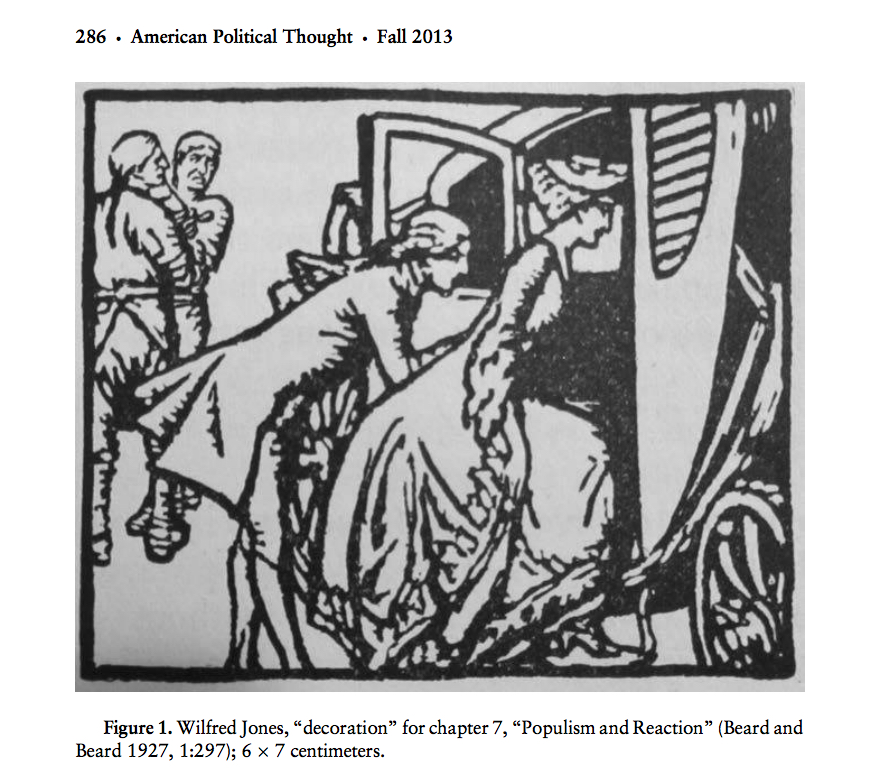
‘Populism and Reaction’, illustration by Wilfred Jones depicting class antagonism in the Revolutionary Era, as imagined for the textbook The Rise of American Civilization (1927) by historians Charles and Mary Beard. Source: Slauter, Eric.
REDISTRIBUTION OF LOYALIST AND INDIAN LANDS
Recall that the Independence War was also a civil war between Patriots and Loyalists, as well as a war between the Continental forces and the Indian tribes who remained allied with Britain. At the war’s end, about 80,000 colonists who had supported the British Empire fled the country, or were driven out by violence. The exodus included some of the wealthiest men aligned with Britain, and their families. Thousands of formerly enslaved people also left with the Loyalists as freedmen, having deserted rebel masters and served in the British cause in exchange for their freedom. At the same time, Loyalist slave-owners strove to keep their own slaves, and to take them along to new destinations in Canada, the Caribbean sugar-island colonies, and elsewhere in the British Empire.
The departing Loyalists left many properties behind. States took possession of these lands and properties, selling them to private parties in auctions, setting off a speculative land frenzy. Large sections of Indian lands seized by Continental forces were also sold in deals between States and speculative companies owned by some of the wealthiest men. This happened with the large territory today known as Western New York, long the homeland of the Iroquois nations. They were expelled forcibly by a scorched-earth campaign ordered by Washington and commanded by General Sullivan of the Continental Army in 1779. This earned the first president of the United States the title of “Town Destroyer” among the Indians. After the war Robert Morris sought to cash in by buying of vast lands in Western New York and acting as the broker for sales. This time he misjudged the market, and the deal helped push the financially adventurous Morris into bankrupcy. This was not the only indicator that the economics of the States were going haywire.
THE ECONOMIC CRISIS OF THE 1780s
Veterans of the Continental Army often found rough conditions on return to their farms. Remember that up to 90 percent of the population lived outside towns and cities. They were farmers, or involved in agriculture in some way or other. The veterans needed cash that would be accepted as payment against debts. They were still waiting for Congress to redeem the Continental bonds they had earned during their service. But the Confederation Congress didn’t have funds for that. Farmers still had to pay mortgages, equipment costs, bills to businesses, back taxes, or whatever else, while sustaining the costs of their households and families. Many went bankrupt. Conditions of economic depression obtained in many regions, lowering prices for farm goods. For a time the States were largely cut off from their former markets for food and other American goods in the British Empire.
Desperate for cash and unable to wait any longer, veterans began to sell their Continental bonds at severe discounts from face value: for 25 percent, in some cases for as low as 6 percent. Speculators entered this market, scooping up Continental bonds on the cheap and hoping for an eventual 100-percent redemption from a future Congress in hard cash (specie).
Many of these second-hand buyers of bonds were already wealthy, and they now had a major interest in establishing a federal government with the authority to impose and enforce taxation from which the bonds could be paid off at full value.
ABIGAIL ADAMS, BOND MARKET PLAYA
Historian Woody Holton tells the story of how Abigail Adams engaged in the bond market. As a woman she was forced to do business in her husband’s name. Often she made the deals against his objections, because he did not understand how profitable it was going to be, and anyway he was usually far from their home in Massachusetts, traveling to Philadelphia for the Congress and such. John Adams was a great lawyer, but Abigail Adams was the one who knew business. In a now famous exchange of letters, she wrote to her husband that the would-be founders of a new Republic must “remember the ladies” (establish protected rights for women), to which he responded with condescension. In the 19th century Abigail Adams would be among the first wealthy women in the U.S. who were able to write their own will and direct the disposal and inheritance of their own properties, although the properties remained in her husband’s name.
DEBT REBELLIONS
Given all these conditions, further credit from banks was scarce, especially for troubled farmers (a perennial problem). Private banks wouldn’t lend to them. States usually didn’t have funds to help them out either, but still demanded they pay their taxes or have their farms repossessed. As farm properties were also put up for auction, wealth inequality among the colonists became far more extreme. The rich got richer, the poor got poorer, debts snowballed. Taxes became higher than under the British. The former lands of Loyalists, expelled Indians, and of foreclosed farmers tended to end up in the hands of the already wealthy.
In Massachusetts, the cradle of the American Revolution, the farm-debt crisis finally boiled over into what is called Shay’s Rebellion in early 1787. Organized in militias, possibly thousands of armed veterans stormed courthouses to burn the debt records stored there. Eventually they were defeated by the Massachusetts state militia, with support from the Confederation Congress and from a new paramilitary organization called the Sons of Cincinattus.
It should be noted that the latter force was specifically raised in the name of George Washington, although he stayed in Virginia and did not lead the ‘Sons of Cincinattus’ himself. Cincinattus was a general of the ancient Roman Republic. When Rome faced potential conquest by the Gauls, the Roman men forced Cincinattus, so the legend goes, to take over as dictator. He led the Romans to victory, and then made a name for himself by refusing, at the height of his popularity, to become a king. He retired from government and went home to his plantation (with its slaves), where he spent the rest of his life. In the Early American lore, this legend was transposed on to General George Washington, who retired to his plantation (twice) at times he allegedly could have become king. Washington is called the American Cincinattus. Naming an American city Cincinatti is another way of calling it Washington.
The farmers who waged Shay’s Rebellion were scattered and repressed. This was far from the first such rebellion, and it would not be the last. The law 1780s saw similar cases in North Carolina, western Pennsylvania and elsewhere in the country.
NORTHERN ABOLITION AND BLACK COMMUNITIES, PART II
To review, the Americans won the war militarily at the Battle of Yorktown in 1781. The Confederation was recognized as an independent state by Britain and the European powers in the 1783 Treaty of Paris. Defeat set off a mass exodus of the remaining Loyalists. About 80,000 people who were Loyalists or accused of Loyalist sympathies were forced out, fled, or packed up and left the thirteen states for Canada and other places in the British Empire. Thousands of free black men left with them. Most of them had fought as soldiers for the British. Paradoxically, Loyalist slave owners also took their slaves with them if they had the chance. In later negotiations with the British, Washington would demand the return of slaves whom he claimed were still his own property.
To look ahead, the United States was formed by a new constitution and its first federal government was inaugurated in 1787-1789. Under the new independent republic, additional northern states adopted abolition. Starting in the 1790s, publications of ‘Narratives’ (autobiographies) by self-freed slaves, such as OIaudah Equiano and Venture Smith, were widely read by the American public. These strengthened the longstanding but weak awareness of the evils of slavery among white people, and contributed to the early anti-slavery and abolitionist movements.
The northern state with the highest proportion of enslaved people, New York, abolished slavery in 1799. New Jersey completed the sequence of Northern Abolition in 1804, taking the opportunity however to deny voting rights to women as part of the legislative deal. (Women had actually been allowed to vote in New Jersey until then, and records show several dozen who did.) All of the later Northern states—meaning those north of Maryland—had become the ‘free states’ of the Union. The Northern credo would become that of ‘free labor,’ in opposition to the slavery of the South. The border between Pennsylvania and Maryland came to be seen as the border between “free states” and “slave states.”
- In almost every case, Northern emancipation came either with the requirement that the enslaved continue to perform long periods of servitude for their masters before gaining freedom, or else it applied only to the next generation, the children of the enslaved. In this way, the states avoided paying compensation to owners for the so-called loss of their ‘property.’ It took until 1828 before the last of the still-living enslaved people in New York were emancipated. By then, large Free Black communities had arisen and were growing in towns and cities of the North. Free Blacks became an important pillar, if not the backbone, of the nationwide movement for abolition in the decades that followed. Britain soon abolished the slave trade—legally, if not yet completely—in 1807, and would abolish slavery in the British Empire in 1833; also legally, if not completely. By 1860 Free Blacks would number about 250,000 people in the North. One of the paradoxes of American history is that during the same period, from its foundation in 1787-1789 and its Civil War in 1861-1865, the United States would become the largest slave-holding society in the world (by number of enslaved people). By 1860, there were also about 250,000 free black persons in the slave states, but they were not in a position to be as political. Back in the early Republic, all of the Southern states, i.e. those that became known as ‘the slave states’, passed laws to permit manumission, allowing owners the option of freeing individual slaves. South Carolina refused to do even that. Recall that the original Carolina colony was started at Charles Town (Charleston, SC) by plantation owners (‘planters’) and long-established slaveholders who moved there from the English sugar-growing colony of Barbados. The planter and slave-trading class of South Carolina became the most hardline of all groups working to defend, rationalize, and expand the racialized, institutionalized, commercial system of chattel slavery. This continued right up until South Carolina became the first state to secede from the Union in the cause of preserving slavery, in December 1860 after the election of Abraham Lincoln. My mentor in American history during my graduate studies, David Waldstreicher, once wrote a book called Slavery’s Constitution: from Revolution to Ratification (Macmillan Books, 2010). The protection of the institution of slavery against those who sought to end it was a factor in the creation of the US Constitution. It was far from the only consideration, but undeniably important. Uniting all of the confederal States under a single federal government required the agreement of delegates not only from states that had abolished slavery well before 1787, like Massachusetts and Pennsylvania, but also from South Carolina, Georgia, North Carolina, Maryland, Delaware, and Virginia. We will now turn to the story of how the Constitution was framed and how it works.
CONTINUED IN PART II