The US Constitution: A Brief History for Students
Part 2. Classes and Factions of the 1780s
*
What were some of the many differing visions of how to address the crisis? Hundreds of pamphlets, newspapers and letters from the time survive to tell their stories.
Farmers, Subsistence, and Markets. The largest part of the free, voting, citizen, male population were small farmers — “small-holders” — heading family households, with or without servants. Only a low proportion of small-holders owned any slaves. Many of them, especially on the frontier, were dependent on household subsistence. In any given year, the farm and household and exchanges within the nearby community provided almost everything that the members of the household needed to survive. Subsistence meant independence from markets, and was therefore part of the ‘yeoman farmer’ ideal. But at least as many farmers were partly if not entirely dependent on selling their goods to market.
Most among the small-holding farming classes would have thought of themselves as republicans or democrats. Their detractors, especially among the richer classes, might have called them the great unwashed rabble, the sad brutes, etc., although, again, the American farmers were often as literate, educated and cultivated as their upper-class antagonists.
Relief from debt and taxes? Many such republicans raised demands for the cancellation of debts. At the same time, yeoman-farmer-republicans tended to believe in small government with low taxation. Many hated paying taxes. This was not only because of the cost, but because taxes could not be paid in goods. Paying taxes in cash forced them to make money. That meant they had to produce some part of their harvest for sale on the market, rather than subsistence, and thus became dependent on the larger economy. This was not a universal view among them, however. There were also farmers who favored a stronger State or federal government that could tax the wealthy, cancel debts, and guarantee credit or aid to farmers and small business. Some even called for the redistribution of landed property, so that large plantations would be broken up among many holders. The examples of Loyalist land confiscations and property auctions and Indian land seizures had set dramatic precedents, even if most of the beneficiaries in that case were already wealthy: Redistribution of existing land ownership was possible.
Sanctity of Debt. Even among these lower classes, however, there were still others who believed instead in the absolute sanctity of debt, credit, property, and contract, and that these must be honored and enforced by the government and courts. For many, this was almost a matter of religious belief. This was also by far the more frequent view among elite groups, among them urban merchants, land speculators, bankers, and the wealthy generally. The self-made Alexander Hamilton and the plantation heir James Madison may have been very different personalities, and come from different backgrounds. But both believed that the general reliability of payments was a vital condition for orderly business. They hoped that predictable and stable financial conditions would help attract foreign investors and creditors (e.g., from France and Britain) to invest capital in the new nation. Hamilton wanted to see British merchant companies who had been pushed out during the Revolution return to the new Republic. They both believed that the advancement of trade and industry would eventually lift all boats, or at least lift the boats of those willing and able to work hard, pay their debts, fulfill their contracts, and be the backbone of a prosperous commercial society. Though Hamilton might not have put it in these words, his ideal republican subject was a person capable of navigating the market society, as opposed to the independent, self-sufficient, democratic yeoman farmer.
Townspeople. As for urban, artisanal and working classes, at least those belonging to the free population, their views of course varied greatly according to their life stories and personal beliefs, but most often their views tended to depend on how they were positioned in the economy. As largely landless classes whose professions were tied to markets and to trading in cash, most of these ‘mechanics’ tended to support the idea of a federal government. As lower classes, however, they tended to support democratic forms of government, and it was clear to all that the Federalists’ proposed constitution represented a rollback of the democracy that had come into being since 1776. In the end, however, most of this group was won over to support ratification of the 1787 constitution.
Who was left out of these debates?
- The majority of the people were women, excluded from public political life by the rules of gender and culture, although they were everywhere at every station of life, and most were liable to have any opinion if asked. Young women generally were tied to their father’s household, while married women were subject to coverture: their husband owned their property. Single women, untied to a father or husband, were considered fallen, dangerous, sad, excluded, etc. Even an intellectual and busy business manager like Abigail Adams had to do it all under her husband’s cover, and was stuck asking him to ‘remember the Ladies’ in his political deliberations. (He didn’t.)
- As we have learned, the enslaved were about 20 percent of the overall population of the States, concentrated in the South but also plentiful in New York. The slave trade continued to bring more people to American ports, with Charleston and New Orleans as the busiest.
- As we have also seen, the ‘unincorporated’ free Indian nations, to the west of the areas settled by Americans, could only regard the united States as an enemy to fight, or as an unavoidable force with which they had to find a way to live with.
- Free Blacks and ‘incorporated’ Indians, who lived within the areas settled by colonists, were usually not involved in these debates, although they were well aware of how the outcomes might affect them in detail.
What about the planters? Big plantation owners, especially those in the South who held large numbers of slave laborers and had a lot of political power, were ambivalent regarding a federation of the States. In principle they too were big believers in property rights, contract, the sanctity of debt, etc. and wanted muscular government enforcement of these institutions. But many of them feared the idea of a strong federal government that one day might be so powerful it could take away their lands, or free their slaves.
- The British had attempted to do that during the Independence War, with the Dunmore Order of 1775 in Virginia. In 1779, the British proclaimed a general emancipation for slaves who abandoned rebel masters and joined the Redcoats.
- After the proposed constitution was submitted to the States in 1787, stiff opposition came from a number of former Patriot political leaders of the war, like the two patrician big-plantation slave-holders from Virginia, Patrick Henry and George Mason. They declared that a strong federal government would be unaccountable. They condemned the proposed constitution as a violation of god-given rights of individual free men, and of the rights of States as independent republics. Mason was a Virginia delegate to the Federalist convention and famously refused to sign the constitution. In these debates, he was canny enough not to emphasize the potential threat to his keeping of human “property.” Above all, he condemned the 1787 Constitution for not including a Bill of Rights.
*
3. Creation of Republic, 1787-91
Federalists, Anti-Federalists, and Compromises
Who were the Federalists? In this essay, ‘Federalists’ refers to the framers and supporters of the Constitution proposed in 1787, which is one way they were called at the time. (‘Founding Fathers’ is a much later, patriotic coinage. The actual men who are now called that would doubtless have wanted to avoid such a term in public.) The opponents of ratifying the Constitution were called Anti-Federalists. Thus ‘Federalist’ here does not refer to supporters of the later Federalist Party, which was very much shaped by Hamilton and Adams in the early years of the Republic after 1789. After the establishment of the Republic, in the first system of political parties, many of the Federalists of 1787 who backed the Constitution were not supporters of the later Federalist Party, but became Republicans a.k.a. Jeffersonians a.k.a. Democratic-Republicans (the party that eventually became known simply as the Democrats, starting in the Andrew Jackson era of the 1820s-1830s).
The Economic Interpretation. So far this outline has largely made the case for an ‘economic interpretation’ of the origins of the Constitution, much as historian Woody Holton argues in his video lecture on ‘Unruly Americans’. Holton’s work is part of a big wave that has revived the economic interpretation among historians in the last couple of decades. It was also very popular with historians in the early 20th century, after books written by Charles and Mary Beard showed that many of the delegates at the Federalist Convention in 1787 had acquired Continental bonds at a discount. Bondholders would have an incentive to see the creation of a strong federal government that could take over the Continental war debt and raise taxes to redeem it at the full face-value of the bond notes. This is exactly what happened.
Woody Holton points out that while many Federalists were also bond speculators, the influence of this particular aspect is exaggerated. In his 2008 book on Unruly Americans, Holton argued that there is much more to the economic case for the U.S. constitution. More generally, as we have seen, men like Madison and Hamilton believed in the sanctity of paying off debts, whether those of the government or of individuals. They believed in protecting private contracts as a means for attracting new investment and credit, and creating a good business climate. Holton tells a story about Madison and Thomas Jefferson. (Jefferson was not a Federalist. During these key years he was the Confederation ambassador to France. He may or may not have truly supported passage of the Constitution; it’s an old dispute.) Jefferson tried to attract French bankers to invest in American land schemes proposed to him by Madison. No one on the French side was interested, even though Jefferson was the ambassador and furthermore THE world-renowned Thomas Jefferson. Experiences like these may have informed Madison’s Federalist outlook as much as his thorough reading of hundreds of books on the philosophies and laws of the world’s past and present Republics.
Watson on page 230 wrote:
The movement to create a stronger central government arose in this turbulent social and political climate. Federalist leaders hoped that a powerful national legislature, controlled by wealthy, educated, and well-connected men like themselves, would rein in the states and balance liberty with their own version of order. Antifederalists hotly replied that the US Constitution would reverse equality and impose a cosmopolitan tyranny. James Madison replied that the United States would be too large and complex for any one group to dominate. Was he right? Could the American republic adopt a strong central government without crushing democratic localism? Put another way, could men like [‘commoner’] William Thompson live freely under a government designed by men like [former governor] John Rutledge? [Their conflict is described in the introduction of Watson, Ch. 6.] On both sides, many Americans believed that the answer depended on how the new administration of George Washington would implement the new constitution.
The Federalist Convention of 1787. This outline so far has given a sense of what was going on when the Federalist group to reform the Articles of Confederation convened in a small Maryland convention in 1786, and when the call went up for a constitutional convention in Philadelphia to start in the spring of 1787. The Federalists included some of the richest and best-connected men in the country, many of them former leaders and heroes of the Independence War. As they arrived in Philadelphia, the recent Shay’s Rebellion was on their minds, as the secret minutes of the Constitutional convention affirm. They did not support debt cancellations. They tended to dislike what they saw as the out-of-control direct democracy of Pennsylvania and other states.
- Looking back on the Revolution they had helped to make, Federalists were happy (like other factions, other than the Loyalists) that Independence had freed the country of distant, unaccountable and burdensome British control and the hereditary crown. They liked the abolition of traditional and feudal limits like primogeniture (automatic inheritance of the first-born son) and titles of nobility. They believed in a system that would allow the ‘best men’ to rise in society through their own accomplishments (as proven, however, in the accumulation of wealth). They believed in choosing representatives to deliberate lawmaking based on reason and a balance of interests, but generally wanted limits on who did the choosing. Despite the contradiction of having taken land and property from Indians and Loyalists, they did not question property relations or the existing class system. They tended to use terms like ‘tyranny’ and mob rule to describe the prospect of direct majority rule.
- Congress empowered the Federalist convention to propose amendments to the Articles of Confederation. Fifty-five delegates, elected from twelve of the thirteen states, met behind closed doors. Their secrecy was a matter of public controversy, but they were able to maintain it. General Washington became president of the Convention after he was nominated by Robert Morris, the Philadelphia banker-merchant, land speculator, and former main contractor to the Continental Army. Morris was one of the few men in the country who may have been richer at the time than Washington himself. Washington was staying at his Philadelphia mansion. The sole delegate to the convention from New York, Hamilton, had served as Washington’s chief of staff, and was a protegé of Morris. The Convention decided to write a completely new federal constitution.
Conflicts and Compromises at the Convention. Debates among the Federalist conventioneers went on for many full days, during a hot summer in a stuffy room with the curtains drawn. The most controversial questions among them concerned how to bridge the differences between the states so as to get them all to accept a federal government. Remember, in Congress under the Articles of Confederation, each state had a single, equal vote. To bridge the gap between the populous and the small states, the Convention agreed that the Constitution would specify a bicameral federal Congress with a Senate (two senators per state regardless of its size) and a House of Representatives (number of representatives based on population as counted in a census).
- By design, a bicameral legislature is less directly democratic than a unicameral legislature. Each body is elected separately and by different methods. Bills must gain a majority of both chambers to pass. The usual arrangement, as with the U.S., is to have an ‘upper house’ that is smaller and will tend to be more exclusive and elite, and a ‘lower house’ that is more popular in orientation. (It doesn’t always work that way in practice.)
- In the meantime, with Northern abolition underway, there was also the widening gap between North and South, the future slave states and free states. The ‘three-fifths compromise’ and a clause preventing Congress from banning the slave trade before 1808 at the earliest were among the devices used to make the Constitution acceptable to the slave states. The Constitution also mandated that States return enslaved people who had escaped from other states.
- A ‘style committee’ was appointed to do the actual writing, which was done mainly by Madison and Hamilton, who also took leading roles in the daily debates. The delegates signed and published the finished document after several months, in September.
- Several delegates left the Convention before it ended. Three refused to sign the final document, making for 42 signatories. Only six of the signatories had also signed the Declaration of Independence, eleven years earlier in 1776.
Public Debate. A busy year followed. States elected conventions of their own to debate and vote on whether to ratify the new Constitution. A number of conventions in small, low-population states ratified in short order, but this was still short of the nine states required for it to go into effect (Article VII). The draft document met with stiff resistance from a variety of political factions. They were described collectively as Anti-Federalists. The debate now raged, fully public and everywhere in the country. Hundreds of articles and pamphlets were published, for and against. For the crucial New York debate, Madison and Hamilton teamed up with John Jay, the New York politician serving the Confederation as Secretary of Foreign Affairs. Under pseudonyms, Madison, Hamilton and Jay published a long series of arguments for ratification in the New York newspapers. These came to be known as the Federalist Papers. (The most famous one has gone down as Federalist No. 10.)
Anti-Federalists. Anti-Federalists made many arguments, sometimes conflicting with each other. Planters might be Anti-Federalists out of fear they would lose their slaves. People who opposed slavery might have feared the new government would protect and help expand the institution of slavery. (Both would prove to be right, eventually. For the first 80 years, the net effect of federal rule was indeed to strengthen and grow the slave system. In the Civil War however, the Union (the federal government, a.k.a. the North) led a war against the seceding states of the Confederacy that ended with the abolition of slavery.
Many feared a federal government would have too much power relative to the States, and impinge upon the rights of free individuals. Others supported federal government but rejected the Federalists’ version of it for not being democratic enough.
One argument in particular emerged as a unifying point for the Anti-Federalists: that the Constitution, as presented, was odious because it lacked a Bill of Rights to protect the natural rights and liberties of individual citizens against the potential for government tyranny.
For example, the Pennsylvania State Constitution specified the inherent rights of citizens that the government must respect and protect already in the first sections. This was no side matter, it was proclaimed as the purpose of having a government. (The Pennsylvania Bill of Rights is very similar to the one that was later added to the federal constitution.)
Did Americans not believe that the Revolution was fought against an arbitrary tyranny that trampled on individual rights to free speech, assembly, petition, fair trial? Did the British not seek to confiscate arms and disarm the colonial militias? Had they not arbitrarily imprisoned suspected rebels, suspended colonial courts, held summary trials, and forced households to host their soldiers? What would prevent a federal government from doing the same?
Madison and other framers had opposed the inclusion of a Bill of Rights in the Constitution. They claimed it was unnecessary. They even argued that listing rights would endanger those rights that were not listed explicitly. (The 9th and 10th amendments were meant to solve the latter problem.) But led by Madison, the pro-Federalists gave way. They agreed to present a set of amendments to the Constitution once it was ratified and the Congress met. (Would one have to vote for Madison to get into Congress first? At the time, his seat in the first Congress was secured.)
This concession helped pave the way for the final Federalist push. The promise was later kept. Twelve amendments to the Constitution were passed as a package deal by the first Congress. Ten of these, known to us as the Bill of Rights, were ratified by 2/3 the States by December 1791. (An eleventh, on Congressional pay, remained active but was only ratified by enough states to go into effect in 1992.)
Ratification (1788). In the end, after intense debates and close votes in several of the larger state conventions, the magic number of nine states was achieved. The rest followed after, not wanting to be left out. All 13 ratified, and Vermont would join in 1791.
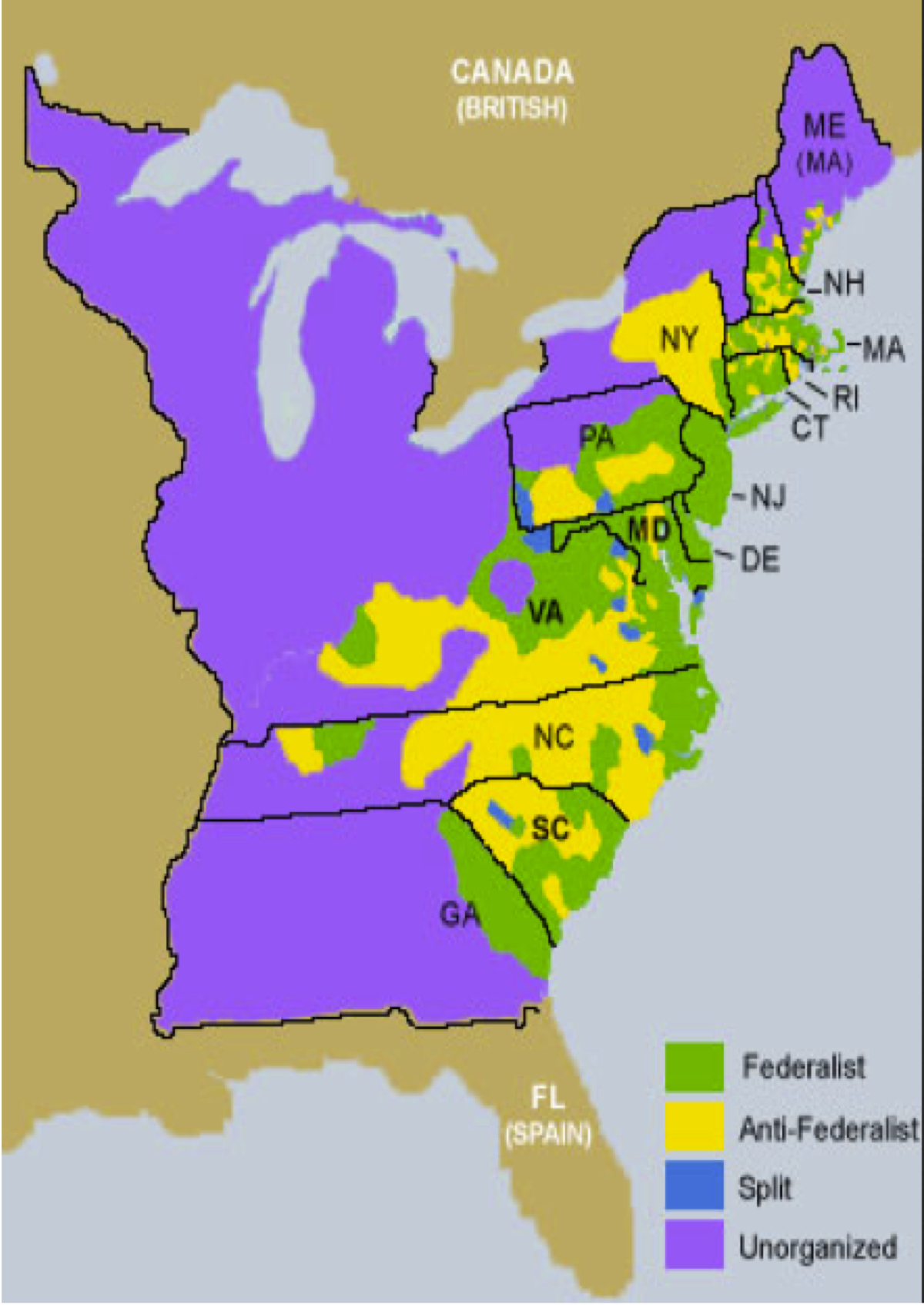
Since delegates were elected from districts to each of these state conventions, we know that support for Federalists was strongest in the towns and cities, and weakest among farmers on the frontier — the yeomen heads of independent farming households idolized as the ideal democratic subjects in the Jeffersonian world-view.
Fig. 3. Ratification: Rural vs. Urban
The New Republic (1789). As we have covered in class, the first federal election was held in the fall of 1788. It resulted in the almost unanimous election by the Electoral College of Washington as the first president. He was inaugurated in the new capital, New York City, in April 1789, and the Congress convened for the first time by the end of that year.
*
So what’s in this thing? What’s on the midterm?
This “Schoolhouse Rock” video is not on the test. But if you listen to it two or three times you will memorize the Preamble to the Constitution. An unbelievable number of people in my age group who grew up in the U.S. will be able to sing this song because we were exposed to it often during the commercials while watching Saturday morning children’s television in the 1970s.
Continue to Parts 4-6